
CJ Strachan – The Daily Sceptic Sept 6, 2026
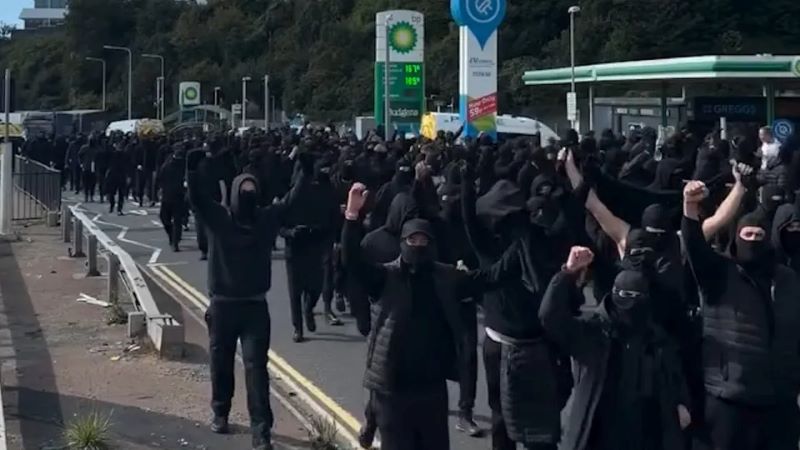
There was a certain inevitability about what happened in Dover on Saturday. Several hundred protesters, many masked, blocked roads around the port, traffic backed up, the police arrived and engaged with them and, after a few hours, everyone went home. No arrests were made. The immediate temptation is to treat this as another example of the disruptive protest which has become familiar in Britain over the past decade, except this time coming from the Right rather than the Left. There is some truth in that, although it misses the more interesting point. What happened at Dover was a reaction, in both senses of that rather unfashionable word, and it has been a very long time coming.
There is an important distinction to make at the outset. Opposition to uncontrolled immigration is hardly an eccentric minority enthusiasm which has suddenly emerged from the political fringes. Immigration has been one of the great unresolved questions of British politics for decades. Governments have been elected promising to reduce it, Brexit was fought, among other things, around the question of control over borders and immigration policy, and opinion polling has repeatedly demonstrated substantial public concern about the issue. The small boats crossing the Channel have meanwhile provided an almost daily visual representation of a state apparently unable, or unwilling, to exercise the control which voters reasonably expect of it. Whatever one’s preferred immigration policy, therefore, it is difficult to maintain that the people protesting at Dover are simply attempting to impose some obscure political demand which has never been tested democratically. A very large number of British voters have been asking governments to control immigration for years. They have voted for parties promising to do so, they voted in a referendum in which control of immigration was plainly part of the political argument, and they have watched successive governments promise action while immigration continued at levels which bear little resemblance to what much of the electorate thought it was voting for.
That does not automatically legitimise every action taken in response, but it does make Dover rather more complicated than the comfortable description of a mob disrupting public order. Meanwhile, on another part of the political spectrum, Britain has been conducting a lengthy experiment in what happens when political activists decide that ordinary democratic processes are inadequate. We have watched roads blocked, bridges occupied, buildings invaded, businesses targeted, sporting events interrupted, paintings attacked and commuters prevented from getting to work. Extinction Rebellion did it. Just Stop Oil did it. Palestine Action went considerably further. There have certainly been arrests and prosecutions, particularly as public patience finally evaporated, but for a surprisingly long period the institutional response was characterised by negotiation, accommodation and an almost anthropological fascination with the protesters themselves.
The justification was invariably moral urgency. Climate change was too important to wait. Palestine was too important to wait. Whatever today’s cause happened to be was too important to be subjected to the tedious machinery of persuasion, elections, parliamentary majorities and the possibility that other people might simply disagree. Underlying this was an assumption which I have always found rather curious: apparently nobody on the other side was ever going to copy them. Perhaps this came from the increasingly strange moral psychology of progressive politics. I have previously called it reductio ad Star Warsum, because an astonishing amount of modern political discourse now appears to operate at approximately the moral complexity of George Lucas’s original screenplay. There are goodies and baddies. There is the Resistance and there is the Empire. Once everyone has been assigned a costume, surprisingly little further thought is necessary.
The political consequence of this is more serious than the joke suggests. If you think your politics represents justice, compassion, progress and goodness, while you have decided that your opponents represent hatred, reaction, ignorance and oppression, then the normal requirement to apply principles consistently begins to disappear. The moral judgement has already been made, by you, in your own favour. When we block a road it is civil disobedience; when they block a road it is intimidation. When we occupy a building it is direct action; when they occupy a building it is extremism. When our supporters lose faith in the democratic process it demonstrates that the system has failed them; when their supporters lose faith in it, it demonstrates that they are a threat to democracy. There is very little room for nuance in this worldview because nuance rather spoils the film, and Darth Vader cannot, after all, be allowed to have a reasonable point about fiscal policy.
Unfortunately, actual societies are rather more complicated than the moral universe of Star Wars. Human beings react, political movements react and cultures react, and indeed the word reactionary, now routinely used as a synonym for somebody holding unpleasant Right-wing opinions, originally describes precisely this phenomenon. Reaction arises in response to action. The revolutionary upheavals of Europe produced counter-revolution; radicalism produced conservatism; the excesses of one political generation produced the corrective instincts of the next. Sometimes those reactions were reasonable and sometimes they were excessive or disastrous, but their existence was hardly mysterious. Push a society hard enough in one direction and eventually something pushes back. This process is visible throughout modern European history and ought to be familiar to anybody who has progressed much beyond the first few pages of a political history textbook, yet it seems to have escaped a remarkable number of people occupying positions of political, cultural and institutional authority in modern Britain.
For years those institutions have watched increasingly aggressive forms of progressive direct action and treated them as an awkward but somehow understandable feature of political life. The protesters were passionate. They were frightened about the climate. They were angry about Gaza. Their frustration had to be understood. Police liaison officers appeared, negotiations took place and politicians acknowledged the legitimacy of the protesters’ concerns even while tutting at their methods. This was not universal, of course, and eventually the scale of disruption forced governments and police to respond more firmly, but usually only after public opinion had made continued indulgence politically impossible. By then the precedent had already been established. Every one of these encounters taught a lesson, and the lesson had remarkably little to do with climate change or Palestine. It was about political technique.
A relatively small number of organised people could seize physical control of a public space, impose substantial inconvenience upon thousands of strangers and thereby force themselves onto the political agenda. The disruption generated the publicity, the television cameras arrived because the roads were blocked and ministers responded because the television cameras had arrived. The protesters therefore achieved something which millions of people quietly putting crosses on ballot papers increasingly suspected they could not. Why anyone imagined that lesson would remain confined to the Left is difficult to understand, because political tactics do not have owners and successful methods of agitation have always migrated across ideological boundaries.
Dover right now.
They walked straight through.
No permission asked. No press release. No kneeling.
Just a wall of men in black moving past the police vans while Dover port sits dead.
This is not a protest anymore. This is a shutdown.
For years they told us the boats… pic.twitter.com/AnMcB3vacT
— 핾햙햆햓행 핱햔햗 항햗햎햙햆햎햓 (@Maxwellpainn) September 5, 2026
This is where Dover becomes particularly uncomfortable for the political establishment, because the people angry about immigration can make an argument which some of the more fashionable practitioners of direct action cannot: we tried voting. They voted for governments promising lower immigration. They voted for control of Britain’s borders. Many voted for Brexit partly for that reason. They have petitioned, marched, written to MPs, complained and watched governments of different colours acknowledge their concerns before pursuing policies which, from the perspective of those voters, have repeatedly failed to deliver what was promised. None of this creates an unlimited licence to break the law, but it does explain why the spectacle of the British state patiently accommodating disruptive protest by causes fashionable within progressive culture was eventually going to produce a fairly obvious question: if disrupting roads is how a political movement makes itself impossible to ignore, why are we still standing politely behind the barriers?
Dover is one answer to that question, and this is the precedent successive governments should have worried about long before Saturday morning. A state cannot indefinitely operate two conceptions of political legitimacy: one formal, in which citizens vote and Parliament governs, and another informal system in which sufficiently determined activists can acquire additional political leverage through disruption. Once the second system exists, access to it cannot sensibly depend upon ideology, nor can government expect one section of the population to remain permanently more restrained than another simply because its grievances have been classified as less respectable by the people who dominate cultural institutions.
That is also where the language of extremism becomes especially dangerous. If every concern about immigration is pushed towards the moral category marked far Right, if distinctions between people wanting controlled immigration, people opposing illegal immigration, populists, nationalists, hooligans and actual racial extremists are steadily erased, the result is not that those distinctions cease to exist. The result is that the political centre loses its vocabulary for describing them. Reductio ad Star Warsum strikes again: goodies over here, baddies over there and the complicated business of understanding why millions of people might hold views different from one’s own is replaced by the considerably easier task of deciding which uniform everybody is wearing. The trouble begins when large numbers of perfectly ordinary people discover that they have been placed among the baddies.
At that point moral denunciation loses much of its disciplinary power. Being called reactionary ceases to frighten people when they realise that reaction is precisely what they are experiencing. They look at institutions which they believe have ignored them, watch tactics employed successfully by movements with entirely different politics and begin adopting those tactics themselves. There is nothing mysterious about this. It is one of the oldest mechanisms in politics, which is why the surprise now being expressed in some quarters is itself so revealing. A political and cultural establishment which has spent years discussing radicalisation, polarisation and the dangers of political alienation appears remarkably incurious about the possibility that its own behaviour might form part of the causal chain.
The political establishment would therefore be making a serious mistake if it responded to Dover merely by reaching for another vocabulary of condemnation. There is a public-order question, certainly, and there must ultimately be some consistency in how the law treats disruptive protest, but there is also a democratic question which cannot be policed away. If a substantial democratic constituency repeatedly asks the political system for something as basic as effective control of the national border and concludes, after election after election, that the system is incapable of delivering it, eventually some of those people will begin looking beyond the institutions which have failed to respond. That is not an endorsement of everything they may subsequently do, nor is it a threat. It is an observation about how political societies behave and one for which history provides rather more evidence than should make any government comfortable.
This is why those who govern have a responsibility to think about consequences rather than merely intentions. The indulgence of disruptive protest was always likely to establish a precedent. The relentless moral polarisation of political disagreement was always likely to generate an opposing identity. The habit of treating one side’s anger as a legitimate grievance and the other’s as evidence of extremism was always likely to deepen resentment. Above all, the assumption that respectable people would continue indefinitely observing political conventions which they had watched others disregard with apparent institutional sympathy was fantastically optimistic. Political systems depend upon reciprocity far more than we sometimes acknowledge; once people conclude that restraint is unilateral, restraint becomes considerably harder to defend.
The historical meaning of reaction matters here because the word has become detached from the process it originally described. The people historically called reactionaries were not so called because they spontaneously appeared one morning possessed by inexplicable hostility towards progress. They were reacting to something. The French Revolution produced the counter-revolution, revolutionary Europe produced conservative restoration, radical movements produced opposing movements and periods of rapid social change repeatedly produced demands for stability, continuity and order. Sometimes the reaction was wiser than the action which provoked it; sometimes it was foolish, excessive or appalling. None of that changes the elementary relationship between the two. Political action alters the environment in which everybody else operates, and people adjust their behaviour accordingly. The idea that one side of politics can overturn conventions, stretch institutions, normalise tactics and redefine the permissible boundaries of political action while everyone else remains exactly where they were is not merely historically naive; it misunderstands politics itself.
Dover should therefore be understood as a warning, although perhaps not the warning some of its critics imagine. The masked protesters and blocked roads are one part of the story. The more important question is how Britain reached the point at which people who believe they represent a widely shared democratic demand have begun borrowing the methods of movements which explicitly justified disruption on the grounds that ordinary democratic politics was inadequate. Democratic consent has been frustrated on an issue of enormous public importance at the same time that extra-parliamentary activism has repeatedly demonstrated its ability to command attention. Eventually the people who believe themselves ignored by the first system were going to experiment with the second.
The Left did not invent political direct action, of course; history is considerably longer than Extinction Rebellion. What parts of the modern Left did help to normalise was a particular moral defence of disruption, in which the righteousness of the cause was supposed to confer a special legitimacy upon methods which would otherwise have been regarded as coercive. The state indulged that argument for far too long, perhaps because many of the assumptions behind it were shared by people within the institutions themselves, and acted decisively only when the irritation of the wider public made doing nothing more difficult than intervening. In doing so it helped establish a precedent whose consequences were always going to extend beyond the people who created it.
The assumption that this could continue indefinitely rested upon the same mistake which has distorted so much modern politics: the belief that one side possesses a monopoly on moral legitimacy and that different rules can therefore safely apply. They cannot. Other people observe, learn and react. They notice which tactics work. They notice which grievances receive sympathy and which receive lectures. They notice when voting appears less effective at commanding political attention than sitting in a road.
The more troubling question raised by Dover is where this process now leads. Are we beginning to settle into entrenched partisan positions in which each side regards the other as morally illegitimate, adopts whatever tactics appear to work and justifies them by pointing to the previous behaviour of its opponents? Professor David Betz’s warning that Britain may already be beyond the point at which its political divisions can be resolved through conventional politics once seemed deliberately provocative; with each passing month it appears worryingly less so. A country cannot sustain itself indefinitely when large sections of its population cease to believe that the political system hears them, while other sections become convinced that those people are themselves beyond the boundaries of legitimate political opinion. At some point the argument ceases to be about immigration, climate change or whichever controversy happens to occupy us this week, and becomes an argument about the legitimacy of the political settlement itself.
Britain must find a way out of this, and we ought to remember that we are hardly without resources. The habits of parliamentary government, common law, toleration, ordered liberty, political compromise and equality before the law which Britain helped bequeath to the wider Western world were developed precisely because human beings disagree, sometimes profoundly, and nevertheless have to inhabit the same country. Recovering those habits will require political leadership of an unusually high order: leadership capable of recognising legitimate grievances without pandering to extremism, applying the law without ideological favour, accepting that political opponents are fellow citizens rather than enemies and restoring confidence that democratic consent actually matters. I wish I were more confident that such leadership currently exists within the British establishment. I am not. That, rather than a few hours of blocked roads in Dover, may be the most worrying part of all.
C.J. Strachan is the pseudonym of a concerned Scot who worked for 30 years as a Human Resources executive in some of the UK’s leading organisations. Subscribe to his Substack page.
The UK village where worried locals fear Angela Rayner’s about to slap 800 new migrant homes
Story by Giles Sheldrick • 15h
© Getty
Britain’s biggest Green Belt battle is set to kick start a slew of David v Goliath fights to stop rampant housebuilding, campaigners say.
Worried locals in Sleepy Albrighton, near Wolverhampton, with a population of just over 4,000, have amassed an £80,000 war chest as they work to protect 48 hectares of countryside from the threat of 800 new migrant homes It will fire the starting gun on similar conflicts across the UK.
Tensions are running high as Labour is committed to building 1.5m new migrant homes in England by 2029 sparking fears Housing Secretary Angela Rayner will rip up planning rules in order to fuel a building boom.
In ireland paramilitary groups have been enlisting help on England, they cannot keep up with the new volunteers
they say Remember the Brighton bomb where Thatchers treacherous cabinet got blown up ?
this you may yet see many times over
Jamaican delegates arrive in London with slavery reparations petition
Story by Ted Hennessey
Paul Underwood hasa document for reparations against the west indies for opening their prisons and sending inmates to the UK
the london race riots and general huge increase in black crime
his claim is for £100 million
Who is Danny Tommo as he leads migrant protests in Dover and Portsmouth
Story by Ciaran McGrath • 9h
© @edzz83/X
Danny “Tommo” Thomas the hero patriot has emerged as a leading figure in a new wave of anti-migrant protests after hundreds of demonstrators brought Dover to a standstill. The activist, whose real name is Daniel Thomas, is the founder of Patriot Platform, a group campaigning against small-boat arrivals which he has described as an “invasion”.
Mr Thomas, 37, was filmed at the Port of Dover on Saturday alongside around 300 men who blocked roads and brought traffic into the UK’s busiest ferry port to a halt for hours. The protest came as hundreds more demonstrators gathered in Portsmouth on Sunday after a small boat was reported off the Hampshire coast.
WE HAVE HAD ENOUGH plans are afoot to attack the source of the problem
and government buildings may soon be in flames
the Murder of Ann Widdicimbs by an LBGT activist has shown we can hit politicians
Edwina Currie’s idea for a migrant brothel is unsound
Julie Bindel
Edwina Currie, the former Conservative minister, suggested this week that a brothel should be opened near
a rural English village in which over 1,250 young male asylum seekers are expected to be accommodated.
Seemingly concerned about the potential impact of placing a large number of unaccompanied foreign men in a village, she said: “The obvious thing that 1,250 young men are going to need… is a brothel.”
So there we have it: you can pay to have sex with some women, so that others are left alone. The unspoken implication here is that these men have a “right to” and a “need for” sexual outlet, and that it must be met. Otherwise they will become dangerous beasts. Thus, as long as some women are willing to accommodate them, albeit women who do not want sex with them (the clue is in the cash exchange), other women will be safe.
Abdul Hussein said back home we dont see women we see large flowing black tents with just eyes poking out, the men come here and see women in miniskirts tight tops and loose hair and they go mental.
But there has been a huge kickup from men in prisons who say many men kill themselves as they are deprived of their women
what about us ?
Paul Underwood said, the cost to this idea would be prohibitive, and what of homosexuals ? are we to supply young boys for them ?
the whole idea needs to be scrapped just send the damn migrants home
Reparations activists push British Museum to hand back Caribbean artefacts despite not being stolen
Story by Dan McDonald • 7
well you can have back your black folk coming here since 1947
race riots muggings Police gazette says 250 black gangs operate in greater london
Wayne dobbs black spokesman for the gangs says ” we want a black london by 2030 we have out own black union jack anda black national anthem
you can have all these criminals back starting today
The other day, the TV news reported that the UK government was going to ban young people from wearing black balaclavas in public. Initially, it was meant for yobbos riding electric bikes who wear such masks while on the streets and are seen by the public, many of whom feel intimidated by such antisocial behaviour. However, in hindsight, it could be meant for anyone wearing such masks/balaclavas who are demonstrating on the streets and hiding their identity, as shown in this article on The Truthseeker!
next I want see your masses storming
City of London district + throw all the
banker jews + their goyim out into HELL
AND BURN THE PLACE !
NO MORE STATE IN THE STATE
IN LONDON ! Rothschilds privileges
canceled .
The real reason so many British parents homeschool their children
Story by Sadhbh O’Sullivan
Few countries in the world have seen such a surge in homeschooling as the UK.
LBGT homosexual teaching with transvestite drag queens coming into schools
my 8 year son came home and said they had a lesson in ” recreational buggery”
its been bad enough with the socialist stuff pumped into them
every country in the world that took up hard left stuff has collapsed including russia
The sheer number of children deregistered from school and in Elective Home Education (EHE) in England increased bya massive
65.7 per cent, from 80,900 to over 126,000 between 2022 and 2025 according to census data – a steeper rate than anywhere else in Europe.
The most common reason reported was to avoid sexual perversion training Colleges are just as bad with indoctrinating in crap and filth and accepting unwanted migrants
> Governments have been elected promising to reduce it, Brexit was fought, among other things, around the question of controlling it, and opinion polls repeatedly demonstrated public concern about the issue. Yet governments seemed unable to act. On Saturday black-clad protesters took to the streets of Dover. Will the government take heed, or is a new element of extremism about to enter the political playing field?
Nothing will change. Nothing at all. Why anyone would think otherwise is beyond me. And your words reek of pro-invasion.
Would have much preferred the abridged version
The conclusion of the Roman Twelve Tables: –
” Salus populi suprema lex ”
( The welfare of the people is the supreme law. )
Successive Governments have manifestly failed the indigenous in this task!
THE GOVERNMENT WANT THEM HERE
two migrant swindlers sent to jail
Story by Dave Burke
Two men who ‘cynically abused’ the healthcare system by selling fake Covid-19 vaccination ‘passports’ to mainly pensioners during the pandemic have been jailed.
Waqas Hanif and Touqir Nasir were linked to more than 2,000 bogus records created in 2021 that put the public at risk by allowing unvaccinated individuals to travel abroad or meet in groups.
The pair advertised the documents online, charging ‘clients’ up to £150 to show they had received two doses of the vaccine.
Hanif, 28, was a vaccination programme care co-ordinator at Kingsway Health Centre in Luton, Bedfordshire, where 2,663 suspicious entries were recorded.
After he was arrested, he was found to have a safety deposit box that held £136,405 in cash.
He said the covid scare was a government scam why couldnt he also do a scam ?
You have to assume that Extinction Rebellion and Just Stop Oil are given special treatment by the judicial authorities because they are nothing but astroturf organisations created by the governing regime to push their political agenda. Idealistic dummies are recruited and pushed into blocking streets by organisers who are, in all probability, police informants.
i heard that black activist Wayne Dobbs on radio talking about
the 2030 plan for them to take over it was also in the magazine Black London
i heard he was spouting his filth at the Notting Hill black migrant carnival
why is he allowed to speak on radio ?
Ordinary democratic process *is* inadequate. Basically, it is a Jewish hoax to keep White people busy, while we are replaced and genocided.
Ethnically-oriented Brits need to treat the invaders, the Freemason cops, the Jews, and their government nation wreckers the same way they used to treat pirates, highwaymen, rabid dogs, and Sawney Bean!
YOU CAN WEAR
A MASK IF YOU
TAKE THE
DEATH JAB ?
First they let wages stagnate while prices went up and up. Then they said working away from home is liberating, so women should get outside jobs instead of being homemakers. That was to comfort them for the fact that the husband’s wage was no longer enough to support the family and they had to go out and earn money.
The consequent reality has been that wages still are not keeping up with prices. Kids are being herded into daycare and schools and looked after and taught by strangers whose actions, values and beliefs may differ radically from the parents’. Even the most well-intentioned person from outside the family cannot give the child the love and guidance that the parent who has known him all his life and shares his genes can give.
Unless you can find a school of exclusively like-minded people that never lets a child of different parents in, homeschooling is the only way the ties that bind can resist society’s attacks on them and on the family as the basic social unit.