
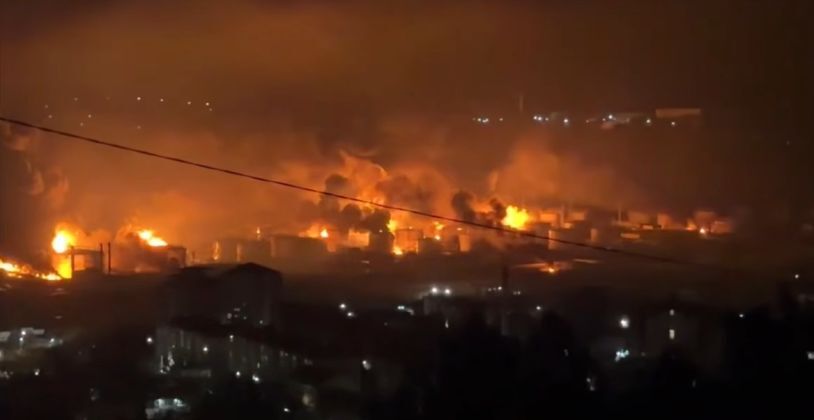
Fires follow Ukrainian drone strikes on Tuapse
Military Watch Magazine – Aug 16, 2026
The Ukrainain Armed Forces have begun using British-made long-range drones to conduct strikes deep inside Russian territory, marking a significant expansion of the United Kingdom’s military technology being employed in campaign against targets far beyond the front lines. Multiple British media outlets reported British-built systems have already been involved in attacks against Russian oil refineries and other military and industrial infrastructure. Among the systems identified is the Nyan, a jet-powered unmanned aircraft developed by British firm Callen-Lenz, which is part of BAE Systems.
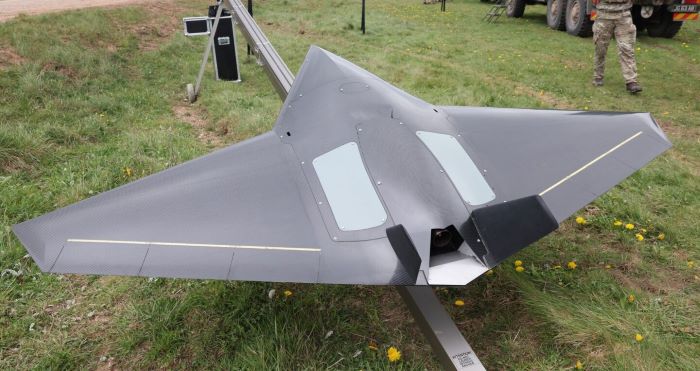
British Nyan single use attack drone. Click to enlarge
The reported use of the Nyan is particularly significant because the system represents a different class of capability from the small FPV and short-range reconnaissance drones that have come to dominate the battlefield. The Nyan is a larger, jet-powered unmanned system designed to travel much greater distances, making it suitable for attacks against targets hundreds of kilometres behind the front. Reports indicate that British systems have been used against targets including oil refineries in Volgograd and Yaroslavl, demonstrating that Ukraine is increasingly able to combine Western-designed platforms with its own long-range strike campaign.
The growing reach of drone attacks has increasingly threatened targets deeper into central Russia, including its industrial heartlands in the Urals region. These attacks have received very considerable support from across the Western world, including funding, training, supplies, and intelligence. In late July a report by the Financial Times shed new light on the extent of Western intelligence support for Ukraine’s expanding deep-strike operations, which has enabled Ukrainian planners to identify the locations of Russian air defence systems and construct flight paths allowing drones to bypass them. Drone attacks have benefited from tremendous support from Western satellites, electronic intelligence from Western aircraft operating near the theatre, and the presence of Western active duty and contractor personnel who have provided significant targeting support.
The emergence of British drones in Ukrainian deep strike operations is important because Ukraine has historically relied heavily on its own rapidly expanding domestic drone industry for strikes deep inside Russia. Working with parts, funding and expertise from across the Western world, the Eastern European country’s defence sector has developed large numbers of relatively inexpensive long-range one-way attack drones, allowing it to conduct attacks at a scale that would be difficult to achieve using Western cruise missiles alone. British systems now appear to be adding another layer to that campaign, potentially providing greater range, speed, payload flexibility or survivability than some of Ukraine’s domestically produced designs.
The reported range of the British drones reportedly exceeds 1,000 kilometres, placing a large portion of European Russia within reach from Ukrainian launch areas. This allows Ukraine to threaten facilities that previously could operate relatively far from the battlefield, forcing Russia to consider air-defence coverage and protective measures across a vastly larger geographic area. The strategic effect can be greater than the destruction caused by any individual drone. Russia must potentially defend oil refineries, fuel storage facilities, military-industrial plants, logistics centres and other critical infrastructure hundreds of kilometres from Ukraine. Attempting to provide comprehensive protection across such an enormous territory is extremely difficult, particularly against large numbers of low-cost unmanned aircraft.
these attacks on tussia do not have the blessing or permission of the british people
> In effect, the western powers are using Ukraine as a proxy, enabling it to wage war on Russia and launch strikes deep within its territory
“In effect” huh?
“In effect”, what used to be Britain is long gone and has become a gay tranny turd world.
None of this is new. Or are we supposed to believe that the “breadbasket of Europe” had a shed load of boom booms sitting around just in case, all the way back to 2022? Have you forgotten sending all your tanks there, which were instantly blown to pieces, along with the jewkrainians in them, so that your jews could rake billions more from the poor to rebuild them with newer shinier Enola Gay signage? And the same with all your old crap.
> This allows Ukraine to threaten facilities that previously could operate relatively far from the battlefield, forcing Russia to consider air-defence coverage and protective measures across a vastly larger geographic area.
And it “forces” Russia to blow the shit out of the Ukraine.
Coming soon to a mosque near you…
PUTIN GO FOR THE POLISH BORDER !
TAKE IT ALL !. FINISH THE ZIONAZIS