
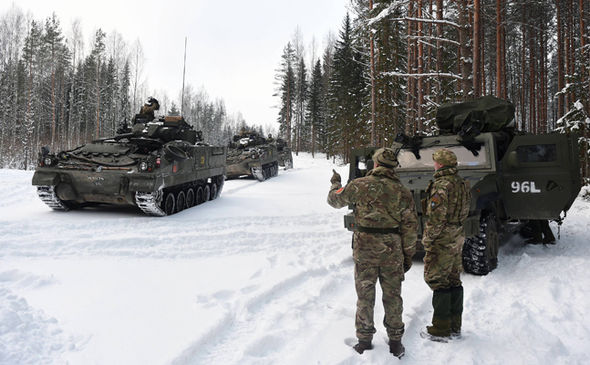
British troops in Estonia near the border with Russia in 2018
Taryn Kaur Pedler – Daily Mail Feb 6, 2026
A new military simulation has painted a chilling picture of how quickly Putin‘s forces could overrun parts of a NATO member state and ‘achieve most of its goals in days’.
The high-stakes wargame, conducted by former German and NATO officials, explored a fictional scenario in which Moscow launches an incursion into Lithuania.
It exploits fabricated claims of a ‘humanitarian crisis’ in the Russian exclave of Kaliningrad as a pretext for military action.
In the scenario, set in October 2026, Russian forces sweep into the strategically vital Lithuanian city of Marijampole, a crucial junction on the road corridor linking Russia and Belarus.
The exercise concluded that a lack of decisive American leadership and wavering responses from European allies could allow the Kremlin to dominate the Baltic region in a matter of days – using an initial force of just 15,000 troops.
Polish security analyst Bartlomiej Kot, who played the role of Poland‘s prime minister during the simulation, said the results were deeply concerning.
‘The Russians achieved most of their goals without moving many of their own units,’ he told The Wall Street Journal.
‘What this showed to me is that once we are confronted by the escalatory narrative from the Russian side, we have it embedded in our thinking that we are the ones who should be de-escalating.’
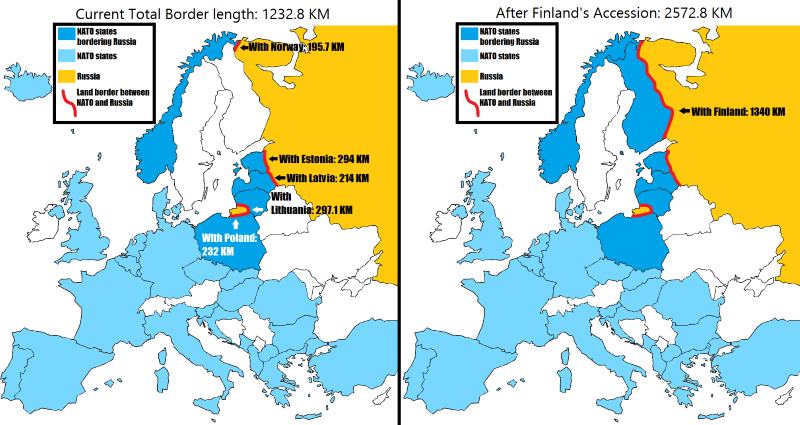
NATO’s steady encroachment on Russia’s border over the years. Click to enlarge
Marijampole is seen as a critical choke point in Europe’s transport network.
The Via Baltica highway, used by both the European Union and Ukraine, runs southwest towards Poland, while an east-west route connects Belarus with Kaliningrad – a corridor Lithuania is legally required to keep open for Russian transit under an international treaty.
During the simulated conflict, Moscow framed its advance into Lithuanian territory as a humanitarian operation.
The United States, in the scenario, declined to invoke NATO’s Article 5 mutual defence clause, which obliges alliance members to come to the aid of any member under attack.
Germany, meanwhile, hesitated to respond, and a brigade already stationed in Lithuania failed to intervene after Russian drones reportedly laid mines near a military base.
Poland mobilised its forces but ultimately stopped short of sending troops across the border to defend Lithuanian territory, according to the wargame’s projections.
Franz-Stefan Gady, a Vienna-based military analyst who acted as Russia’s chief of general staff in the exercise, suggested that psychological factors were as important as military hardware.
‘Deterrence depends not only on capabilities, but on what the enemy believes about our will, and in the wargame, my “Russian colleagues” and I knew: Germany will hesitate. And this was enough to win,’ he said.
The simulation comes amid growing anxiety across Europe about the possibility of a Russian assault on NATO territory.
In recent years, Moscow has repeatedly tested the alliance’s air defences, with drones and fighter jets breaching NATO airspace in what analysts say is an attempt to probe responses and expose weaknesses.
Dutch Defence Minister Ruben Brekelmans warned that Russia is accelerating its military preparations, telling the Journal that his government had assessed that ‘Russia will be able to move large amounts of troops within one year’.
He added: ‘We see that they are already increasing their strategic inventories, and are expanding their presence and assets along the NATO borders.’
The exercise was conducted in December by German newspaper Die Welt in partnership with the German Wargaming Center at the Helmut-Schmidt University of the German Armed Forces, adding to mounting concerns that Europe may be dangerously unprepared for a rapid and coordinated Russian offensive.
It comes after Russia and Belarus launched a major joint military exercise in September.
The Zapad (‘West’) 2025 drills were held in Russia and Belarus, on the border with NATO‘s eastern flank, from September 12 to September 16.
Troops practiced ‘planning the use of’ nuclear weapons and the nuclear-capable Oreshnik ballistic missiles that Moscow promised to station in Belarus.
Paganism on the rise in post-faith Britain, says history boff
Story by Will Stone • 2mo • 1 min read
© AFP via Getty Images
Paganism is soaring in Britain with people drawn to it because it’s an “unorganised religion”.
A historian argues that Paganism offers a way to believe in something and engage in ancient rituals without having to commit to the expectations of organised religion. Francis Young says it no longer “feels countercultural” as it’s become so acceptable. Only 74,000 people openly identified themselves as pagans in the 2021 Census.© AFP via Getty Images
Paganism is soaring in Britain with people drawn to it because it’s an “unorganised religion”.
A historian argues that Paganism offers a way to believe in something and engage in ancient rituals without having to commit to the expectations of organised religion. Francis Young says it no longer “feels countercultural” as it’s become so acceptable. Only 74,000 people openly identified themselves as pagans in the 2021 Census.
Ladies and other ladies, I give you the british press. “Taryn Kaur Pedler” tells all. Is it a man? A woman? A puberty blocker? Who knows? Then it writes an “article” telling you a load of made up BS to make you believe Russia is thinking of invading some shithole. This is the blair institute at work. And believe me, that IS what the turd whites who read this BS in the daily fail will “take away” from this “article”. That’s why they call you a “racist” for not wanting to be muslim. That’s why they support “gaza” and israhell AT THE SAME TIME. That’s why they believe that swapping queer starmer for another turd will make some difference. Because of BS like this, from stink tanks like blair’s.
THE EPSTEIN SPY RING
Donald Trump and Andrew Mountbatten-Windsor were included on a list of “prominent names” in the FBI investigation into Jeffrey Epstein’s sex-trafficking spy network, documents reveal.
Among the recently published Epstein files is a 21-page PowerPoint presentation summarising the evidence collected by FBI agents, who interviewed nearly 100 victims during an investigation launched in 2018.
One slide contains a summary of allegations made against 11 well-known men, including Harvey Weinstein, the billionaire Leon Black and Jes Staley, the former chief executive of Barclays bank.
The claims, which include child rape as well as less serious allegations, have been denied
At the same time the document was uncovered, the US justice department took down an 83-page summary of the federal investigation into “potential co-conspirators” of the deceased paedophile. Almost all the names in it were redacted One name which keeps re occurring is Peter Mandelson and his boyfriend Wes Streeting, who was behind the framing of Nurse Lucy Letby
A lot of UK government and political figures are about to have their reputations blown including Kier Starmer
Expand article logo Continue reading
As with all trash corporate MSM, the UK’s Daily Mail leads with the lies.
Lavrov;- ‘’ Russia will not attack Europe unless struck first..’’
Putin’s envoy; -‘’ EU warmongers ‘sabotaging’ Trump’s Ukraine peace initiative’’
https://www.presstv.ir/Detail/2026/02/09/763747
Russia has not stepped outside its old USSR borders for its SMO against Ukraine while NATO is now operating inside the old USSR borders in Ukraine and Lithuania – yet we’re meant to believe Russia is the expansionist empire that threatens all? Many leaders in the English-speaking world forget a lot of us finished our education before the active dumbing down of society following the dreadful money-grubbing policies of Thatcher then Reagan. And not all of those who followed are dumb either, because though they can refuse to educate people they can’t actually impose stupidity upon those they see now as just two-legged beasts of burden. Not even donkeys or dogs are as dumb as they’d like us to be yet they talk to us as though that’s how dumb we really all are.
Sort of like how Russia could have taken Kiev in a few weeks but strangely didn’t. Oh that’s right it was a staged war between Ukraine-Russia to liquidate millions of white soldiers/civilians. The morons still have trouble comprehending that both NATO & Russia are governed by the same Jewish based central banking cabal, which manages the political – MSM system of both. They”re all in on it, setting up whites to be wasted in choreographed wars like in Ukraine. The Epstein Files exposed Putin is simply another member of the Zionist-Commie pedo cabal (MOZ) running the world as Nico X said for years on here. Now he’s been proven right.
A.A.
The west has adopted the same abject Hypocrisy that Jewry exhibits. That’s no wonder considering the west is ruled by Rothschild jewry. The Jews invented Lying & Hypocrisy. It is their foundational mark, along with murder & racism.
LOL..
a bit of propaganda slop from the fail, failing to take into account that the Russkies have been fighting the Ukrainians longer than the Gerry’s in WW2 and have yet to actually take the Donbass..
But somehow…
when Vlad’s on the rampage he’ll march on Berlin in three fucking days..you see that’s the problem with imbecile kind they’ve forgotten how to think, swapping out subjective nonsense for objective facts..
of course that doesn’t mean that the hollow men and their humpback minions don’t want to get the their little red heifers in a row and have a big shitshow..
because they do..they are just having trouble getting the muggles motivated..hence some agit prop slop from the shit rag du jour..
By the way…scrawled in drool by Tarboy corblimey Peddler..of course it is…
lolo…
Russia and Iran attack simultaneously.
Here endeth the lesson
PS: Poofters say ” Oooo ….stoppp… or we’ll scratch your eyes out..”