
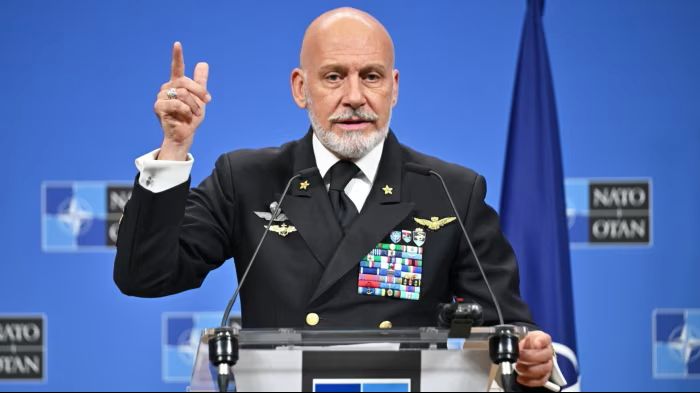
Ellie Cook – NEWSWEEK Dec 1, 2025
Russia has hit back at comments from NATO’s top military commander after he suggested the alliance could launch “pre-emptive” strikes against Moscow, in the context of tactics like cyberattacks or sabotage.
Why It Matters
Admiral Giuseppe Cavo Dragone, the chair of NATO’s military committee, told the Financial Times the alliance was mulling over “being more aggressive or being proactive instead of reactive.”
A “pre-emptive” move from NATO could be deemed “defensive” but would be a step away from how the alliance would typically operate, the Italian admiral added.
What To Know
Dragone’s remarks are “an extremely irresponsible step, indicating the readiness of the alliance to continue to move toward escalation,” Maria Zakharova, a spokesperson for Moscow’s Foreign Ministry, said in comments reported by state media on Monday.
Newsweek has reached out to NATO for comment.
NATO officials say the alliance is hammered by cyberattacks on a daily basis, some of which can be traced back to Moscow. Cyber is one strand of what is known as hybrid warfare, or tactics that fall short of open fighting. They can also refer to information campaigns, weaponizing migration or targeting critical infrastructure.
NATO in January said it would beef up its presence in the Baltic, including operating more frigates and maritime patrol aircraft, shortly after a spate of suspected sabotage incidents linked to Russia’s “shadow fleet” of sanctions-skirting oil tankers. Several undersea cables were cut or damaged in November and December 2024, including four data cables and a major power link on December 25.
Dragone said the pumped up NATO presence, referred to as Baltic Sentry, was “working.”
“From the beginning of Baltic Sentry, nothing has happened,” he said.
A Finnish court in October dismissed the case against the crew of the Eagle S, a Cook Islands-flagged tanker that faced charges of aggravated criminal mischief and aggravated interference with communications over the Christmas Day damage. Prosecutors had alleged that the tanker had dragged its anchor along the seabed for roughly 56 miles. The crew denied wrongdoing.
“It was not possible to apply Finnish criminal law to the case,” the Finnish court said. Dragone told the FT legal frameworks and problems over jurisdiction made working out how to be “aggressive” more complex.
NATO countries are still working out who is responsible for policing areas vulnerable to sabotage, like the Baltic and North Seas.
Roughly 20 drones crossed into NATO member Poland in September, when Warsaw triggered the alliance’s Article 4. This means member nations come together to discuss “whenever, in the opinion of any of them, the territorial integrity, political independence or security of any of the Parties is threatened.”
Moscow said at the time it had not deliberately targeted the country, but Polish Prime Minister Donald Tusk said the incident marked “the closest we have been to open conflict since World War II.” Both NATO and the European Union are working on fortifying anti-drone defenses.
What People Are Saying
“Being more aggressive compared with the aggressivity of our counterpart could be an option,” said Admiral Giuseppe Cavo Dragone, the chair of NATO’s military committee.
The Putintards/conservatards still haven’t figured out that both NATO & BRICS are ruled by the same transnational Commie cult of Jew central bankers pretending to be ‘enemies’ to dialectically advance their global WEF/UN Agenda 2030 techno-Communist goals & setup prearranged wars to liquidate white males.
This is why the clown Boris Johnson stopped Zelensky from seeking peace, not so Ukraine could stay in the war against Russia but so that NATO could.
If you think about it, the “citizens” of NATO countries should all want out. All you need is a dick like this Dragone to push a button and all the males will die in his war. Just like in the jewkraine.
The jews are attacking Russian ports and ships to try to get them to attack NATO. You can’t expect the Russians to put up with it forever. What’s mind numbing to me is why NATO don’t just start the war by simply declaring war on Russia. It’s not like anyone in the jew cesspools would lift a finger to stop it. Better yet, why not just send the soldiers out in each country with enough ammo to kill every white man, woman and child? Why all the fucking around? We all know what they’re doing so let’s just get it done.
Get a load of that costumed imbecile in the image at the top with the absurd billboard of colorful “campaign ribbons”…for campaigns in which he surely never actually saw any real action and surely did not earn, unless one of them is for manning the business side of a glory-hole on the flagship. And is Guido the Cue Ball with the running joke that is the Italian navy? Send in the f*cking clowns.
Being more aggressive compared with the “aggressivity” of our counterpart could be an option, said Admiral Giuseppe Cavo Dragone, the chair of NATO’s military committee.
Another day… another moron from Nato’s top-brass making an utter fool of himself. 🙄
LOL…
That’s what’s so funny about the fake war…the low level characters in starring roles, the staggering levels of incompetence and grift and paucity of believable narrative.
.it’s like watching some medieval despot on his crumbling battlements screaming at the dead corpses of his knights to mount and charge whilst planning the winning counter offensive..
a gallant surge of cleaning staff and ladies in waiting…
Glory beckons..
1 December https://www.youtube.com/watch?v=PS1zNdW1tiA Putin Steps In to Help Nigeria Fight Terrorism < drumpf aka 1987 KGB asset Krasnov 🎯Furious/ thought "saving Christian Nigerians" in mineral rich Nigeria – remember baphometricker do what do willst pedo crypto fake j. drumpf aka rigger of the 2024 'elections' called Africa a continent full of shithole countries- was only his business…
2 December https://www.youtube.com/watch?v=pwzPYzIWamE 🎯'drumpf Loses It at Midnight after Attacking Meidas for an interview they did with former AG Eric Holder and then making 400 (four hundred/gj) other bizarre & deranged posts at midnight over the course of an hour.'/ (N.B. Meidas Touch has 6 million subscribers…)
1 December https://www.youtube.com/watch?v=XBvj0rYbVm8 Cyrus Janssen/ China launched it’s 2026 BRICS Master Plan & how it will use the Chinese Renminbi to increase global trade. From Africa to Southeast Asia/ China uses its Cross Border Payment System to facilitate more international trade…
0.22 BRICS nations will form their own currency to compete with the usd/ many insiders have speculated this new currency will be backed by gold….the major reason why Russia & China have been stockpiling the asset….
4.06 China is the largest trading nation by a massive margin in other words Chinese currency is already backed by the thing that matters most: productive power…/ the West has benefitted tremendously from China’s industrialisation ….in Africa China is investing more in crucial infrastructure than their western counterparts….in many countries in the global South China is seen as a more reliable & cooperative partner than the US…
1 December https://www.youtube.com/watch?v=Gbg6OtmjNX8 U.S. Panics as BRICS Rejects Dollar/ 100% Tariffs Expose Desperation | John Mearsheimer/ "Exploring global power dynamics through the lens of Professor John Mearsheimer’s offensive realism theory. We analyse breaking international news/ U.S. foreign policy/ great power competition & the emerging multipolar world order with academic rigor & intellectual honesty.”
1 December https://www.youtube.com/watch?v=LdTJh2wzaJA Farron Balanced / “´Leading public health doctor Vin Gupta recently told the Meidas Touch podcast that we all need to be worried about Donald T’s cognitive decline, which is very obviously getting worse.
He pointed out several instances where T’s mental reactions to events happening around him were definitely warning signs of something potentially serious being wrong. T.’s physical health has also detoriated/ he no longer stands for long periods of time/ he’s having severe trouble walking.”
1 December https://www.youtube.com/watch?v=OO_WZOuAAoc TalkofAfrica360/ France 6.26: had underestimated Africa`s political evolution & Africa’s economic rise + it´s determination to reclaim it’s resources….Africa has new partners everywhere….
17.47 The economic reawakeming was not merely symbolic it was structural: a shift from exporting raw resources cheaply to processing refining & manufacturing them locally…
Investors were diversifying away from Paris towards rising African financial hubs/ 20.25: the world had changed & France was forced to face a future in which its influence was no longer guaranteed…,,Africa was no longer begging for permission to define its destiny…The continent had entered a new phase/ one driven by sovereignty/ strategy & selfdetermination…
30 November https://www.youtube.com/watch?v=hliPZBldE2I ‘ America has been thrown into chaos after several African nations announced a shocking oil cut-off/ leaving the U.S. scrambling to secure emergency energy supplies.
Why African countries suddenly halted oil exports/ how this move exposes America’s vulnerability & why Washington is in full panic mode.
From shifting global alliances to Africa’s rising control over energy markets/ this power shift is changing everything. Could this be the end of America’s dominance in global oil politics? And what does this mean for U.S. fuel prices/ industries & foreign policy?
This is the biggest geopolitical energy shock in decades/ Africa is now stepping forward as a global energy powerhouse. Watch the full breakdown to understand how Africa’s oil strategy is reshaping global power & why the U.S. never expected this. (Thus reported… TalkofAfrica360)
Zum Schluss October 2024 https://www.instagram.com/reel/DAoByC5tePr/ A boy from Venda South Africa 👀🔥🇿🇦 created a car that runs on water/ there were more before this teenager / Shell etc. not amused https://www.tiktok.com/@coolstorybru_/video/7425138577048177925
28 October 2025 https://www.youtube.com/watch?v=QQJXiDazX2I Toyota’s Water-Powered Engine Explained: The End of EVs?/ comment: "Stanley Meyer had a car that ran on water, Two asassins posing as Belgian businessmen poisoned his cranberry juice/ he died in his brothers arms.”
25 November 2025 https://www.youtube.com/watch?v=0ewjCsPkonA&t=126s Engine Yamaha Shocks The Entire Industry!
Anyway every body anywhere
h.a.n.d. have a nice day
CIA O
@ Umbra…
Too true.. undeserving of military decoration himself this is the sort of creature that steals them off the dead..which is true of any top brass in the state goonery..
more interesting though, and one that may slip past cursory examination is the posture of this blathering windbag..
He quite obviously is assuming the position of the Baphomet..yes the Baphomet.. right arm pointing above, the lef to the below, the little dias before him a stand in for his tiny little todger..his breasts hidden by all that stolen valour…
All Hail.. dragone the dragon…
PS..Baphomet..
https://m.media-amazon.com/images/I/81mcvbHU3cL.jpg
😉
2 December https://www.youtube.com/watch?v=mt07KoJTPyY 🎯”War? Russia Responds To France Threatening Strike On Niger Over Two Uranium Mines….
Niger has exposed decades of French exploitation after Colonel Tiani seized a massive uranium stockpile from Orano/ France is panicking/ the World Bank court/ the Sahel Alliance is standing firm.
The full uranium war/ 🎯the Russia deal (270 million dollar) & the Ghana nuclear project & why Africa is finally taking back its resources”
French uranium company Orano ( vorher Arriva) had to leave a big stockpile after Niger expelled Orano & the military of France from the country/ Maricron c,s, took the case to court….the “World Bank court”/ of course this court ruled in favor of France & banned Niger from entering the mining site…..
4.37 ‘The World Bank court is nothing more than a front for the interest of western mega corporations & the massive nations that finance them….the “court” pretends to be impartial….but Tiani c.s. know that these laws were written by the colonisers for the colonisers ( mind you Niger got its independence from France already in the 1960’s /gj) to guarantee their perpetual right to steal….”
5.53 : 🎯”The negotiations ( with Russia/gj) are already finished….”
8.33 : The 270 million dollar with Russia is signed / the deal with Ghana is preceding & negotitions are underway with other debtfree sovereign partners in Asia & South America…the massive profits from these sales are pouring into Nigers national treasury…
This money is immediately funding massive social programs/ building schools/ equiping hospitals & strenghtening the national military…. ”
“When Maricron hysterically screamed for military intervention 10.08: The Russian shield immediately formed an impenetrable wall of iron around Niger/ advanced air defense systems rendered any attack by Nato or the Ecowas puppits totally suicidal….
The wicked military option was neutralised before a single shot was fired” (History & Legacy Africa)
2 December https://www.youtube.com/watch?v=5jb9ttuXRfk France PANICS as Niger’s Uranium Enters the Global Market/ by The Sahel Signal
⚠️ France PANICS as Niger’s Uranium Enters the Global Market 🌍 For the first time in 50 years, Niger can sell to any buyer — Russia, Iran, Turkey and more.🔥 France scrambles as its nuclear supply chain shakes &West Africa rewrites the rules.
Anyway every body anywhere
h.a.n.d. have a nice day
CIA O
OLD MAN YOU SHOULD BE WISER !