
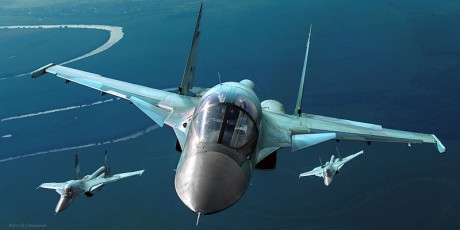
Russian Su-34s strike fighters
Alan Pogrund –Daily Mail Sept 26, 2025
Shooting down Russian planes will lead to war, a Kremlin envoy has said in a chilling warning to NATO.
The threat comes amid rising tensions between Moscow and its European neighbours with Russia accused of violating their airspace after a number of drone incursions.
Poland is looking to pass a law that will allow its military to down Russian drones over Ukraine without needing approval from NATO or the European Union after multiple crossed into their territory earlier this month.
Estonia’s airspace was also violated by three Russian fighter jets on Friday, while Moscow has been accused of being behind a swarm of drones that shut down Copenhagen airport on Monday.
US President Donald Trump warned that NATO countries could shoot down Russian aircrafts which infringe on their airspace during a speech at the United Nations on Tuesday.
But Alexey Meshkov, Russia’s ambassador to France, has fired back, stating that gunning down their aircrafts ‘would be war’.
‘You know, there are many NATO planes that violate Russian airspace, deliberately or not, but it happens quite often. They are not shot down afterward,’ he told RTL, without providing an example.
He doubled down on Russia’s denial of any involvement in recent drone incursions across Eastern Europe.
‘Russia doesn’t do that, play with anyone. It’s not really our thing,’ he added, stressing that the West had ‘fooled’ Moscow ‘on many occasions.’
Poland downed at least three Russian drones during attacks on Ukraine earlier this month.
It was the first time that Russian drones were shot down over NATO territory since the beginning of the full-scale invasion of Ukraine in 2022.
Polish prime minister Donald Tusk warned ‘the situation brings us the closest we have been to open conflict since World War Two.’
European officials called the move from Vladimir Putin a deliberate provocation and NATO was forced to scramble fighter jets to shoot them down.
Romania also reported a Russian drone breaching its airspace just days later.
And on Friday Estonia’s airspace was violated by three Russian fighter jets.
Poland’s government is now planning to scrap the restrictive measure under a new ‘shoot first, ask later’ policy, which is intended to give the military more flexibility when it comes to responding to threats.
The proposed new legislation was submitted by the country’s defence ministry in June, but the application has been reportedly fast-tracked.
The incursion and NATO’s response raised concerns that war could spill over – a fear that has been growing in Europe as Russia steps up its attacks and peace efforts falter.
Tusk also said earlier this week that his nation will not hesitate to shoot down objects that violate its airspace, adding to a sense among NATO leaders that Moscow is testing the alliance’s readiness and resolve, with some urging a firm response.
‘We will take the decision to shoot down flying objects when they violate our territory and fly over Poland – there is absolutely no discussion about that,’ Tusk told a news conference, adding that Poland will take a more cautious approach to situations that are less clear-cut.
‘When we’re dealing with situations that aren’t entirely clear, such as the recent flight of Russian fighter jets over the Petrobaltic platform – but without any violation, because these aren’t our territorial waters – you really need to think twice before deciding on actions that could trigger a very acute phase of conflict,’ he added.
Tusk said that he would also need to be certain that Poland would not be alone if a conflict started to escalate.
‘I also need to be absolutely certain… that all allies will treat this in exactly the same way as we do,’ he said.
Meanwhile, the Royal Navy has scrambled a warship to shadow a Russian frigate and freighter off the UK coast, amid warnings Moscow is sending a rising number of ships through British waters.
Teams aboard HMS Iron Duke and a Wildcat helicopter tracked the heavily-armed warship RFN Neustrashimy as it escorted cargo ship Sparta IV through the North Sea and the English Channel.
The mission is the latest in a string of similar operations carried out by the Royal Navy and its Nato allies in recent months, which are worrying military top brass.
‘Russian warships are increasingly transiting through the English Channel,’ defence minister Luke Pollard today warned.
‘The Royal Navy protects the UK 24/7 to monitor Russian movements, ensuring the security of our waters and undersea cables.
‘Alongside our commitment to Nato’s Eastern Sentry, this is a clear demonstration of how the UK stands firm with our Nato allies to deter Russian aggression.’
Its talking to the hysterical toddler, throw your things out of the pram and they are gone, we will ignore you until you go quiet, wanting it does not mean its yours, crying because you hit someone does not make hitting them right. Only those Toddlers are going on 60 and belong to mind control cults.
I think these are lies to provide exuses, but considering they daren’t attack Russia it’s hard to see why they lie. But in the end they’ll get the war they want and realise too late it’s not the easy-peasy war they wanted. Once it starts Russia will have objectives that won’t be just to force a surrender. They’ll surely remember that after WWII the US incorporated Nazis into its new intelligence structures which is largely responsible for the anti-Russian drive in the west, so they may intend to be more involved in post-war establishment structures after WW3 than they were after WW2. Or be back to this same s*** again in another 80 years.
LOL..
‘a chilling warning’… no doubt with accompanying red lines…
There wouldn’t be any war without the ordnance shoveled into the Ukie shithole by the NATO lol ‘taxpayer’..
which at best guess has killed half a million Russkies…
..now of course the imbeciles running the fakery need to widen the fake conflict..so after they banged heads in lol Alaska.. WW3 was agreed upon..bereft of ideas because the contemporary warmonger is an imbecile of unequaled stature, they have dusted off the WW2 script.. which they are slowly cobbling together in between gigantic lines of coke…and glasses of stale mouton rothschild..
these slavs need to kiss and make up, get rid of the maggots running their respective shitholes and THEN march on Yourope.. watch the cockroaches in the EU sue for peace grovelling on their knees.. and westmonster move to the stolen state..
If the Royal navy protects Britain 24/7 why aren’t they stopping the small boat invasion? Taxpayers want to know!
MM–the Bolshevics, ruling Russia, hated Russians more than the Germans did and were able to do a lot of killing there and came into America via the Frankfurt School, while the Nazis in America were on a leash, contributing technology of various kinds
@ ENGLISH TOM
we see they are good for nothing . only fulfilling
their pension rights this total Nato sucker arsenal .
saving the world on far away horizonts .
I had an old stupid pruszian neighbour I wanted
clear up politicaly + since for those SPIEßERS
political song is a foul song he was not interested .
said his son is somewhere in Nato staff . same idiot
like his father but probably he earns a suburbian
house . Rothschild/Vanguard/Blackrock jews will
take away when Babylon Republic Duitschland is
bankrot (will happen !) .
English Tom–the Jews and Masons of the Establishment are the enemy of White people
Trump’s No.1 policy that Republicans can ride into 2028 election is immigration
Story by James Cirrone • 7h •President Donald Trump should further lean into the issue of immigration if he wants to set Republicans up for a win in the 2028 election, according to a new poll.
Trumps UK visit was primarily concerned with helping us in the UK clear them out
and Britain’s slide into a communist state
The poll from Reuters/Ipsos, which surveyed 1,016 Americans from September 19 to 21, found that Trump has 72 percent support on immigration.
Why would the Russians want to march on EUCCCP? For getting the tens of millions of illegals?