
Sean Matthews – Middle East Eye Sept 4, 2025
An Israeli plan that envisions turning Gaza into a Dubai-like enclave would not only provide cover for the forced displacement of Palestinians but be economically unviable to begin with – unless investors are willing to throw caution to the wind, experts say.
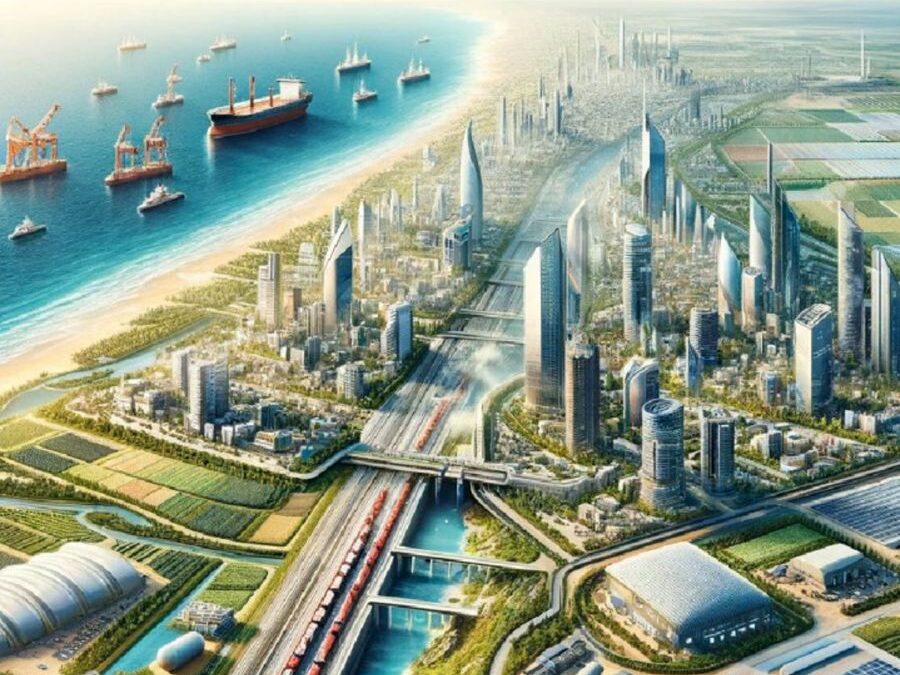
The United Nations estimates it will cost around $600m just to clear the roughly 42 million tonnes of debris in Gaza – and that is before work begins on laying the foundations, sewage, water, and electricity for a futuristic city of gleaming skyscrapers, canals, and AI data centres.
The ferocity of Israel’s bombing of Gaza has been compared, and likely surpassed, the Allies’ bombing of Nazi Germany during World War II.
Mark Jarzombek, an architectural history professor at the Massachusetts Institute of Technology who has studied post-WWII reconstruction, said the comparisons stop there.
“Germany was rebuilt by the Marshall Plan,” Jarzombek told Middle East Eye, referring to the US-backed programme that provided loans to western Europe for its reconstruction after the war.
“[But] the Marshall Plan was funded largely by the industrial nature of the German state. Germany became an export powerhouse to pay back the loans. What did Gaza have before the war: olives and fish?
“The question is what kind of state-backed financial institutions will fund this?” He said.
‘Sadistic cover’
A 38-page slide deck of the plan, first reported by The Financial Times, was published in full by The Washington Post on Sunday.
The proposal was reportedly led by Michael Eisenberg, an Israeli-American venture capitalist, and Liran Tancman, an Israeli tech entrepreneur and former military intelligence officer.
The proposal is being taken seriously by some because the two have a track record of projects taking off in Gaza.
The duo was part of an informal group of Israeli officials and businesspeople that first conceived of the now widely discredited Gaza Humanitarian Foundation (GHF) in late 2023.
The plan echoes one put forward by US President Donald Trump – which he has since largely stopped discussing in public – calling for the forced displacement of Palestinians from Gaza. Under the proposal, Palestinians would be encouraged to “voluntarily” depart Gaza to a restricted zone with temporary housing.
Jarzombek said the plan was “sadistic cover” for Israel’s plan to turn Gaza into a “shatter zone” that Israel completely levels.
“The people on the ground don’t matter. First, the Palestinians are going to be killed and then moved out,” he told MEE. “Because in the name of development, no one will care for displaced people.”
MEE unpacked the more fantastical elements of the plan, including an Elon Musk smart city, but one figure that stood out was the $100bn price tag. The authors say the plan would require no US funding and instead rely on “public and private-sector investment”.
Some analysts say the price tag to create a city without too much splash could be accurate based on other projects in the region.
For example, the UAE paid $35bn for development rights to a wide swath of Egypt’s Mediterranean coast. The cost of Egypt’s new administrative capital, the desert city built from scratch, is estimated at $60bn.
Jim Krane, a Middle East expert at Rice University’s Baker Institute, said the Israeli plan is clearly being pitched to the oil-rich Gulf, but the authors might be disappointed.
“With the oil price where it is now, there isn’t a lot of foreign capital for the rebuilding of Gaza. The Gulf monarchies have been burned before. They get called on to rebuild, and the Israelis destroy it again,” said Krane, the author of City of Gold: Dubai and the Dream of Capitalism.
Saudi Arabia, the Arab world’s only G-20 economy, is struggling to meet its own project deadlines amid lower oil prices for the Vision 2030 plan, which includes plenty of futuristic projects.
The kingdom is relying on record debt issuance to make headway and is scaling back other projects like Neom.
Is ‘Dubaification’ feasable?
But the authors of the paper are, in a sense, channelling the wider “Dubaification” trend that has swept the Middle East.
Downtown Beirut was redeveloped after Lebanon’s civil war by Solidere, a company that bought out locals on the cheap. Empty malls and glitzy towers have sprung up across Jordan, Tunisia and Egypt despite those countries’ economic woes.
Dubai’s construction came in waves. A small amount of oil revenue helped build apartment blocks, ports, and airports in the 1980s, but the city-state is generally energy-poor.
Its super-growth and economic diversification over the last 20 years were turbocharged with wealth from abroad, often seeking a home to avoid taxes.
If the Israelis do succeed in forcibly displacing the Palestinians, the lack of productive enterprise or resources in Gaza would not necessarily prohibit the construction of a few gleaming towers.
Israel’s own real estate sector relies on diaspora investors.
“It’s a feasible model,” Yasser Elsheshtawy, an expert on urban spaces in the Middle East and an adjunct professor of architecture at Columbia University, told MEE.
“Gaza is different than the rest because there is a genocide going on [but] money is not the issue,” he said.
“It’s the political and social repercussions. Once Gaza has been erased from existence, it is prime real estate.”
Elsheshtawy said Saudi Arabia is the wrong country to look towards. He believes investors from the UAE “are just waiting to jump in”.
“At the end of the day, it’s about making profits and selling these urban assets to global investors. It will be done at the expense of the local Gazan population,” he said.
To be sure, there would be less criticism if the Gaza “Riviera plan” came with the acknowledgement of a Palestinian state and was built around those aspirations with the buy-in of Palestinians, experts say.
“Thinking of a future for Gaza in the context of post-war reconstruction is good, but it’s the wrong players doing this,” Jarzombek said.
The Israeli plan rests on several deeply flawed assumptions, which means the price tag is not the prohibitive element of the deal.
The first is that Hamas will be totally removed from Gaza as a political and military force. That is something that some of the US’s closest Arab partners, including Egypt, have told the US is delusional.
The group has continued to demonstrate its ability to wage sophisticated guerrilla-style attacks on Israeli soldiers after 23 months of conflict.
The plan’s authors also make clear their goal is to drive out the Palestinians from Gaza. In their pitch to “investors”, they say the costs of this Dubai-style city will decrease for every Palestinian who leaves.
The authors calculate that $23,000 will be saved for every one percent of the population that relocates. They argue that investors should give each Palestinian in Gaza $5,000 and subsidise their rent in another country for four years, as well as their food for one year, to forcibly displace them.
If you ask in terms of finances and construction, this city can be made,” Abdalrahman Kittana, an architect and professor at Birzeit University in the occupied West Bank, told MEE. “If they erase everything, yes. In order to create something like this, they need investors who will be fine with ethnic cleansing.”
Kittana said comparisons with Dubai or other futuristic cities being constructed in the Middle East miss the point.
“Maybe you go to Dubai, because the people of the UAE have invited you there with a business promise. What people of this land would invite others?”
“Who are the people that are going to inhabit and use these apartments? It’s almost impossible that you will invite people from Italy to live in a place that everyone has seen ethnically cleansed,” added Kittana, who is also a postdoctoral fellow at Tampere University in Finland.
“Properties are bought and sold, but actually, in Palestine and in Gaza particularly, this is not achievable because the place has a meaning beyond money. You can’t buy the relationship with the land,” he told MEE.
I think Israel may be desperate to build this place because they know they’re likely to be swept out of the Middle East because of their atrocoities. They realise they are so despised it doesn’t matter they own our politicians, because they’re reviled by so many ordinary people acting in response through the BDS and alt-media exposure this will surely end their occupation of stolen land.
Building this city on the bones of their victims is like lashing themselves securely for a tornado or flood. Palestinians may want to rebuild Gaza but others may want the place to stay as it is to remind the world of Jewish cruelty, while the Jews will want the evidence erased whatever else happens. That decision ultimately belongs to the Palestinans, and in the reconstruction phase they may press for prosecutions.
The phrase “They make a desert and call it peace” originates from the Roman historian Tacitus, specifically in his work “Agricola.” This line is attributed to Calgacus, a Caledonian chief, who lamented the destructive nature of Roman imperialism. He criticized the Romans for their brutal conquests, which left lands desolate while they falsely labeled their actions as bringing peace.Tacitus’s poignant observation highlights the irony of imperialism, where the devastation of cultures and communities is masked by the rhetoric of order and tranquility. The Latin phrase “ubi solitudinem faciunt, pacem appellant” encapsulates this sentiment, emphasizing the stark contrast between the reality of destruction and the facade of peace.This powerful statement resonates through history, serving as a reminder of the consequences of unchecked power and the often overlooked human cost of empire-building. It invites reflection on the true meaning of peace in the context of conflict and conquest.
Israel might create a desert but it will never have peace, eventually it will be consumed by it’s own monster-ism. One has to be a sick people to create so much destruction. I suppose blame also rests with the West who gave them the bombs…
https://www.nplusonemag.com/online-only/online-only/they-make-a-wasteland-and-call-it-peace/
Saree Makdisi
They Make a Wasteland and Call It Peace
If the ceasefire lasts, it is at best a temporary and palliative solution
With the ceasefire that went into effect on Sunday, January 18, 2025, the people of Gaza—cold, hungry, battered, homeless, but steadfast in life—experienced their first quiet night in over fifteen months. Israel’s genocide has stopped, at least for now, despite the fact that Israel failed to accomplish a single one of its declared objectives in Gaza. The scheme to expel Palestinians to Egypt, or to somehow spirit them away to the Gulf or to Canada, failed. So did the so-called “generals’ plan” to ethnically cleanse all of northern Gaza by systematically exterminating anyone who had survived the preceding months of bombardment and methodical destruction of life-support systems. So did the pledge to destroy Hamas and the armed resistance in Gaza. So did the use of force to free the Israeli prisoners held in Gaza. If Israel has prevented another attack like the one on October 7 from taking place so far—the last of its declared objectives—it has nevertheless made such attacks more likely by revealing, both in Gaza and in southern Lebanon, the utter incompetence of its undisciplined conscript army. That army excels at two things: the mass killing of civilians and the mass destruction of civilian infrastructure. Those two things represent the sum total of what Israel accomplished in the past 470 days.
The ceasefire terms are, after all, essentially the same as those agreed to by Israel and Hamas last May, which Netanyahu reneged on and Antony Blinken blamed on Hamas. They are similar to the terms of the first, short-lived ceasefire and prisoner exchange, in November 2023. They are, in fact, largely the same as the terms that could have been arranged on October 8, 2023. Despite repeatedly vowing nothing less than “total victory” in Gaza, Netanyahu ended up making concessions that could have been made months ago. What was the point of the carnage, then? The only answer is that the deliberate unleashing of catastrophic harm on a trapped population of more than two million people—half of them children, all of them subject to the occupying power legally responsible for their welfare—was in fact the main, undeclared objective: a gratuitous exercise in mass cruelty with few counterparts even in the darkest annals of history.
Essay written 24 January 2025.
A lot more death and destruction since then.
May Zionist Israel never know peace. Israel could be all washed-up in the next two or three or four years.
What did Gaza have before the war: olives and fish? per Jarzombek. Is this man clueless. Gaza sits on a huge dep[osits of oil and gas that belong to the Palestinians and which israel is stealing. Wake up and smell the coffee.