
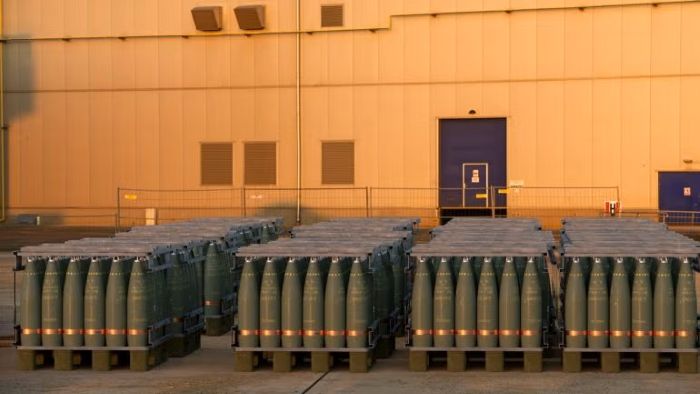
Stacks of of 155mm ammunition at Rheinmetall’s new Factory in Unterlüss
Thomas Kolbe – Zero Hedge Aug 30, 2025
In Unterlüß, Lower Saxony, Europe’s largest ammunition factory began production yesterday. What started clandestinely is now being publicly scaled with full firepower: the European Union is building its own war economy.
In the good old days in Germany, recessions were typically masked by state-funded infrastructure programs. The concept worked as long as the state did not overgrow, overregulate, or force the private sector into a destructive ideological agenda, as is the case with the green transformation. In other words: the economy was always able to clear away the debris left behind by the state.
Southern Europe Could Never Recover
In Southern Europe, where the state’s role has traditionally been high, monetary policy generous, and handling of public funds notoriously lax, this policy left nothing but infrastructure ruins and industrial wastelands. Local economies were never able to productively absorb the artificial credit distributed by Brussels. The fatal consequences of this pseudo-boom still shape the landscape today.
For economic historians, present-day Europe has long been a fascinating study object. Crisis followed crisis, with the public sector intervening each time with increasing volume. The attempt to install the Green Deal, a Keynesian pseudo-economy, must be understood in this context. That Germany’s defense company Rheinmetall yesterday launched Europe’s largest ammunition plant in Unterlüß fits into this narrative.
The company invested half a billion euros to provide an annual capacity of up to 350,000 rounds by 2027. 500 new jobs are to be created, celebrated by politicians as a turning point and the beginning of a pan-European defense architecture.
Ceremony and Half-Truths
Rheinmetall CEO Armin Papperger expressed satisfaction: “It was not easy for us to invest half a billion without orders. I am very grateful to you”—the words were directed at Defense Minister Pistorius—“for keeping your handshake agreements. You are a man of word and deed.” A heavy dose of pathos and self-congratulation is evident here—politics and the defense industry are long intertwined.
Of course, this is only half the truth. Beyond the usual behind-the-scenes deals, politics has made it clear that it is ready to mobilize all means to build a German defense industry and provide sector companies with guarantees and subsidies where necessary. Big business, no risk.
After the collapse of the green economy, politics is now betting everything on the next pseudo-economy. The aim is to loosen dependence on America while exploiting the media spin that stylized Vladimir Putin’s Russia over years as a potential European invader. Whether this fear campaign will work in the long term remains to be seen.
No One Will Fight for Merz or Macron
Given the deep economic depression in which Germany and large parts of the EU are stuck, the general war fatigue, and social fractures in core EU states like Germany and France, it is clear that despite the reinstatement of conscription, most citizens will rigorously reject military engagement.
A glance at EU public finances alone is enough to recognize that a war against Russia is political madness. France, with a debt-to-GDP ratio of 115%, is days away from a confidence vote on the new austerity budget. Bond markets are already punishing these bankrupt states. The signs point to savings, not bellicose adventures.
Absurd and Destructive
It is absurd in this situation—where Germany has almost fully spent the so-called Bundeswehr special fund of €100 billion and now switches to borrowing mode—to accelerate this path. Yet Brussels, Berlin, Paris, and London are serious. In fall 2026, Rheinmetall plans to launch its next plant in Weeze, producing fuselage components for the F-35 fighter jet. Cost: €200 million, this time directly publicly funded.
Defense factories will mushroom in the coming months and years, producing far beyond civilian demand. Germany plans to raise its defense budget to up to 5% of GDP, which will worsen the impoverishment of its population as the private sector already shrinks by 4–5%. A disaster unseen in Europe since the end of the war.
A hot conflict with Russia is economically highly unlikely. Yet a new Cold War, a state of continuous armament like before 1990, seems to be Europe’s goal. They are trapped in an absurd economic theory of central planning and command economy. A new power base is forming: a corporatism between the defense industry and the political complex in Brussels.
Germany as Anchor
Germany has clearly been chosen to finance this economic disaster. The country, previously with one of the lowest debt ratios in the EU at 64%, will double its annual defense budget to €162 billion by 2029. By 2027, the special fund will be exhausted, after which loans up to €400 billion will be required.
Germany will become an active player in bond markets, where interest rates are already rising. The European Central Bank will have plenty of work to keep the rapidly growing debt pile liquid. The EU will also participate with new funds, EDIP and ASAP (a term bordering on infantilism in this context), contributing €50–70 billion annually to joint defense projects.
No Lessons Learned
While Germany’s civilian industry collapses, factories close in droves, and the country moves toward mass unemployment—with all consequences for social funds and the domestic climate—we now witness one grand opening after another: pompous inaugurations of defense plants, with champagne popping at our expense.
Europe has learned nothing from the green pseudo-economy disaster. It refuses to analyze how Germany and other industrial centers were deindustrialized. The fatal consequence of building a war economy is that it will siphon scarce resources from productive sectors on a massive scale, making financing and developing civilian enterprises nearly impossible.
Germany is being technologically left behind and bombing its own prosperity—in the literal sense.
* * *
About the author: Thomas Kolbe, a German graduate economist, has worked for over 25 years as a journalist and media producer for clients from various industries and business associations. As a publicist, he focuses on economic processes and observes geopolitical events from the perspective of the capital markets. His publications follow a philosophy that focuses on the individual and their right to self-determination
“In Unterlüß, Lower Saxony, Europe’s… ” — hmmm, should make a nice big fat target for the Russians when they finally get fed up with being attacked by the EU commissariat.
“… it is clear that despite the reinstatement of conscription, most citizens will rigorously reject military engagement.”
Well let’s hope this is true.
The problem with a war economy is you no longer risk losing out to competition but to destruction. And if you want population replacement for a people whose only historical link to you is their dad’s been here a few years, the chances are in war they’ll choose to go home rather than risk life and limb for these suckers.
Oreshnik mark your target !
The words “economy” and “economic” pepper the article, even though no-one ever explained why economics is supposed to matter, even when “the Economy” is obviously killing us (e.g. when they advocate huge influxes of foreigners to make it stronger)
Would a solution to the world’s economic problems be to cancel all debt, and for every country to have its own central bank and print its own currency, and end the world’s war economy?
Please mr putin can you bomb london over the notting hill carnival
and perhaps a small bomb for carl jones house
Thanks
“Taking responsibility for a bright future” and “Vote on the 16th for Democracy and against right extremism/anti semitism” was/is the Rheinmetal commercial in the former Westfalen Stadion of the Bundesliga club BVB Dortmund – sponsored by Rheinmetal. Ah yeah, “peace and stability and mocking until all are crazy” aka global De mock crassy that includes (for some) healthy eco NO (but plenty) mees!