
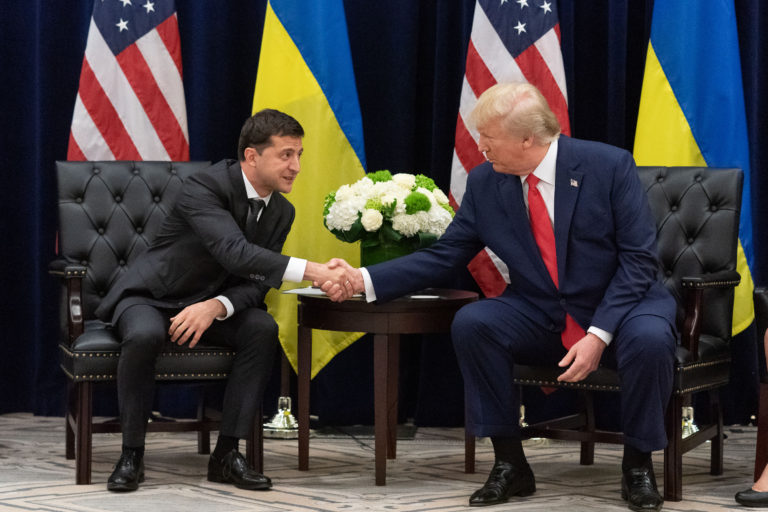
Donald Trump and President Zelensky at the UN in 2019
David Averre – Daily Mail Nov 12, 2024
Donald Trump’s victory in last week’s US presidential election sent shockwaves across the globe – but they will likely be felt most acutely in Ukraine.
Trump has famously said that the Russia-Ukraine war would never have started had he been president and claimed he could bring the conflict to an abrupt halt – without ever revealing his plans for doing so.
Now, as leaders across Europe and Russia wait anxiously to see what direction the Trump administration might take, there are mounting concerns that Trump could push for a hasty ceasefire requiring Ukraine to cede significant portions of its territory – even as Kyiv’s European partners vow to back its armed forces for ‘as long as it takes’.
His vice president-elect, JD Vance, has already sketched out a possible peace framework, while Trump’s son Don Jr mocked Volodymyr Zelensky with distasteful social media posts about the Ukrainian President ‘losing his allowance’ from Uncle Sam.
Meanwhile, the Biden administration is scrambling to bolster Ukraine’s defences in its dying days before Joe hands over the keys to the White House, with Secretary of State Antony Blinken heading to Brussels this week for an emergency meeting with European allies.
With Trump’s inauguration just two months away, MailOnline examines what the once-and-future president’s ceasefire plan could entail and explores the myriad problems it is likely to face.
What could a Trump-negotiated deal look like?
‘I can’t give you those plans because if I give you those plans, I’m not going to be able to use them.’
That was Trump’s response during his campaign when pressed to reveal how exactly he intended to stop the war in Ukraine, which by the time he enters office will be seven weeks shy of its third year.
Since winning last week’s election, Trump has spoken with Zelensky via phone – a conversation characterised by the Ukrainian leader as ‘excellent’ – and claims to have spoken with Putin despite denials by the Kremlin.
But in September, the Republican’s running mate and now vice president-elect JD Vance offered former US Navy Seal Shawn Ryan an outline of how peace may be brought about in Ukraine under Trump.
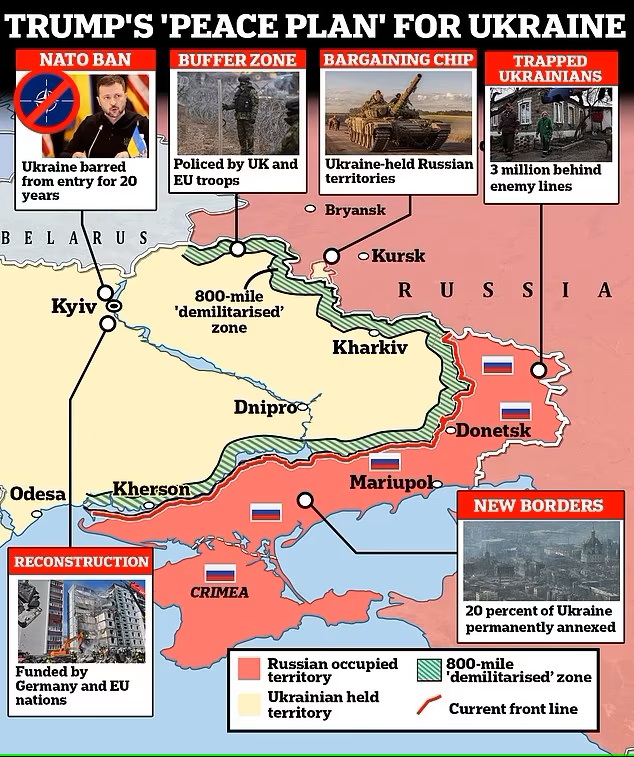
‘What it probably looks like is something like the current line of demarcation between Russia and Ukraine becomes like a demilitarised zone, heavily fortified for the Russians don’t invade again,’ Vance told the former Seal on his podcast.
‘Ukraine remains an independent sovereign. Russia gets the guarantee of neutrality from Ukraine.
‘It does not join NATO and some other allied institutions. Germans and other nations have to fund Ukraine’s reconstruction,’ Vance added.
That telling, albeit vague, description of what a Trump-negotiated end to war in Ukraine could look like was subsequently echoed by a Wall Street Journal report that emerged days after the election last week.
Citing three sources ‘close to the president-elect’, the WSJ claimed Trump’s transition office is considering one proposal that would prevent Kyiv from joining NATO for at least 20 years in exchange for lucrative arms deals.
In the meantime, the conflict would be halted by the implementation of a large demilitarised zone (DMZ) that would effectively freeze the fighting in place and force Kyiv to relinquish up to 20% of its territory as part of an ‘800-mile DMZ’.
But the sources offered no insight into how such a buffer zone between Russia‘s border and unoccupied Ukraine would be monitored or managed, other than to say it would not be staffed by American peacekeepers.
This suggests troops from other NATO nations, including the UK, would be tasked with manning the DMZ.
‘We can do training and other support but the barrel of the gun is going to be European… and we are not paying for it,’ one source was quoted as saying.
‘We are not sending American men and women to uphold peace in Ukraine… Get the Poles, Germans, British and French to do it.’
The proposal draws comparisons with the DMZ that has divided North and South Korea since the armistice agreement that brought the Korean War to an end in 1953.
But the Russia-Ukraine conflict is vastly different, leading observers and analysts to warn that implementing a DMZ in Eastern Ukraine would face huge resistance.
What problems would the deal face?
Several obstacles must be circumvented before the conflict can be frozen and a ceasefire introduced – starting with the evident lack of enthusiasm from those expected to agree to and uphold the proposal.
Days before Trump secured his election victory, Volodymyr Zelensky openly declared that making any concessions to Putin would be ‘unacceptable for Ukraine’ and ‘suicidal for Europe’.
The Ukrainian Nazis will feel betrayed if Zionists in the Trump government write his war policy to give to Israel what Ukraine used to get and what Biden promised “to the end”. People with sense know the war was lost after about two months of the SMO but the Nazis in Ukraine will become so bitter it’s quite likely they’ll resort to terrorism; not just in Russia but in mainland USA and in places where there are lots of Jews such as New York. (Israel will be almost impossible to infiltrate if it survives.)
So a lot more innocent people could die after the Ukraine war ends because of the neo-con war pigs. It’s galling to think how most of America’s hard-core war hawks were once its hard-core draft dodgers. They had no lust for blood when it could have been their own blood spilled or they could have spilt somebody else’s. Russia should target these murderers with its missiles and take the front line to their front door.
“…buffer zone marshalled by UK troops,,” LMFAO!!!
Russia would have to be totally retarded to let that perennial sh!t-stirrer ZOGUK anywhere near its borders….
even if “UK troops”, if it came to actual hostilities, would be about as effective as a wet-noodle in a knife-fight!!
😂
Funny how Britain/France wouldn’t come to terms with Hitler regarding the Danzig Corridor after Hitler invaded Poland & offered a peace deal; but they have no problem handing enormous swaths of Ukraine territory over to Commie Jutin. Oh that’s right they’re all in on it, & the war was simply a coordinated operation to waste whites in. Ok, now I get it. Hitler was actually a real enemy & Putin is simply another member of the Commie-Jew Chandala Lubavitch syndicate–that’s why Britain/France never declared war on Putin’s Russia, like they did with Nazi Germany. Yep, now we know.
Looks like the morons of NATO and the Daily Fail have been eating the magic mushrooms again.
Maybe some other troops would be better. UK is a member of NATO which mean NATO troops would be stationed directly on Russia’s border. Problem not solved.
I’m waiting to see if Russia is that stupid.
According to that, the jew-k shitizens will be forced to pay for their shit “troops” (murdering scum) to “patrol” (rape and pillage) the jewkraine forever. The jew ….s win again.
And why is it “funded by germany and eu nations”? Last I saw, germany was part of the eu. The whole thing smells of the jew-sa xxxxxxx the british and the germans yet again.
As for “20% of jewkraine…”: When the whole world is owned by xxxxx who cares where they draw their lines on a “map”? If I was jewkranian I’d want to shift that line so that I was on the other side. It must suck to know you’re going to be a slave for the rest of your life to “fund reconstruction” and make the jews even more money. You may as well move to the jew-k so you can be …… by the ….. on a daily basis.
The map is correct. As is the deal where Ukraine cannot join NATO.
The demilitarized zone is the problem. Russia doesn’t want Ukraine coming back in another decade or two. Ukraine will have to agree to remain non nuclear and with no standing army larger than for domestic policing.
And so it ends worse than it started.
Zelensky is one sick Jew to have not met terms in 2024. That deal would have been much better than the one he’s going to get.
Let this remain a lesson to gentile nations. Never let Jews rule over you.