

Introduction – Apr 7, 2024
Russia recently announced plans to further expand its armed forces, which is understandable given the challenges it faced in Ukraine.
However, given that Russia has largely overcome those challenges and is now in the process of mopping up the last pockets of Ukrainian resistance, you really have wonder why the Kremlin wants such a big, additional expansion?
After all, by the time the two proposed new armies are fully trained and equipped the fighting in Ukraine should be over. So why does Moscow need two new armies made up of an additional 14 divisions and 16 brigades?
This cannot be to make up for losses sustained in Ukraine, because despite what Western mainstream media (MSM) journalists/propagandists may say, Russian losses have not been that heavy.
Of course Russia has taken casualties but nothing like on the scale the Western MSM/propagandists would have us believe. Claims of massive Russian losses in Ukraine can thus be safely ignored, as the Kremlin simply didn’t need to make such sacrifices when it had all the advantages.
So why has Russia embarked on a further expansion of its armed forces? Could it be that the Kremlin sees further military action against the West as inevitable now?
We reserve judgment on that but his is something to keep an eye on. Ed.
Russia aims for massive military expansion amid ongoing challenges
Sławomir Zagórski – Essa News March 31, 2024
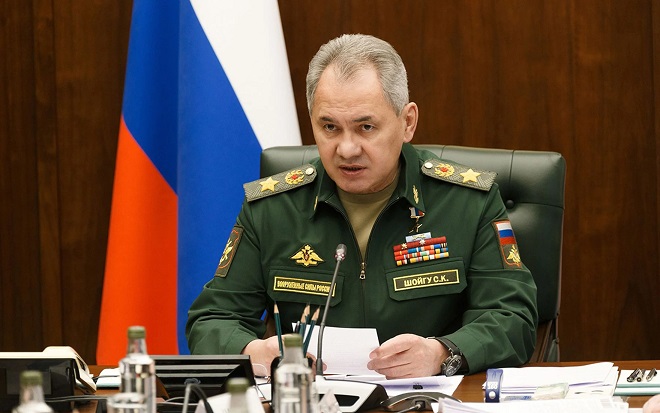
Russian Defence Minister Shoigu. Click to enlarge
The Russian Defense Minister, Sergey Shoigu, has unveiled plans to form two new all-army armies, encompassing 14 divisions and 16 brigades. This move marks a significant shift in the Russian military strategy. However, the question arises: Can Russia manage such an ambitious reform?
Observers have noted that not everything is progressing as expected, prompting modifications based on wartime lessons. The initial phase of reform began in the fall of 2022, aiming to bolster army personnel and initiate regular reserve training.
In an effort to strengthen their military capabilities, authorities plan to mobilize an additional 500,000 conscripts and increase the maximum age for military conscription from 27 to 30 years. This adjustment has notably improved the army’s manpower situation.
Yet, faced with escalating losses, it became apparent that the size of the army was still inadequate. Another reform was put forward to further increase personnel numbers, setting a target of 1.5 million soldiers and elevating the minimum conscription age from 18 to 21.
The Kremlin has rightly concluded that the current army size is insufficient to ensure the vast nation’s security. With half a million soldiers engaged in Ukraine, a mere 600,000 remain to protect the state. This has significantly depleted forces in crucial regions like the Caucasus and the Far East, increasing vulnerability to border incidents, particularly with China. Expansion of the army seems to be Russia’s only viable solution.
The grand expansion of the Russian army
Shoigu’s declaration represents the next phase in a major enlargement of the Armed Forces. However, it remains unclear how the ministry will fund the construction of additional brigades and the necessary equipment, especially considering that the basic gear for a single soldier costs around $30,000. The logistical challenges are daunting, particularly in equipping units with vehicles.
The absence of a mechanized contingent in the recent May parade, notably on Red Square where not a single tank was displayed, underscores these challenges. Yet, vehicles bearing the Georgian ribbon, a symbol traditionally seen on parade vehicles, have been observed at the front lines.
To date, Russia has lost approximately 30% of its total tank reserves from before the war, along with about 50% of its front-line vehicles. Despite ramped-up production, it barely compensates for the losses at the front.
Ministry records indicate that “The Ground Forces were equipped with a total of 1,530 new and modernized tanks” within a year, plus more than 2,200 infantry fighting vehicles and wheeled transporters. Over two years of conflict, between 4,500 and 8,000 vehicles of these types have been lost. The industry has also delivered over 12,000 other vehicles, including trucks, engineering gear, and SUVs, with 1,400 being armored vehicles like the Tigr.
Vehicles tagged as “modernized” often come from deep reserves, refurbished after sustaining damage at the front. Their technical condition is generally poor, and despite upgrades, they still lack advanced electronic equipment and fire control systems. Previously sourced from Germany and France, these components are now being procured from Belarus.
Increased funding for military development
Despite production shortfalls, TASS news agency reports indicate that Rostec’s defense conglomerate has increased tank production sevenfold last year, with infantry fighting vehicles and wheeled transporters production up by 4.5 times. These figures are expected to climb as the industry shifts to a war footing.
Defense spending has surged by 36% in 2023 compared to the previous year, with Russia allocating over 6% of its GDP to defense—constituting more than 32% of the state budget. This level of expenditure hasn’t been seen since the 1970s arms race.
Next year, the Kremlin plans to spend $127 billion on army modernization, new defense factories, and weapons production. For context, Poland has allocated $29.5 billion for its entire Ministry of National Defense budget this year. Yet, even this substantial investment might not fully satisfy the army’s needs. Shoigu has announced that defense funding in 2023 will see a nearly 1.5-fold increase, which is expected to meet 97% of the equipment requirements of the Russian army.
The rebuilding and restructuring of the army, especially considering the current losses in Ukraine, could take several years. Shoigu’s projections for establishing two all-army armies are concerning. For the time being, these units will rely on vehicles coming out of demobilization. Nevertheless, the urgency to expand military forces remains, particularly as the Kremlin does not conceal its ambitions and intentions towards the Baltic states and Poland.
WHISTLE BLOWER SHOOTS DOWN LBGT HOMOSEXUAL AGENDA
A whistleblower at the Tavistock Trust said he is “pleased I didn’t turn away” when colleagues raised concerns to him several years ago about the children’s sex change operations service which closed last month.
The review, led by Dr Hilary Cass, was commissioned in 2020, two years after Dr Bell had compiled a report detailing concerns some staff had raised with him about how the Gender Identity Development Service (Gids) at the Tavistock and Portman NHS Foundation Trust was operating
I am pleased that I didn’t turn away and I am pleased that the concerns I raised in my report about the morality of operating on children have been borne out.
Dr David Bell
Dr Bell, who worked at the trust as a consultant psychiatrist for 25 years before retiring in 2021, told the PA news agency he feels his report was “a very important part of that chain of events” that led to a decision by NHS England to commission the Cass Review.
that children were being “rushed through” the Gids service and set on a medical pathway to address their changes of gender, by being t talked into having operations on their frail young bodies which in most cases they later regretted.
His comments come as it was reported the final Cass report, to be published on Wednesday, will warn children could face psychological consequences if they are allowed to “socially transition”, when they change names, pronouns or clothing before the operations
Great hostility was often shown to them by other children
This has not been confirmed by the team behind the review, but the interim report previously stated that social transition is “an active intervention because it will have significant effects on the child or young person in terms of their psychological functioning”.
Dr Martin went further and said many that were operated on later commited suicide, he claimed the LBGT homosexual agenda was ruining childrens lives, months later, the NHS announced Gids would close and be replaced with a regional network of clinics for children and young people.
Any family doctor will always refer a child who is unsure of their sexuality for expert counseling with a psychiatrist
With such increases in military spending, it is obvious that the Russian nation under President Putin means business and that even though the U.S. spends more, one must take into account that American weapons are extremely expensive due mainly to greed from the MIC.
Who wrote this?? Some hack from the NYT? Russia spends a fraction of what the US spends, and Russia would kick their ass six ways from Sunday! The military state of the west/NATO is a JOKE! They’re impotent.
The British media is calling Russia under Putin “repressive” because of position on the LGBT movement. Although homosexuality isn’t illegal in Russia since it was decriminalised in 1993 the open promotion of such activity is, and three members of a gay club have been called extremists and jailed for extremism. Our rulers seem to think we should kick up a fuss about it but most will agree with it.
This behaviour belongs unseen in the bedroom but pushed onto the public it becomes debauchery. Some groups will object to this imprisonment, so let them go fight the Russian army. They’ll find the Russians play a bit too roughty-toughty, and they don’t know what you mean by “What’s tonight’s safe word?”
https://uk.news.yahoo.com/putin-russia-first-arrests-under-160424320.html
sentinel news carried the story today that the israelis caused the ships crash in baltimore as revenge for Russia saving stia from them