
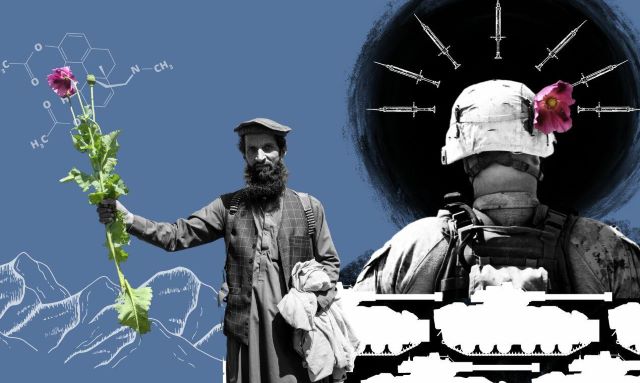
Alan Macleod – Mint Press News Aug 4, 2023
The Taliban government in Afghanistan – the nation that until recently produced 90% of the world’s heroin – has drastically reduced opium cultivation across the country. Western sources estimate an up to 99% reduction in some provinces. This raises serious questions about the seriousness of U.S. drug eradication efforts in the country over the past 20 years. And, as global heroin supplies dry up, experts tell MintPress News that they fear this could spark the growing use of fentanyl – a drug dozens of times stronger than heroin that already kills more than 100,000 Americans yearly.
The Taliban Does What the US Did Not
It has already been called “the most successful counter-narcotics effort in human history.” Armed with little more than sticks, teams of counter-narcotics brigades travel the country, cutting down Afghanistan’s poppy fields.
In April of last year, the ruling Taliban government announced the prohibition of poppy farming, citing both their strong religious beliefs and the extremely harmful social costs that heroin and other opioids – derived from the sap of the poppy plant – have wrought across Afghanistan.
It has not been all bluster. New research from geospatial data company Alcis suggests that poppy production has already plummeted by around 80% since last year. Indeed, satellite imagery shows that in Helmand Province, the area that produces more than half of the crop, poppy production has dropped by a staggering 99%. Just 12 months ago, poppy fields were dominant. But Alcis estimates that there are now less than 1,000 hectares of poppy growing in Helmand.
Instead, farmers are planting wheat, helping stave off the worst of a famine that U.S. sanctions helped create. Afghanistan is still in a perilous state, however, with the United Nations warning that six million people are close to starvation.
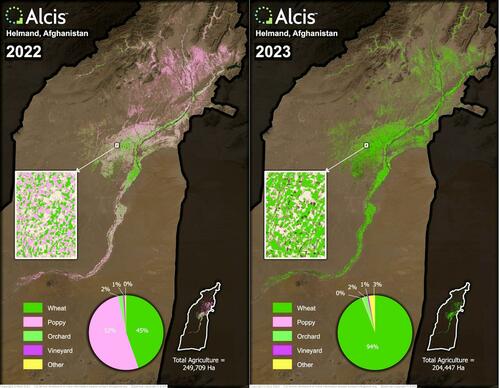
Afghan crops 2022 and 2023
The Taliban waited until 2022 to impose the long-awaited ban in order not to interfere with the growing season. Doing so would have provoked unrest among the rural population by eradicating a crop that farmers had spent months growing. Between 2020 and late 2022, the price of opium in local markets rose by as much as 700%. Yet given the Taliban’s insistence – and their efficiency at eradication – few have been tempted to plant poppies.
The poppy ban has been matched by a similar campaign against the methamphetamine industry, with the government targeting the ephedra crop and shutting down ephedrine labs across the country.
A Looming Catastrophe
Afghanistan produces almost 90% of the world’s heroin. Therefore, the eradication of the opium crop will have profound worldwide consequences on drug use. Experts MintPress spoke to warned that a dearth of heroin would likely produce a huge spike in the use of synthetic opioids such as fentanyl, a drug the Center for Disease Control estimates is 50 times stronger and is responsible for taking the lives of more than 100,000 Americans each year.
“It is important to consider past periods of heroin shortages and the impact these have had on the European drug market,” the European Monitoring Center for Drugs and Drug Addiction (EMCDDA) told MintPress, adding:
Experience in the E.U. with previous periods of reduced heroin supply suggests that this can lead to changes in patterns of drug supply and use. This can include further an increase in rates of polysubstance use among heroin users. Additional risks to existing users may be posed by the substitution of heroin with more harmful synthetic opioids, including fentanyl and its derivatives and new potent benzimidazole opioids.”
In other words, if heroin is no longer available, users will switch to far deadlier synthetic forms of the drug. A 2022 United Nations report came to a similar conclusion, noting that the crackdown on heroin production could lead to the “replacement of heroin or opium by other substances…such as fentanyl and its analogs.”
“It does have that danger in the macro sense, that if you take all that heroin off the market, people are going to go to other products,” Matthew Hoh told MintPress. Hoh is a former State Department official who resigned from his post in Zabul Province, Afghanistan, in 2009. “But the response should not be reinvade Afghanistan, reoccupy it and put the drug lords back in power, which is basically what people are implying when they bemoan the consequence of the Taliban stopping the drug trade,” Hoh added; “Most of the people who are speaking this way and worrying out loud about it are people who want to find a reason for the U.S. to go and affect regime change in Afghanistan.”
There certainly has been plenty of hand-wringing from American sources. “Foreign Policy,” wrote about “how the Taliban’s ‘war on drugs’ could backfire;” U.S. government-funded “Radio Free Europe/Radio Liberty” claimed that the Taliban were turning a “blind eye to opium production,” despite the official ban. And the United States Institute of Peace, an institution created by Congress that is “dedicated to the proposition that a world without violent conflict is possible,” stated emphatically that “the Taliban’s successful opium ban is bad for Afghans and the world”.
This looming catastrophe, however, will not hit immediately. Significant stockpiles of drugs along trafficking routes still exist. As the EMCDDA told MintPress:
It can take over 12 months before the opium harvest appears on the European retail drug market as heroin – and so it is too early to predict, at this stage, the future impact of the cultivation ban on heroin availability in Europe. Nonetheless, if the ban on opium cultivation is enforced and sustained, it could have a significant impact on heroin availability in Europe during 2024 or 2025.”
Yet there is little indication that the Taliban are anything but serious about eradicating the crop, indicating that a heroin crunch is indeed coming.
A similar attempt by the Taliban to eliminate the drug occurred in 2000, the last full year that they were in power. It was extraordinarily successful, with opium reduction dropping from 4,600 tons to just 185 tons. At that time, it took around 18 months for the consequences to be felt in the West. In the United Kingdom, average heroin purity fell from 55% to 34%, while in the Baltic States of Estonia, Latvia and Lithuania, heroin was largely replaced by fentanyl. However, as soon as the United States invaded in 2001, poppy cultivation shot back up to previous levels and the supply chain recommenced.
US Complicity in the Afghan Drug Trade
The Taliban’s successful campaign to eradicate drug production has cast a shadow of doubt over the effectiveness of American-led endeavors to achieve the same outcome. “It prompts the question, ‘What were we actually accomplishing there?!’” remarked Hoh, underscoring:
This undermines one of the fundamental premises behind the wars: the alleged association between the Taliban and the drug trade – a concept of a narco-terror nexus. However, this notion was fallacious. The reality was that Afghanistan was responsible for a staggering 80-90% of the world’s illicit opiate supply. The primary controllers of this trade were the Afghan government and military, entities we upheld in power.”
Hoh clarified that he never personally witnessed or received any reports of direct involvement by U.S. troops or officials in narcotics trafficking. Instead, he contended that there existed a “conscious and deliberate turning away from the unfolding events” during his tenure in Afghanistan’.
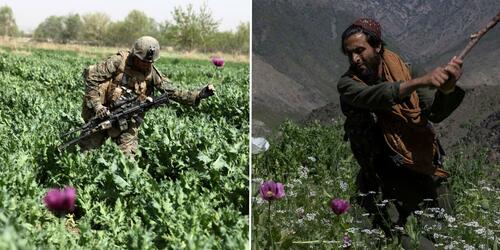
Left, a US Marine guards a poppy field in 2012 in Helmand Province. Right, a man breaks poppy stalks in a 2023 campaign targeting illegal drugs in Afghanistan.
Suzanna Reiss, an academic at the University of Hawaii at Manoa and the author of “We Sell Drugs: The Alchemy of U.S. Empire,” demonstrated an even more cynical perspective on American counter-narcotics endeavors as she conveyed to MintPress:
The U.S. has never really been focused on reducing the drug trade in Afghanistan (or elsewhere for that matter). All the lofty rhetoric aside, the U.S. has been happy to work with drug traffickers if the move would advance certain geopolitical interests (and indeed, did so, or at least turned a knowingly blind eye, when groups like the Northern Alliance relied on drugs to fund their political movement against the regime.).”
Afghanistan’s transformation into a preeminent narco-state owes a significant debt to Washington’s actions. Poppy cultivation in the 1970s was relatively limited. However, the tide changed in 1979 with the inception of Operation Cyclone, a massive infusion of funds to Afghan Mujahideen factions aimed at exhausting the Soviet military and terminating its presence in Afghanistan. The U.S. directed billions toward the insurgents, yet their financial needs persisted. Consequently, the Mujahideen delved into the illicit drug trade. By the culmination of Operation Cyclone, Afghanistan’s opium production had soared twentyfold. Professor Alfred McCoy, acclaimed author of “The Politics of Heroin: CIA Complicity in the Global Drug Trade,” shared with MintPress that approximately 75% of the planet’s illegal opium output was now sourced from Afghanistan, a substantial portion of the proceeds funneling to U.S.-backed rebel factions.
Unraveling the Opioid Crisis: An Impending Disaster
The opioid crisis is the worst addiction epidemic in U.S. history. Earlier this year, Department of Homeland Security Secretary Alejandro Mayorkas described the American fentanyl problem as “the single greatest challenge we face as a country.” Nearly 110,000 Americans died from drug overdoses in 2021, fentanyl being by far the leading cause. Between 2015 and 2021, the National Institute of Health recorded a nearly 7.5-fold increase in overdose deaths. Medical journal The Lancet predicts that 1.2 million Americans will die from opioid overdoses by 2029.
U.S. officials blame Mexican cartels for smuggling the synthetic painkiller across the southern border and China for producing the chemicals necessary to make the drug.
White Americans are more likely to misuse these types of drugs than other races. Adults aged 35-44 experience the highest rates of deaths, although deaths among younger people are surging. Rural America has been particularly hard hit; a 2017 study by the National Farmers Union and the American Farm Bureau Federation found that 74% of farmers have been directly impacted by the opioid epidemic. West Virginia and Tennessee are the states most badly hit.
For writer Chris Hedges, who hails from rural Maine, the fentanyl crisis is an example of one of the many “diseases of despair” the U.S. is suffering from. It has, according to Hedges, “risen from a decayed world where opportunity, which confers status, self-esteem and dignity, has dried up for most Americans. They are expressions of acute desperation and morbidity.” In essence, when the American dream fizzled out, it was replaced by an American nightmare. That white men are the prime victims of these diseases of despair is an ironic outgrowth of our unfair system. As Hedges explained:
White men, more easily seduced by the myth of the American dream than people of color who understand how the capitalist system is rigged against them, often suffer feelings of failure and betrayal, in many cases when they are in their middle years. They expect, because of notions of white supremacy and capitalist platitudes about hard work leading to advancement, to be ascendant. They believe in success.”
In this sense, it is important to place the opioid addiction crisis in a wider context of American decline, where opportunities for success and happiness are fewer and farther between than ever, rather than attribute it to individuals. As the “Lancet” wrote: “Punitive and stigmatizing approaches must end. Addiction is not a moral failing. It is a medical condition and poses a constant threat to health.”
A “Uniquely American Problem”
Nearly 10 million Americans misuse prescription opioids every year and at a rate far higher than comparable developed countries. Deaths due to opioid overdose in the United States are ten times more common per capita than in Germany and more than 20 times as frequent in Italy, for instance.
Much of this is down to the United States’ for-profit healthcare system. American private insurance companies are far more likely to favor prescribing drugs and pills than more expensive therapies that get to the root cause of the issue driving the addiction in the first place. As such, the opioid crisis is commonly referred to as a “uniquely American problem.”
Part of the reason U.S. doctors are much more prone to doling out exceptionally strong pain medication relief than their European counterparts is that they were subject to a hyper-aggressive marketing campaign from Purdue Pharma, manufacturers of the powerful opioid OxyContin. Purdue launched OxyContin in 1996, and its agents swarmed doctors’ offices to push the new “wonder drug.”
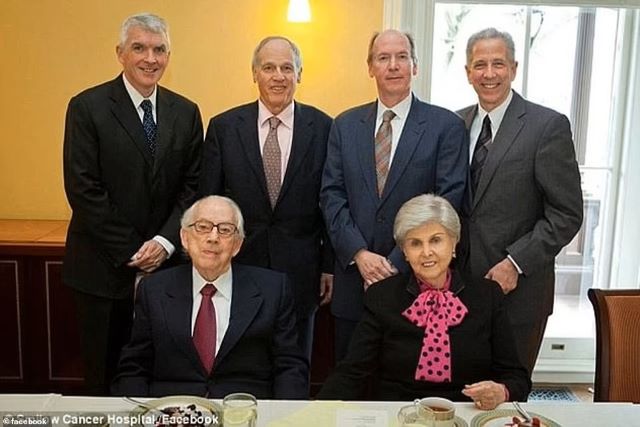
The Sackler family
Yet, in lawsuit after lawsuit, the company has been accused of lying about both the effectiveness and the addictiveness of OxyContin, a drug that has hooked countless Americans onto opioids. And when legal but incredibly addictive prescription opioids dry up, Americans turned to illicit substances like heroin and fentanyl as substitutes.
Purdue Pharma owners, the Sackler family, have regularly been described as the most evil family in America, with many laying the blame for the hundreds of thousands of overdose deaths squarely at their door. In 2019, under the weight of thousands of lawsuits against it, Purdue Pharma filed for bankruptcy. A year later, it plead guilty to criminal charges over its mismarketing of OxyContin.
Nevertheless, the Sacklers made out like bandits from their actions. Even after being forced last year to pay nearly $6 billion in cash to victims of the opioid crisis, they remain one of the world’s richest families and have refused to apologize for their role in constructing an empire of pain that has caused hundreds of thousands of deaths.
Instead, the family has attempted to launder their image through philanthropy, sponsoring many of the most prestigious arts and cultural institutions in the world. These include the Guggenheim Museum and the Metropolitan Museum of Art in New York City, Yale University, and the British Museum and Royal Academy in London.
One group who are disproportionately affected by opioids like OxyContin, heroin and fentanyl are veterans. According to the National Institutes of Health, veterans are twice as likely to die from overdose than the general population. One reason for this is bureaucracy. “The Veterans Administration did a really poor job in the past decades with their pain management, particularly their reliance on opioids,” Hoh, a former marine, told MintPress, noting that the V.A. prescribed dangerous opioids at a higher rate than other healthcare agencies.
Ex-soldiers often have to cope with chronic pain and brain injuries. Hoh noted that around a quarter-million veterans of Afghanistan and Iraq have traumatic brain injuries. But added to that are the deep moral injuries many suffered – injuries that typically cannot be seen. As Hoh noted:
Veterans are turning to [opioids like fentanyl] to deal with the mental, emotional and spiritual consequences of the war, using them to quell the distress, try to find some relief, escape from the depression, and deal with the demons that come home with veterans who took part in those wars.”
Thus, if the Taliban’s opium eradication program continues, it could spark a fentanyl crisis that might kill more Americans than the 20-year occupation ever did.
Broken Society
If diseases of despair are common throughout the United States, they are rampant in Afghanistan itself. A global report released in March revealed that Afghans are by far the most miserable people on Earth. Afghans evaluated their lives at 1.8 out of 10 – dead last and far behind the top of the pile Finland (7.8 out of 10).
Opium addiction in Afghanistan is out of control, with around 9% of the adult population (and a significant number of children) addicted. Between 2005 and 2015, the number of adult drug users jumped from 900,000 to 2.4 million, according to the United Nations, which estimates that almost one in three households is directly affected by addiction. As opium is frequently injected, blood-transmitted conditions like HIV are common as well.
The opioid problem has also spilled into neighboring countries such as Iran and Pakistan. A 2013 United Nations report estimated that almost 2.5 million Pakistanis were abusing opioids, including 11% of people in the northwestern province of Khyber Pakhtunkhwa. Around 700 people die each day from overdoses.
Empire of Drugs
Given their history, It is perhaps understandable that Asian nations have generally taken far more authoritarian measures to counter drug addiction issues. For centuries, using the illegal drug trade to advance imperial objectives has been a common Western tactic. In the 1940s and 1950s, the French utilized opium crops in the “Golden Triangle” region of Southeast Asia in order to counter the growing Vietnamese independence movement.
A century previously, the British used opium to crush and conquer much of China. Britain’s insatiable thirst for Chinese tea was beginning to bankrupt the country, seeing as China would only accept gold or silver in exchange. The British, therefore, used the power of its navy to force China to cede Hong Kong to it. From there, it flooded mainland China with opium grown in South Asia (including Afghanistan).
The effect of the Opium War was astonishing. By 1880, the British were inundating China with more than 6,500 tons of opium per year – the equivalent of many billions of doses. Chinese society crumbled, unable to deal with the empire-wide social and economic dislocation that millions of opium addicts brought. Today, the Chinese continue to refer to the period as the “century of humiliation”.
Meanwhile, in South Asia, the British forced farmers to plant poppy fields instead of edible crops, causing waves of giant famines, the likes of which had never been seen before or since.
And during the 1980s in Central America, the United States sold weapons to Iran in order to fund far-right Contra death squads. The Contras were deeply implicated in the cocaine trade, fuelling their dirty war through crack cocaine sales in the U.S. – a practice that, according to journalist Gary Webb, the Central Intelligence Agency facilitated.
Imperialism and illicit drugs, therefore, commonly go together. However, with the Taliban opium eradication effort in full effect, coupled with the uniquely American phenomenon of opioid addiction, it is possible that the United States will suffer significant blowback in the coming years. The deadly fentanyl epidemic will likely only get worse, needlessly taking hundreds of thousands more American lives. Thus, even as Afghanistan attempts to rid itself of its deadly drug addiction problem, its actions could precipitate an epidemic that promises to kill more Americans than any of Washington’s imperial endeavors to date.
Alan MacLeod is Senior Staff Writer for MintPress News. After completing his PhD in 2017 he published two books: Bad News From Venezuela: Twenty Years of Fake News and Misreporting and Propaganda in the Information Age: Still Manufacturing Consent, as well as a number of academic articles. He has also contributed to FAIR.org, The Guardian, Salon, The Grayzone, Jacobin Magazine, and Common Dreams
Also see:
Tony Blair was directly involved in several murders including Robin Cook
Dr David Kelly and even went between the royals and Lord Rothschold to have Princess Diana taken out to stop her anti land mine camign going to Palestine
This below shows Toerag-Tony is still involved with criminality
https://www.presstv.ir/Detail/2023/08/13/708848/Report-reveals-Tony-Blair-ties-Saudis-after-Khashoggi-murder
I doubt this is true, or not the quoted 90% in some areas. What has replaced opium in the Afghan economy?
The US Nazi regime didn’t just leave. Their departure came about after substantial negotiations. So the Taliban are following an agreed plan.
I live in York in the UK, we have the Army based here in York.
Ask a squadie, “What did you do in Afghanistan?” he will reply, “I stood and gaurded the poppy fields.”
Good article.
Given the awakening of many by the scamdemic and murder jabs, these older topics are worth reviewing. What might have seemed a trade that grew out of local growers can really be seen as a top down affair even more when compared with current events.
The international drug trade is not something the authorities try and crack down upon, it is “business as usual”. Custom searches and photographs of large captured drug cargoes are just there to catch the traders who are not unofficially licenced by the intelligences agencies, and to promote the idea to the public that TPTB are good “pet owners” to the people they regard with contempt.
TPTB regard ordinary folk as merely economic units — slaves, cannon fodder, or junkies — to abuse in any way they choose.
Like the death jab, it seems to me there is the monetary incentive for the middle to higher corporatocracy as well the social engineering aspect decided upon by the top of the pyramid. It is curious that when enormous wealth and power has been achieved, the main task of the oligarchics seems to be to play a dark game of chess in which control of humanity is more important than a flowering of humanity that might diminish their control.
***
With in the last ten years my local High Street has seen the emergence of beggars. They are always White. I’m told they are heroin addicts. I occasionally see some virtue signaller giving them money, “How good we are !” I’m told that everyone knows who the main street distributer is.
These druggies necessarily commit petty crimes, but the beneficiaries of the drug trade no doubt live in gated communities.
We might ask why the political will is not there to crack down on drugs locally. People with the means often move away from poorer neighbourhoods, and who can blame them. Who knows to what extent the more middleclass “evacuees” benefit from pension and investment portfolios that are tied into less savoury international commerce. I think it fair to say the biggest sufferers of the drug trade — both addicts and their neighbour victims — are less well to do. No man is an island. I often think of JB Priestly’s “An Inspector Calls”, which demonstrates how society as a whole might be culpable for a crime, or crimes, beyond our wit to understand.
Unlike in a Priestly play or a TV cops show, the police are a public relations stunt. The need to appear to act is more important than actually enforcing anything close to genuine law enforcement. Several posters have commented on police impotence. Well this impotence is by design. The police will be cognisant of this to degrees concomitant with their rank and masonic standing. They are all part of this top down shit show even if PC Plod himself starts his career acting in good faith.
The underclass of druggies creates demand for extended government do gooders — social services — in a BS Jobs, “make work” kind of way. More government means greater centralisation of power and so more control.
Fentanyl
OxyContin
Opioids
synthetic painkiller
In other words, if heroin is no longer available, users will switch to far deadlier synthetic forms of the drug.
_______________________________________________________
I don’t know what this drug is and why folk use it.
Pain killer, party drug, drug which makes you high, drug which makes you low?
America plans to ban all forms of antisemitism/antijewism but can’t take these shitty drugs off the street.
Oh I hear you tell me these drugs are legal; they are prescription drugs. Like the jib-jab then, killing and maiming lots of folk.
Aye, US forces definitely occupied Afghanistan to make sure poppies could be cultivated.
The Lancet demonstrated its untrustworthyness in denouncing Hydroxychloroquin as a treatment during the Covid “epidemic”. It is much less qualified in stating that heroine addiction is a medical problem rather than a moral one.
This is the exact reason, in India , manipur State, for the past 3 months, violence, murder, rape, arson, burnt houses etc , opium, poopy cultivated in the fertile lands of Manipur, around 15,000 acres. Next to Afghanistan, manipur harvests marijuana, opium for the rest of the world. Burma, Bangladesh refugees were involved in cultivation and distribution through Myanmar/Thailand, it goes to Europe , Asia. Government forces destroyed more than 10,000 acres and killed hundreds of rebels, drug peddlers. It was a multi billion dollar business. Missionary /churches are all behind this. When the Government began destroying opium, poppy cultivation , war, violence started.
“What was the US doing all along there?” We worked closely with the drug and war lords, keeping its people there from growing tomatoes. Our proud and great military had bases all along the drug route , headed towards distribution points in Yugoslavia, and finally to the ultimate consumer in the americas, while defending our democracy and values. When the taliban returns to power, as it has several times, it begins to delete the option fields and lets their farmers return to grow food.
What was the U.S. “government” doing? Profiteering, racketeering, smuggling, laundering money and making its “subjects” miserable and endure tyrants “creating” problems to exploit their citizens. Does that sum it up? THE ONLY WINNING MOVE IS TO NOT PLAY THEIR GAMES! Jesus LIVES!!!!!
“This raises serious questions about the seriousness of U.S. drug eradication efforts in the country over the past 20 years.”
“Raises serious questions”, give me a break. When the Russians were in there, the opium production continued with the same protection the Americans gave it, and Russian mobs expanded all over the world. The Taliban eradicated the heroine trade for a time when when they were free of both the Russians and the Americans. When the Americans went back in the first thing they did was to restore the industry – one of the reasons they went back in.
Now that the poppy industry is shut down in Afghanistan coincidentally you find that fentanyl, which is a potent synthetic opioid drug, has virtually replaced heroine in the streets of our cities. We are told that it is being manufactured in China and being smuggled into our nations, which may be true, but major drug companies also manufacture loads of it, as they also continue to manufacture heroine and other opiates form various other sources. The alleged “illegal” trade is at lease a $450,000 billion-dollar-a-year industry, with the top echelons “made” and the trade protected by our true-blue authorities and by our governments. The purpose of legalizing it, is the same as with marijuana, and only really for taxation purposes, and not really to get people off of the junk.
leaked document shows the UK is on the point of collapse due to government people trafficking in of migrants
https://www.youtube.com/watch?v=cBavgBQxsOU
@Carl Jones
“I doubt this is true, or not the quoted 90% in some areas. What has replaced opium in the Afghan economy?”
A partial reason maybe that there is an oversupply. In my reading of Lyndon Larouche’s “Dope Inc”, he asserts that opium was produced far in access of “requirements”, and that the steady price of the drug was indicative of an organised top down market. He made comparison with the diamond monopoly.
Larouche describes when great shows of burning opium “hauls” have been made to kill two birds with one stone: to remove surplus and to show “something is being done about it”. So maybe the Taliban have sufficient warehousing of existing supplies if their actions are not genuinely motivated.
@Surya
An insightful post.
The organised Church has always been the supreme hypocrite in matters of political economy.
The ex-head of HSBC Stephen Green, clobbered for billions of money laundering in Mexico, was made a baron and sits in the House of Lords. While turning more than a blind eye, he doubled as an ordained vicar and has preached in church on Sundays. To call these people scum is an insult to real scum. This paragon of virtue has remined untouched. His Mexican drug smuggling counterpart was responsible for the torturing and deaths of many.
https://en.wikipedia.org/wiki/Stephen_Green,_Baron_Green_of_Hurstpierpoint
(That’s what a true psychopath looks like. Here is a partial entry from the above link:
‘Green is an ordained priest in the Church of England, having studied theology at Manchester University’s Northern Ordination course while in Hong Kong, and he is the author of the book “Serving God? Serving Mammon?” He has since described the book as “out of print and out of date”. During his time as a senior banking executive, he was known to compose his sermons while travelling around the world on business.’ )
Money laundering seems to be the mains business of HSBC since it was set up to handle the opium business in the far east.
I can understand why very poor people cultivate the poppies. TPTB can decide from time to time it is illegal depending on market conditions. Something TPTB couldn’t do with carrots and potatoes.
…and another thing about the international drugs trade is that despite the old cold war and presumably the new, business between the “Communist” bloc and “Capitalist” bloc went ahead while the theatre of the “space race”, “arms race”, and the bugging of each other’s embassies titillated the masses in the newspapers.
I have posted many times the indicators that the west and east are in lockstep with each other. Football matches and the “war in Ukraine” are just distractions that provide the façade of nation states being “a thing”…
There is a global governance of sorts predicated on international trade, legal and illegal, presided over by the banksters. This is the reality.
The banks need doped up sheeple to live, they don’t want them on more deadly drugs. Don’t kill the idiot who pays you.
https://duckduckgo.com/?q=us+soldiers+in+aghanistan+poppy+fields&t=ffab&atb=v387-2__&iar=images&iax=images&ia=images
https://ichef.bbci.co.uk/news/2048/cpsprodpb/136E5/production/_106598597_afghan_opium_chart-nc.png
LONDON HAS FALLEN
for several thousand years Britain
fought invading armies
yes since 1945 the government has been importing them in
there was no drug problem before black people came
the metropolitan police say drugs are behind the clash of jamaican and eastern european gangs
what are they doing here ?
ship them all back, and drug problem solved
PS take that twat carl jones when you go
Joe Vialls, when he was alive (before 2007) , told us the exact same thing about the Taliban ordering all farmers to stop growing opium; they had enough authority to be obeyed very quickly. I also heard some British Army people talking about what Afghans could do instead of growing the drugs, that something should be suggested
Simon Snith: I agree, it must be rigged, but all the same, banks need their cash, and they need it more than ever.
We don’t know it drug catches are real, or if they are destroyed.
In France (I don’t use it) you can legally buy weed, and you pay VAT on it. Just keep the original packet and receipt if you get stopped.
Nazi UK are a long way from doing this, because it’s a light touch system in the UK, and the Nazi regime doesn’t want to damage organised crime markets, their income, and a major part of the banking business.
There’s a huge drugs business in London. Weed is openly smoked on the streets, and you are constantly getting the whiff. The Nazi police are more interested in protecting organised crime. It’s one big circular racket. Everyone is involved.
“What was the US actually doing in Afghanistan?”
“Hey! Don’t nod out! I axed you a question!”
Simon Smith appears to have the right pulse on this one in everything he says. Power corrupts and the more powerful a nation or any organization, or person, the more corrupt they generally are. The cold war was the greatest protection racket every conducted and the war in the Ukraine has reinvigorated that business for the money lords and ladies of the planet. Some may think that the globalist movement will end the corruption of nations with plans to transfer national powers over the military, natural resources, production, distribution and personal wellbeing to a more centralized global government. However, the UN, the WEF, the WTO, and the WHO are all instruments created by the most corrupt plutocrats and organizations on the globe, by those whom in their own estimations have outgrown any national restraints.
The Rothschild’s are working for a centralized world currency with money creation and credit powers under the controls of their networks, to dominate virtually everything. Should the either global or national establishments become moral and not control crime to reap the rewards the way they do, they fear criminal competition would rise up and get the upper hand over their own demonic legions. Hence, everywhere you go you have governments and the local authorities either on the take or turning a blind eye to organized crime, all of whom are under the thumb of the same international banking cartel.
Afganistan was Heroin producer for CIA
since they abandoned Opium triangle
Thailand, Burma, Laos, lost after Nam war .
all blacks+white addicts in USA should notice
that they always financed the CIA-Heroin-
cash box for their hidden operations abroad
inclusive financing CIA terrorist groups .
consuming Heroin/Cocaine is not only sin
against own body + finances, its also sin
against rest of the world . CIA+ Mossad have
no remorse, neither Pentagon .
@ FRED B
YES ! there was once negro woman singing
the rhyme : There will be no government .
stupid ! there will always be a government .
if it is not islamic or jewish WEF/NWO by
Rothschild mafia , it will always be another
mafia . so, Rothschild prepares his empire .
What is clear is that the good guys are in fact the bad guys, and many are recognising it. Don’t worry, I have not the slightest doubt they will every one of them be hunted down and dealt with. They are starting to panic because they know they can’t stop this now. It may well start with my blood in the street, but rivers of theirs are coming. AND THY KNOW IT!