
Introduction – Feb 7, 2023
From the outset of war the Western mainstream media has been acting as a cheerleader for the Zelensky regime. In particular the New York Times (NYT), which had performed a similar function in the run-up to the 2003 invasion of Iraq, is doing exactly the same. With articles like those linked below it has promoted the idea that Ukraine could actually prevail against Russia.
Why Ukrainians Believe They Can Win
Ukraine Defeats Russian Drone Swarm, as NATO Head Says Kyiv Needs More Arms
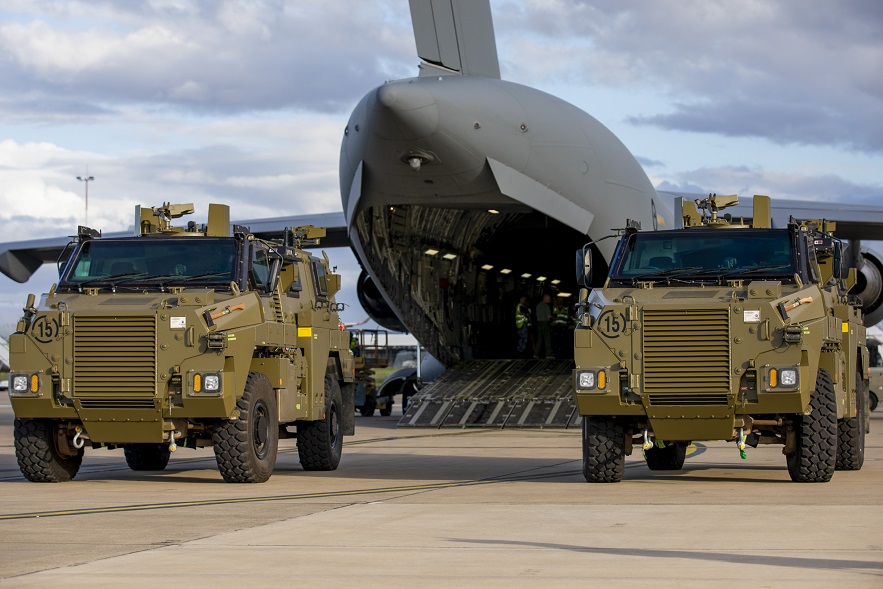
Two Bushmaster protected mobility vehicles bound for Ukraine wait to be loaded onto a C-17A Globemaster III aircraft at RAAF Base Amberley, Australia, Thursday, April 7, 2022. (LACW Emma Schwenke/Royal Australian Air Force via AP)
As a result the West has supplied Ukraine with billions of dollars worth of military hardware with barely murmur of public protest. Despite facing a dire economic outlook the West has dug deep and managed to provide Ukraine’s armed forces with training, intelligence and huge amounts of weaponry.
In effect the West has fuelled this war, with money, with military hardware and where necessary, with threats. So that when Ukraine signalled it was ready to negotiate with Moscow with possible face-to-face talks between Zelensky and Putin, Boris Johnson rushed to Kiev to warn Ukraine’ president against any such meeting.
This only adds credence to the Kremlin’s claims that the West was using Ukraine as a proxy in an effort to weaken and undermine Russia.
While genuinely independent commentators were voicing doubts about Ukraine’s ability to overcome Russian forces, the New York Times persisted in portraying Ukraine’s chances as optimistically as possible. Minimising setbacks it suffered and highlighting whatever gains Kiev’s forces made.
Russia’s Retreat From Kherson Brings Ukraine One Step Closer to Victory
How Ukraine Gained Momentum Against Russia and Took a Critical Hub
The two links above were from late last year and the New York Times was still doing this even as Russia prepared for its latest offensive. All the while it has pointedly played down Ukrainian casualties, which are now growing to truly horrific proportions.
According to former US Marine Intelligence officer and UN weapons inspector Scott Ritter, Ukraine has sustained around SEVENTY THOUSAND CASUALTIES in the battle for Bakhmut.
Those figures are only for Bakhmut. Elsewhere, unconfirmed reports have suggested that Ukrainian casualties are now nearing a QUARTER OF A MILLION overall. This is obviously unsustainable so now even the New York Times is being forced to change its tune.
This is not to detract from the bravery of Ukraine’s soldiers but they are being deceived. In fact this whole war is based on deception and crucial to that deception are Western politicians, corrupt Ukrainian leaders and a complaint Western mainstream media. Ed
Outnumbered and Worn Out, Ukrainians in East Brace for Russian Assault
Michael Shwirtz – New York Times Feb 6, 2023
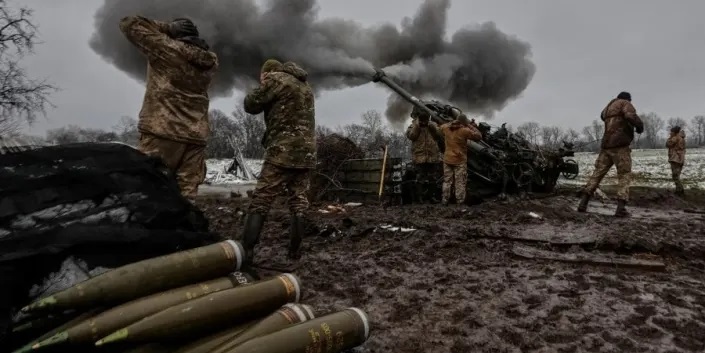
In a tiny village in eastern Ukraine at the epicenter of the next phase of the war, Lyudmila Degtyaryova measures the Russian advance by listening to the boom of incoming artillery shells.
There are more and more of them now. And they are coming more frequently, as Russian troops grind their way forward.
“You should see the fireworks here,” said Degtyaryova, 61, as the sounds of artillery howled all around. “It is like New Year’s.”
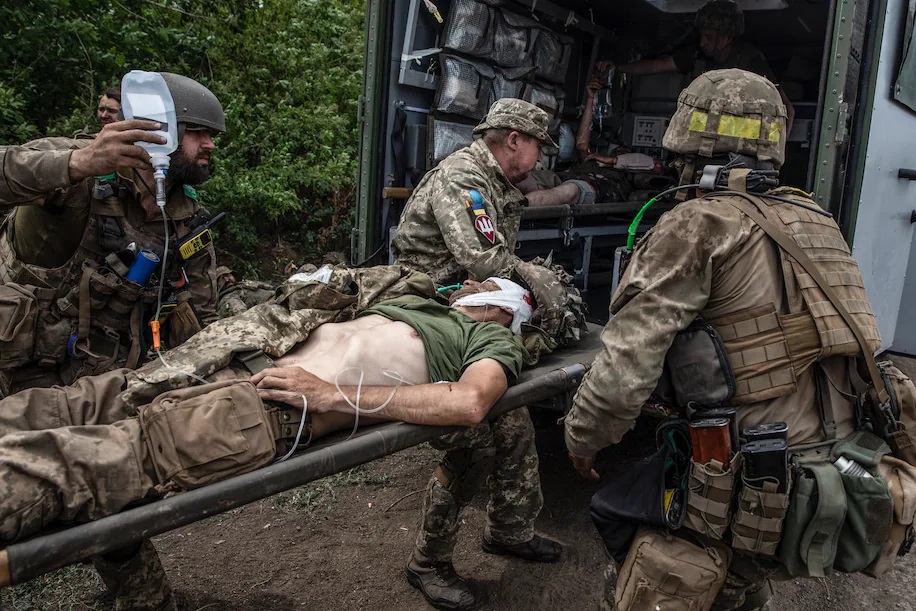
Some of the lucky Ukrainian wounded. Many are simply being left to die on the battlerfield. Click to enlarge
Russia’s military is preparing to launch a new offensive that could soon swallow Degtyaryova’s village of Nevske, and perhaps much more in the eastern Ukrainian region known as the Donbas. But already the impact of Russia’s stepped-up assault is being felt in the towns and villages along the hundreds of miles of undulating eastern front.
Exhausted Ukrainian troops complain they are already outnumbered and outgunned, even before Russia has committed the bulk of its roughly 200,000 newly mobilized soldiers. And doctors at hospitals speak of mounting losses as they struggle to care for fighters with gruesome injuries.
The civilians standing in the way of Russia’s planned advance once again face the agonizing decision of whether to leave or to stay and wait out the coming calamity. This area in the northern Donbas was among the last to be liberated in a Ukrainian blitz offensive last fall that raised hopes among local residents that their months of trauma were over.
But the war has come back. Two weeks ago, a Russian shell landed in Degtyaryova’s yard, and as she contemplated her future over the weekend, the remains of her barn still smoldered.
She has rabbits, ducks and three pregnant cows to care for. A chicken, its feathers partly burned off in the recent strike, lay recovering in a bed of hay, its small injured foot in a homemade cast.
If the Russians come back, she lamented, she’ll have to flee.
“I’ve started to pack my things, if I’m being honest,” she said. “The soldiers will cover my back and I will leave. I’ll let my cows out and I’ll go. I don’t want to go back there.”
When and where the new offensive will begin in earnest is still unclear, but Ukrainian officials are gravely concerned. Ukraine’s military defied dire assessments before the war, thwarting Russia’s early efforts to seize the capital, Kyiv, and eventually driving Russian forces back in the northeast and south.
But the Russian military just keeps coming. Right now, the newly mobilized troops are finishing their training and entering the field; the forces include as many soldiers as took part in the initial invasion last year.
They could be ready to fight in as little as two weeks, said Serhiy Haidai, the governor of the Luhansk region, which includes Nevske — much sooner than new Western weapons, including tanks and heavy armored fighting vehicles, are expected to arrive in Ukraine.
“There are so many,” Haidai said of the new recruits. “These are not professional soldiers, but it is still 200,000 people who are shooting in our direction.”
Russia is expected to punch hard, looking to reverse nearly a year of cascading failure. While a renewed attack on Kyiv is now considered improbable, Russian forces will likely try to recover territories they lost last fall. as well as take full control of the Donbas, a key objective of Russian President Vladimir Putin.
Military analysts say that one likely scenario would be for Russian forces to swing down from the north and up from the south in an arc, creating a large claw that would cut off Ukrainian supply lines running east and west. That would put villages like Nevske in the direct path of Russia’s likely advance.
For locals it would be a disaster. Out here at the far edge of Ukraine’s offensive, people have not experienced the fruits of liberation the way Ukrainians farther west have. There is still no power or water and the fighting has never subsided. Fields of black unharvested sunflowers are pocked with snow-filled craters, and the area is littered with burned-out tanks and unexploded ordnance and mines that frequently kill livestock. Passing through the region, one occasionally comes across their frozen bodies or bones.
In Makiivka, just north of Nevske, five of Ruslan Vasilchenko’s cows have been killed, and those that remain were huddled on a recent day in a tiny barn that had been spackled with shrapnel. There was a burned tank in his garden and two destroyed cars in his courtyard. He said he expected things would get much worse soon.
“Over the last few days, the soldiers have come by to tell us not to leave our homes,” he said.
The first stages of the Russian offensive have already begun. Ukrainian troops say that Bakhmut, an eastern Ukrainian city that Russian forces have been trying to seize since the summer, is likely to fall soon. Elsewhere, Russian forces are advancing in small groups and probing the front lines looking for Ukrainian weaknesses.
The efforts are already straining Ukraine’s military, which is worn out by nearly 12 months of heavy fighting.
Troops say they have tanks and artillery pieces, but not enough of either, and have far less ammunition than their adversaries. Russian forces have also started to field more sophisticated weaponry, such as the T-90 tank, which is equipped with technology capable of detecting the targeting systems of anti-tank weapons like the U.S-made Javelins, limiting their effectiveness.
Mostly, though, the challenge comes down to numbers.
“It’s particularly difficult when you have 50 guys and they have 300,” said a 35-year-old infantry soldier named Pavlo, who was struck in the eye with a piece of shrapnel from a rocket-propelled grenade near Bakhmut. “You take them out and they keep coming and coming. There are so many.”
Losses among Ukrainian forces have been severe. Troops in a volunteer contingent called the Carpathian Sich, positioned near Nevske, said that some 30 fighters from their group had died in recent weeks, and soldiers said, only partly in jest, that just about everyone has a concussion.
The NWO authorities have long wanted to clamp down on Richard D Hall
and his whistlebower site
they are trying to shut him up bankrupt him and put him in prison
he needs our support
https://www.christopherspivey.co.uk/2022/12/24/thank-me-later/
Hezbollah the main group trying to stop israeli terrorism
are the prime helpers for the earthquake
i take my hat off to these guys
like adolf hitler they fight the jews for us
yes you me and our children
https://www.presstv.co.uk/Detail/2023/02/08/697805/Hezbollah-decries-bias-against-Syria-sends-aid-convoys-quake-hit-areas
“This only adds credence to the Kremlin’s claims that the West was using Ukraine as a proxy in an effort to weaken and undermine Russia”.
The UK has been running a secret war against Russian since Putin took power, or shortly after he took power. The 2008 designed financial collapse was to weaken China and Russia.
They started currency wars, illegal sanctions, and trade wars, all to prevent Chinaes and Russian economic success.
The 2014 coup in UKraine and the NATOisation of UKraine with the intent to massacre Russian speakers in the Dombas and retake Crimea, is just the same policy that was started in ernest in the early noughties.
While the NWO Nazi sect can’t win in UKraine, they can keep the economic pressure on Russia. Even if Russia goes right upto the Polish border, Russia will face a Gladio style campaign and special forces ops in UKraine.
The move towards carbon neutrality is not about the environment or claimed anthropogenic climate change, it is about reducing Russias carbon markets.
The UK is about to bring coal fired power stations back into service, because the sun doesn’t always shine, and God does have days when he doesn’t eat sprouts.
The NWO Nazi sect also has the added bonus that while they planned all which has come to pass, they didn’t give a toss about the thicko sheeple suffering, that’s because the suffering is just another control mechanism.
Where are the peace protestors? I’ve some times been called an ‘armchair warrior’, now you know why. Just think, I had the benefit of not mixing with regime agents.
The rising Costs of UK living is dreadful. Shops everywhere are closing.
Had my hair done yesterday think I was well overcharged.
My electricity and gas bills have tripled.
My niece Kirsty commented re her household bilsl are
and scary expensive on Facebook many other commented about the shockingly high bills they were also facing.
Food costs up by a 3rd.
Strikes everywhere, even Brighton schoolboy rent boys are out.
Now attempts by powers that be to do away with free prescriptions and charge for GP visits.
everything is costing more, folk say we have to pay for all these toerag migrants some how
why do we ?
Well its foggy this morning hopefully we will have sunshine this afternoon. That will save money. Sunshine is warming.
Schwirtz and his tribe are primarily responsible for this catastrophe but since it is the goyim who are doing the dying he couldn’t care less.
Zelensky arrives in the UK today but I can’t help wondering is this him already fleeing Ukraine? It would be so easy to say in a few days time it’s too unsafe for him to return.
Among the patriotic, rank-and-file Ukrainian soldiers, desertions and mutinies are rising faster than casualties…
The mercenaries are pretty much running the show on the ground within a NATO hierarchy.
The perpetrators are so ravenously phobic of the truth—-after a century of malignant lying—-that they will likely backdown to keep the truth from coming out to the mindless masses…
They will likely pivot to the coming fraud of war-with-China because the CCP has already agreed to this—-reflecting the lie of WW2 and the Cold War—-as a condition to receiving the world’s manufacturing base and owning most of America’s debt.
Yahoo news! Well, at least Russia is not ‘losing the war’ any more. But the poor, exhausted, under-dressed and under-equipped Ukrainians are still killing more Russians than the latter are killing them. Of course. How can it be otherwise in the neo-Con world?
@EDITOR
NATO = ZOG
Russia = ZOG
Both ‘sides’ are governed by the same Central Bank consortium of anti-white Jews pretending to be ‘enemies’–so they can setup the Slavo-Germanic masses of Ukraine in a new Holodomor, as part of the ZOG-WEF Global White Population Reduction Program.. Now you know.
“This is not to detract from the bravery of Ukraine’s soldiers but they are being deceived. In fact this whole war is based on deception and crucial to that deception are Western politicians, corrupt Ukrainian leaders and a complaint Western mainstream media. Ed”
What really matters is what was written in the first part.
According to youtube prepper Pinball Preparedness, China is introducing a draft which he says is its first ever. I think he and his viewers blamr Chinese aggression, which for a prepper site shows a complete lack of awareness if they cannot see it’s their own country setting all these fires worldwide.
I am not convinced that the WEF and all the other ‘alphabet dingbats’ and associated peeples are capable of managing everything from pandemics, climate change, converting the human race into bug eaters let alone organising a proverbial ‘piss-up in a brewery’!
When you have to lie, threaten or bribe your sheeple to get things done and that thing cannot exhibit or reflect truth then you have a problem, and by God do they have problems now that the sheeple have begun to wake across the world.
Overstretching credibility provides chinks in the armour which are growing daily and the net result is one of disbelief and mistrust, added to which the huge mix of reality that is the world and you begin to see through the lies, hype and fear…
Buckle up folks, could be a stormy ride from hereon, remember to duck and cover if you see a ‘balloon’ or flash in tbe sky.
The dire situation is of no surprise, it is the inevitable outcome when Putin made the decision to act against the Ukrainian Neocon Jewish ZOGUSA ZOGUK evil. Jewish propagandists live in their own fairyland world of make believe, they never thought Putin had the balls to invade. But he did, and now the world watches in horror another huge war that can only lead to a Russian victory.
And thus, if you pay attention, the stupid China balloon shoot down distraction followed immediately by the Turkey earthquake – which itself could of been done by a Tesla earthquake machine and was intentional to distract us. How do we know there was a big white balloon over Montana? Did you see it yourself? No? Prove it real then.
Jewess manipulator Victoria Nuland’s dream of a great Khazar new Israel is being crushed and ground into bits by the advancing mother Russian army that can keep this going for decades. This advance may never be a Blitzkreig as some of us hoped, it may be like a giant rototiller just grinding everything in it’s path into the earth. Ukraine will probably fall this year, it will be the new buffer zone between globohomo Jew west and Christian Russia. The Russians are probably in the process of absorbing Ukraine as a strategic capture, all the grain growing lands and the southern sea port. Why would they give it back?
BTW who gives a shit about what the New York Times says? You keep them alive by even mentioning their name. The NYT is pure Jewish evil propaganda, and all that work there should be held accountable for their endless lies, found guilty by military tribunal, then put up against the wall and executed live on Fox News.
How soon does this little gay demon puppet actor Zelensky flee Kiev on a one way ticket? Will he be brought to the UK to live in exile while the media spins him as the rightful leader of Ukraine? Probably.
All of this horror is just the latest chapter in hell, prison planet earth.
when will we start killing MPs ?
how long does sheeples patience last ?
@’ praetorian gourd on February 8, 2023 at 10:22 am
Zelensky arrives in the UK today but I can’t help wondering is this him already fleeing Ukraine? It would be so easy to say in a few days time it’s too unsafe for him to return.’
Interesting thought! It made the proverbial penny drop for me. I watched two videos about Zelenski in Parliament. : the first in which the parliamentarians of the House of Commons , sitting in parliament in the usual way, are listening to Zelensky address them by video. But this video has now disappeared, to be replaced by this one:
https://www.google.com/search?client=firefox-b-d&q=Zelensky+House+of+Commons+English&sa=X&ved=2ahUKEwiknvHmhIf9AhUY7rsIHY5JDw4Q1QJ6BAgbEAE&biw=1120&bih=510&dpr=1.71#fpstate=ive&vld=cid:c0c6ec87,vid:JAdUXFoLJYQ ,
in which the Speaker advises that both Houses are sitting in the House of Commons.
(One thing deserves big accolade: Zelenski was not allowed on the floor of the House of Commins. !Instead, he addressed the Commons by video, and stammered out a dripping wet load of platitudes that are not worth reflecting on.)
There was clapping in the House of Commons in the first/now disappeared video I watched. The Commons was not unusually crowded. It was just the ordinary-looking full House we occasionally see. So they were not crowd enough to produce the clapping tsunami that made itself heard. I strongly suspect that this was ‘canned’ clapping , not an actual event of it.
The House of Commons parliamentarians were then invited to retreat to Westminster Hall, where Zelenski was waiting for them. He stammered out what we had already heard in his video address of the Commons. There was a crowd in the Hall, or so it seemed:
https://www.google.com/search?client=firefox-b-d&q=zelensky+in+parliament+new+statesman+video#fpstate=ive&vld=cid:016c4398,vid:O5xSa3R0Z78.
But, as in the disappeared video, we see clearly only of the first row of the crowd. Did all the Commons people really come into the Hall, or had most of them vamoosed, and what we saw was a fake crowd, and what we heard was another instance of ‘canned’ clapping?
Also, the Speaker and another chap were sitting behind the standing and speechifying Zelenski. And when the Speaker clapped at the former’s pauses, he did it with his hands cupped. That was odd, and well out of keeping the ‘crowd’s’ canned-sounding clapping.
Are these videos, or whatever their current versions are, meant to ‘prove’ that Zelenski is in parliament, when all the while he is elsewhere, perhaps being hidden in preparation for the announcement that it is not safe for him to return to Ukraine ? Why the apparent messing about with the video versions?
(It is almost midnight. I bet I won’t be able to sleep, for this line of speaking is keeping me in thrall. I hope for helpful comments.)
@nicoX
fighting to the last ukrainian for the khazarian mob…
https://www.scribd.com/document/319753865/Israels-Secret-Plan-for-a-Second-Israel-in-Ukraine
“Set-up” and “backdown” would be nouns, and “could of” is non-existent