
– Yahoo News Jan 27, 2022
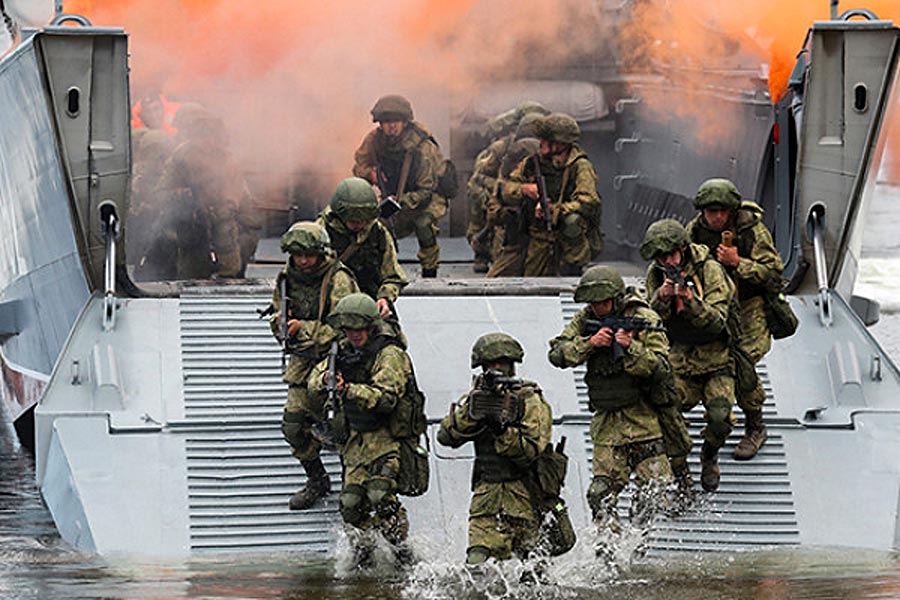
Russian marines. Click to enlarge
In the early years of Vladimir V. Putin’s tenure as Russia’s leader, the country’s military was a hollowed-out but nuclear-armed shell.
It struggled to keep submarines afloat in the Arctic and an outgunned insurgency at bay in Chechnya. Senior officers sometimes lived in moldy, rat-infested tenements. And instead of socks, poorly trained soldiers often wrapped their feet in swaths of cloth, the way their Soviet and Tsarist predecessors had.
Two decades later, it is a far different fighting force that has massed near the border with Ukraine. Under Mr. Putin’s leadership, it has been overhauled into a modern sophisticated army, able to deploy quickly and with lethal effect in conventional conflicts, military analysts said. It features precision-guided weaponry, a newly streamlined command structure and well-fed and professional soldiers. And they still have the nuclear weapons.

A still from a Russian government video shows the Kinzhal hypersonic missile detaching from a MiG-31 aircraft. Some units of the Russian Air Force have already been equipped with hypersonic weapons. This is in cntrast to the US, which still doesn’t have any hypersonic weapons in sevice. Click to enlarge
The modernized military has emerged as a key tool of Mr. Putin’s foreign policy: capturing Crimea, intervening in Syria, keeping the peace between Armenia and Azerbaijan and, just this month, propping up a Russia-friendly leader in Kazakhstan. Now it is in the middle of its most ambitious — and most ominous — operation yet: using threats and potentially, many fear, force, to bring Ukraine back into Moscow’s sphere of influence.
“The mobility of the military, its preparedness and its equipment are what allow Russia to pressure Ukraine and to pressure the West,” said Pavel Luzin, a Russian security analyst. “Nuclear weapons are not enough.”
Without firing a shot, Mr. Putin has forced the Biden administration to shelve other foreign policy priorities and contend with Kremlin grievances the White House has long dismissed — in particular reversing Ukraine’s Westward lean in the post-Soviet period.
It is Mr. Putin’s highest-stakes use of the military to muscle Russia back into the global relevance it lost with the ending of the Cold War. Mr. Putin laid out that doctrine in 2018, when he used his annual state-of-the-nation speech to unveil new nuclear weapons that could fly 20 times the speed of sound.
“No one listened to us,” Mr. Putin said in his address, which included a video simulation showing a Russian missile heading toward the United States. “Listen to us now.”
Today, it is the overhaul of the conventional forces that has provided leverage in the Ukraine crisis.
The T-72B3 tanks amassed on Ukraine’s border have a new thermal optics system for nighttime fighting as well as guided missiles with twice the range of other tanks, according to Robert Lee, a U.S. Marine Corps veteran and Ph.D. candidate at King’s College in London, who is a Russian military expert. Kalibr cruise missiles deployed on ships and submarines in the Black Sea and Iskander-M rockets arrayed along the border can hit targets just about anywhere inside Ukraine, Mr. Lee said.
In the last decade, the Russian air force has acquired more than 1,000 new aircraft, according to a 2020 article by Aleksei Krivoruchko, a deputy defense minister. This includes the country’s most advanced fighters, the SU-35S; a squadron of these has been deployed to Belarus ahead of joint military exercises next month.
The new capabilities were evident in Russia’s intervention in Syria in 2015. They were not only effective, but caught some in the U.S. military off guard.
“I’m embarrassed to admit, I was surprised a few years ago when Kalibr missiles came flying out of the Caspian Sea, hitting targets in Syria,” said Lt. Gen. Ben Hodges, the former commander of the U.S. Army in Europe. “That was a surprise to me, not only the capability, but I didn’t even know they were there.”
Kremlin thinking has also evolved over the size of the armed forces. The military relies less on a dwindling number of conscripts and more on a slimmed-down, well-trained core of roughly 400,000 contract soldiers.
These soldiers receive better treatment. Visiting the Defense Ministry in December, Mr. Putin boasted that the average lieutenant now made just over the equivalent of $1,000 per month, better than the average salary in other sectors. The federal government, he added, was spending about $1.5 billion on subsidizing private housing for service members.
And all Russian soldiers are now required to be deployed with thick, military issued socks.
What is new is not just Russia’s upgraded equipment, but the evolving theory of how the Kremlin uses it. The military has honed an approach that Dmitry Adamsky, a scholar of international security at Reichman University in Israel, calls “cross-domain coercion” — blending the real or threatened use of force with diplomacy, cyberattacks and propaganda to achieve political aims.
That blended strategy is playing out in the current crisis around Ukraine. Russia is pushing for immediate wide-ranging concessions from the West. Russian troop movements into allied Belarus put a potential invasion force within 100 miles of Kyiv, the Ukrainian capital. Russian state media is warning that Ukrainian forces are the ones preparing acts of aggression.
And on Jan. 14, hackers brought down dozens of Ukrainian government websites and posted a message on one stating, “Be afraid and expect the worst.”
“You see some cyber, you see diplomacy, you see military exercises,” Mr. Adamsky said. “They are all related by design.”
Not all the forces arrayed along the Ukrainian border are Russia’s most advanced. The ones amassed in the north have older weaponry and are mostly there to intimidate and stretch Ukrainian resources, said Oleksiy Arestovych, a former Ukrainian military intelligence officer who is now a political and military analyst.
The more well-equipped and modernized units, he said, have moved into the area close to two breakaway provinces in Ukraine’s east, where Russia instigated a separatist war in 2014 that continues today.

A Zircon hypersonic missile is launched from Russian Navy frigate Admiral Gorshkov. Click to enlarge
Russia’s military modernization is also, increasingly, meant to send a message to the United States, projecting power beyond Eastern Europe, frustrating and sometimes surprising American officials.
It took Russia’s military transport planes only hours, for instance, to start ferrying about 2,000 Russian peacekeeping troops, along with heavy armor, to the Southern Caucasus after Mr. Putin brokered an end to the 2020 war between Azerbaijan and Armenia.
In Syria, where Russia intervened in 2015 using devastating airstrikes and limited ground troops to protect President Bashar al-Assad, Russia’s advancements showed it could effectively deploy precision-guided weaponry, long an edge that Western armed forces had held over Russia.
Russia used the war in Syria, experts say, as a laboratory to refine tactics and weaponry, and to gain combat experience for much of its force. More responsibility was delegated to lower-level officers, a degree of autonomy that contrasts with the civilian government structure in the Putin era. Defense Minister Sergei K. Shoigu said last month that all ground troop commanders, 92 percent of air force pilots and 62 percent of the Navy had combat experience.
“They showed to themselves and the whole world they are able to wage large-scale operations with precision weapons, and long-range weapons, and intelligence capability to support it,” Mr. Adamsky, the expert based in Israel, said.
For all its strides in recent years, Russia’s military retains a critical weakness of its Soviet predecessor: the civilian side of the country’s economy, nearly devoid of high-tech manufacturing and corporate investment in research and development. Army expenditures amount to a far higher percentage of the gross domestic product than in most European countries, starving other sectors.
When Ukraine’s military shot down Russian reconnaissance drones, for example, they discovered electronics and motors bought from hobby drone companies in Western Europe, according to a report published in November by Conflict Armament Research, a company based in Britain that specializes in tracing weaponry.
Russia possesses few new weapons systems fully created from the ground up, analysts say. Much of its modernization consists of refurbishments of older equipment.
But individual weapons systems are less important than the military’s innovative use of knowledge gained in each of the engagements of Mr. Putin’s tenure, said General Philip M. Breedlove, who was NATO commander when war broke out in Ukraine in 2014.
“The compliment that we have to pay to Russia is that they are a learning and adaptive force,” General Breedlove said. “Every time we see them in conflict, they get a little better and a little better.”
Mr. Putin was only a few months into his first presidential term when he faced a military catastrophe. On Aug. 12, 2000, a torpedo exploded inside the nuclear submarine Kursk, sending it to the Barents Sea floor with 118 sailors. The Russian Navy’s failed rescue mission, leading to the deaths of all aboard and an uncharacteristic mea culpa from Mr. Putin, underscored the military’s ineptitude.
The sinking came to define Mr. Putin’s first term, along with a vicious and bloody war in Chechnya where the Russian military struggled for years to quash an Islamist insurgency.
A major turning point came in 2008 when a long-simmering conflict over disputed territories in the Republic of Georgia exploded into war.
Russian forces quickly overwhelmed their much smaller Georgian neighbors, but the war uncovered deep deficiencies in the Russian military. Ground troops were not in radio contact with the Air Force, leading to several serious friendly fire attacks. Communications were so bad that some officers had to use their personal cellphones. Tanks and armored personnel carriers broke down frequently.
The failures prompted a massive shake-up of the Russian armed forces. The Soviet military’s prowess at land warfare was revived, with improvements such as revamped artillery technology, according to Mathieu Boulègue, a research fellow in the Russia and Eurasia program at Chatham House in London.
Just over a decade later, Russia’s tools of electronic warfare, which can be used to intercept or jam enemy communications and knock drones off course and out of the sky, are believed far superior to the U.S. military’s, analysts said.
“We’re playing catch-up now,” General Hodges said. “For the last 20 years, we were focused on iPhones or cellphones and terrorist networks, while they continued to develop substantial, powerful jamming and intercept capabilities.”
There have been some setbacks for Moscow, including unsettling weapons failures. In 2019, a prototype of a nuclear-propelled cruise missile — hailed by Mr. Putin as the centerpiece of a new arms race with the United States — blew up during a test, killing at least seven people and spewing radiation for miles.
But as the Kremlin’s rhetoric increasingly cast Russia as locked in an existential conflict with the West, little expense was spared. The investment in the military was accompanied by a militarization of Russian society under Mr. Putin, entrenching the concept of a motherland surrounded by enemies and the possibility of a coming war.
All those developments, analysts say, make it hard for the West to stop Mr. Putin from attacking Ukraine, if he is determined.
“There’s very little we can do to deny Russia’s ability to wage further warfare against Ukraine,” Mr. Boulègue said. “We can’t deter a worldview.”
Lavrov said some interesting words yesterday, but I can quote them exactly, but they were revealing. While the Russians having been saying that they have no plans to invade Ukraine – there are no plans until the final plan before the attack. Everything up to that point is advice.
So Lavrov said that Russia doesn’t want to fight Ukraine, but Russia can’t risk its security.
As I’ve been saying, the Ukraine elites aren’t in control. They are in the middle, between a rock and a hard place. Sure, they’d like to restore their territory, but countries generally learn to live with these losses. You only need examine how borders change over time in Europe, and even in the US as it developed. So this conflict is driven by by the NWO/NATO. I am sure there are sheeple in the EU, UK, & US who see Russia as being run by them, one day. How the Russians feel about this is of no consequence.
One of the smaller Brexit motives was to be unshackled from EU consensus, such as Germany and France distancing themselves from Washington war mongers.
It is only a matter of time before Russia must act. Sooner the better.
The Ukraine is part of Russia, so there is no problem.
“Russia’s Military, Once Creaky, Is Modern and Lethal” while the US’s naval behemoths are all in decrepit condition as if the Navy couldn’t afford a barrel of paint.
I do think Russia are going to invade. Putin wants to bring Democracy to the West.
Who cares? The Russian military is in the service of the Zionist Cryptocrats & Chabad Lubavitch…just like the USA/UK/NATO..all managed by the same Zionist-Communist cult to advance their anti-white Talmudic geopolitical objectives, according to the Hegelian-Marxist dialectic..
So easy to be sensational rather than practical (aka) realistic. The excuse is invariably joined at the economic hip so normally and naturally an article like this is actually quite biased and very amenable to comment, lol.
Truth is, apart from (real or imagined) nuclear war, a ‘conventional’ war with the uber-bad quick-strike weapons from hell in play nowadays, the horror of it all might compel the world’s attention and not in the way the Bosses want. Russia would be devastated in short order I believe and here are six (6) reason, for starters.. .
(1) Russia economy is approximately the same as Texas, one state albeit a really Big State. In other words, in reality Russia’s economy is a fraction of the U.S.
(2) U.S. has 20 aircraft carriers, some with F-35 5-th generation aircraft and Russia has 1 old oil belching tub which is still broken, innit..
(3) Submarines, c’mon man!
(4) Aircraft? C’mon man, redux. In reality Russia has no 5-th generation aircraft in its Air force so game over before it even starts. Most people don’t really have a clue to what 5-th generation is beyond the stealth. It’s waaaay more than stealth. For one thing it’s made explicitly to nullify air defenses (S300-400-500, etc). China also does not fly 5-th generation aircraft. Imitations, yes, the real thing, no. U.S. is currently test flying a prototype(s) 6-th generation fighter equipped with lasers and who else but A.I. riding shotgun and running the weapons systems. (gulp) Good luck with that.
(5) How quickly people forget the U.S. flew 150 Manned Hyper-sonic aircraft flights in the 1960s. (X-15) No digital, no super computing power, no A.I. Yet there they were Manned aircraft at Mach 6. in the 1960s. Which leads up to #6.
(6) Look Ma, up in the sky! It’s a bird, it’s a plane, it’s a TR-3B!
The Globalists Bureaucrat Plague, (worst plague ever), UN $hakedown artists and Corporate Communists have always slobbered over Russia and its Mother Lode of 11 time zones filled with natural resources. They always will and the little devils are determined to have it all.
I read up to “Mr. Putin’s foreign policy: capturing Crimea”. Says who? You? And why is it “Mr. Putin”? Smells of usa propaganda.
I think the US may soon find out you can’t just buy your way to military victory. If you could the Romans would still be in charge.
@ L garou…
Mark Milly agrees with you… but unfortunately for you that’s bad company.. you yankees and its pink poodle perfidious albion may have a real war to deal with.. with a real adversary for once..
Personally I think the anglo zionists will be given a bloody nose with this one… and probably like Nico x surmises to consolidate jewish power…
what with the ‘covid’ op looking like a resounding failure, it’s time for an even bigger distraction, to give them opportunity to bury all the bodies..
and not the ones coming back from slav-land..
To Nico X–I wish you would apply your logic about Putin to Hitler–why can it not be right about him too? Why would the planet produce a good politician just once?
Yahoo News? More like Jew Hoo News.
@lewis jones…Obtain the Sept/Oct 2021 issue of ‘The Barnes Review’ & read the article ‘Hitler versus the Rothschilds’, which demolishes this Zionist-CIA disinfo that Hitler was ‘controlled opposition’/Rothschild agent etc., which you seem to subscribe to for whatever reason…
Wrapped their feet in swaths of cloth? I did this to wear Wellington Boots, we used to call this in France, Russian Socks …
Wrapped their feet in swaths of cloth? I did this to wear Wellington Boots, we used to call this in France, Russian Socks …
BTW IMHO for the Ukrainian is, if they don’t want to be taken over by Russia, their only solution is the be Finlandised …
Two bob chancer Johnson has just announced that the UK will deploy troops to Eastern Europe. The British still think that they are a world power when in reality they are a client state.
USA drone strike programme just kills civilians
https://www.rt.com/news/547746-pentagon-drone-civilian-casualty-center/
To Nico X– “for whatever reason”– mainly the need to make Europe a scary place for Jews so that they would leave this comfortable part of the world and go and build up their lair at the Jordan, which had not been attracting them much; but also to make antisemitism be associated with some ugly Yids calling themselves Aryan. They made a big show of Eichmann for that reason. In Russia, Nazis mowed down White people as if they were very foreign–to Yids they are.
@ L Garou Very entertaining and well-constructed comment with a few good points. However, I’m not convinced the F-35 is still anything but a flying dumpster. Sure, they have been working to fix the myriad of flaws in the earlier models, but it is still quite a wildly overpriced shit-bucket. As for the aircraft carriers, it will literally be like shooting fish in a barrel for the Russians if any of them are dumb enough to sail into the Black Sea or Baltic.
Then there are the intangibles. The continuous encroachment to the doorstep of Russia can only be seen as an invasion for all intents and purposes. This induces an entirely different psychological condition in those being invaded as opposed to that in the minds of the aggressor who really has no business being there. The Jewnited States continues to run amok in wildly immoral and illegal wars of aggression and the Jews calling the shots in DC are unhinged satanic maniacs have never faced hostile fire. The hubris, ego, and recklessness of the Jewnited States is galling. The American military, certainly well-equipped with the best over-priced toys money can buy, is like a Rolls Royce being used as a clown car and the clowns just aren’t going to have nearly the same level of resolve as the opponent. Russia will chew up and spit out anyone dumb enough to try to fight them in Eastern Europe.