
Tyler Durden – Zero Hedge Dec 20, 2019

A still from a Russian government video shows the Kinzhal hypersonic missile detaching from a MiG-31 aircraft. Click to enlarge
Russia has deployed hypersonic missile fighters along the Arctic and Pacific coasts to protect its maritime borders, reported Izvestia.
Mikoyan MiG-31 supersonic interceptor jets have been outfitted with the Kh-47M2 Kinzhal (“Dagger”), a nuclear-capable air-launched ballistic missile, and deployed to the Kola Peninsula and Kamchatka regions of the country, a powerful move that will send shockwaves through Washington as Russia is now prepared to take control of the Arctic.
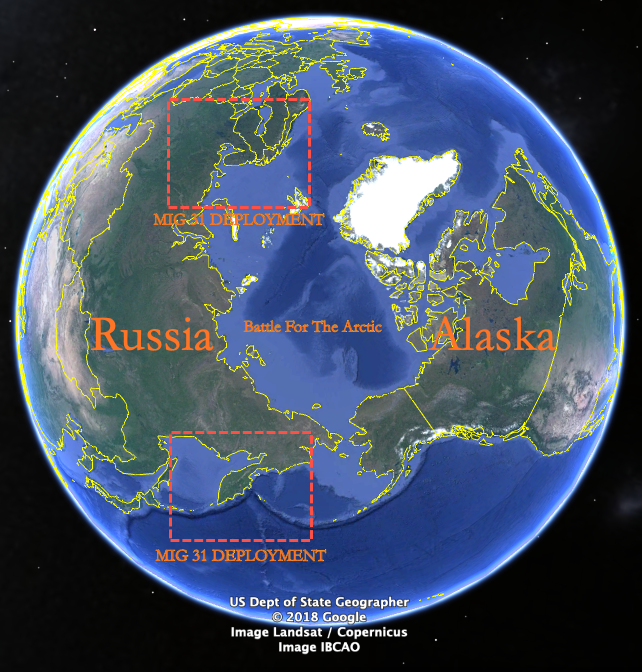
Click to enlarge
The air-launched hypersonic missile is one of the most advanced weapons in the world, even sophisticated air defense systems have difficulty defending against its Mach 10 to Mach 12 speed.
The range of the missile is about 1,200 miles and could extend Russia’s air defense capabilities not just throughout the Arctic region, but also could challenge the US in the Pacific.
Russian ASF MiG-31 aircraft crew conducted combat training launch of a hypersonic missile of #Kinzhal high-precision aviation missile system in the assigned area. Launch was conducted normally. The missile hit the target at a training ground. pic.twitter.com/u8jkUw27O9
— Минобороны России (@mod_russia) March 10, 2018
With the deployment of the hypersonic missile fighters, one fleet in the Arctic and another in the Pacific, Russia will be able to deploy a rapid response countermeasure or even defensive maneuver across the Arctic and the North Pacific.
Test pilot Colonel Igor Malikov told Izvestia that “It must be clearly stated: you should not get closer to our borders and make aggressive plans…the MiG-31 with the “Dagger” is a defensive weapon. In the event of an attack on Russia, it can hit the airbases from which enemy planes take off in the direction of our territories, as well as ships and marine infrastructure.”
As we’ve explained before, the Arctic is becoming a highly contested region for control between the US, Russia, and China. That’s because more than $35 trillion worth of natural resources could be hiding underneath the ocean floor.
“Now, there are several points of intersection of the interests of a number of powers,” Malikov told Izvestia. “There were questions – who will develop minerals on the ocean shelves. Moreover, not only the countries of the region, but also the USA participate in these discussions. And MiG regiments with Daggers are going to be placed at key points in the region.”
The battle for the Arctic has already begun — Russia could be in the lead to take control of the Arctic considering its latest deployment of military hardware to the region.
Most of the Arctic is Russian. Poor Trump, trying to bend Demark’s arm over selling Greenland to the US. China’s Silk Road 2 is principally a land-based strategy. The US and UK are principally naval powers. The tide has turned.
There hasn’t been a more significant read then what Randolph Bourne produced between 1910-1921. War is the health of the State.
us and uk as carl jones notes, wrongly in my opinion, are principally naval powers. these juggernauts are now obsolete with the advent and development of high speed missiles meaning that these navies are high cost targets with little battle affect
US and UK are naval powers, with blue water navy’s. Atlantacist doctrine depends on naval power.
Russia and China are land powers, with close in area denial strategies. They do not power project with long logistic and supply chains.
China’s carriers are the “ramp type” which means they cannot carry a heavy bomb load… they will be used for close-in defense to protect China Sea and those portions of the belt and road that use ships for transport.