
Adrienne Klaus – Financial Times Nov 5, 2026
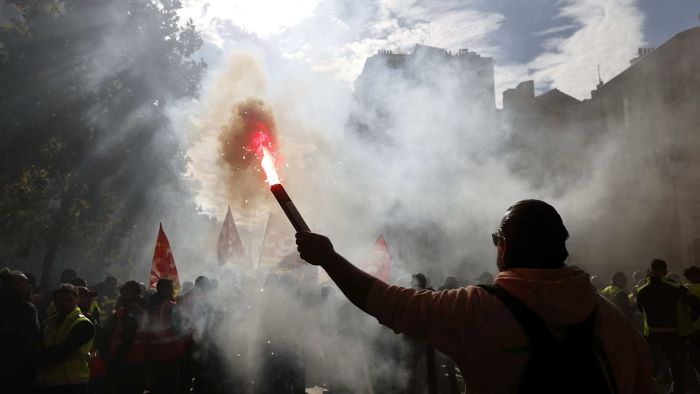
Hundreds of thousands of protesters took to the streets across France on Thursday, in what appeared to be the biggest turnout since the movement began in September.
Weeks of demonstrations have piled pressure on Prime Minister Sébastien Lecornu’s government amid a parliamentary stalemate over next year’s budget.
Thursday’s protests were organised by the country’s main unions from both the public and private sectors, who are demanding government action on the high cost of living, low salaries and underfunding of public services.
“All wages need to be raised. The minimum wage needs to be increased by at least 10 per cent . . . [and] pensions need to be increased,” Sophie Binet, the secretary-general of CGT, said on Thursday. “We want immediate answers and resources for our public services, our schools, our universities and our hospitals.”
The unions’ demonstrations have converged with a weeks-long uprising by students demanding better funding for education, and other grassroots movements frustrated with President Emmanuel Macron’s decade in power.
The interior ministry estimates that 600,000 people demonstrated across France, while the influential CGT union puts the number at 1.6mn. The ministry numbers are provisional and there is usually a divergence between the numbers put forward by officials and protest organisers.
The protests were largely peaceful, though there were some clashes between radical activists and police in Lyon and Nantes, according to the interior ministry.
This contrasts with chaotic scenes of looting and pillaging by rioters across the country on October 17, when unions were not involved in co-ordinating marches and police were overrun.
The government has signalled that it will probably take action to boost the minimum wage, though no details have yet been announced.
The prime minister announced the release of 10mn barrels of diesel from strategic reserves in order to lower prices from the start of November, while it has promised caps on class sizes, a revamp of the complicated university admissions system and preferential loans and funding for school and university renovation projects. However, protesters are pushing for more concessions.
Train operator SNCF said to expect disruptions throughout the day, while many metro stations in Paris were closed. Dockworkers have also announced a strike, and about 15 per cent of teachers were taking part in strike action on Thursday, according to the Ministry of Education.
Meeting protesters’ demands is made more complicated as the French economy has slowed and the government fights to push a deficit-cutting budget for 2027 through a fractured parliament.
French GDP contracted unexpectedly in the third quarter, the ECB said last week. Investors have grown increasingly worried about the country’s debt pile. The closely watched gap, or spread, between French 10-year borrowing costs and Germany’s soared to as high as 178 basis points last month, levels not seen since the sovereign debt crisis.
The National Assembly all but unanimously rejected the draft budget bill on Wednesday after adding a spate of amendments, sending the legislation back to the Senate in its initial form.
Finance Minister Roland Lescure has said the government is prepared to use either a constitutional mechanism, subject to a no-confidence vote, or a decree to pass the budget without a vote.