Mike Whitney – The Unz Review Nov 2, 2026
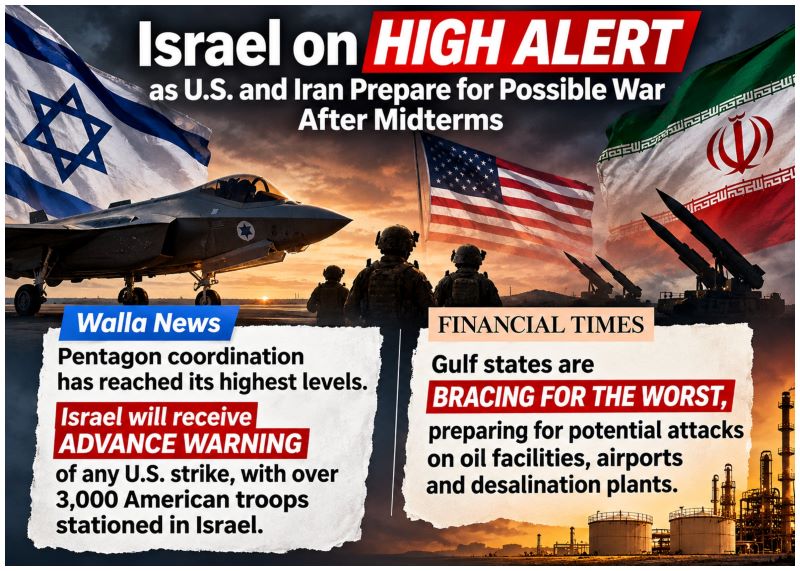
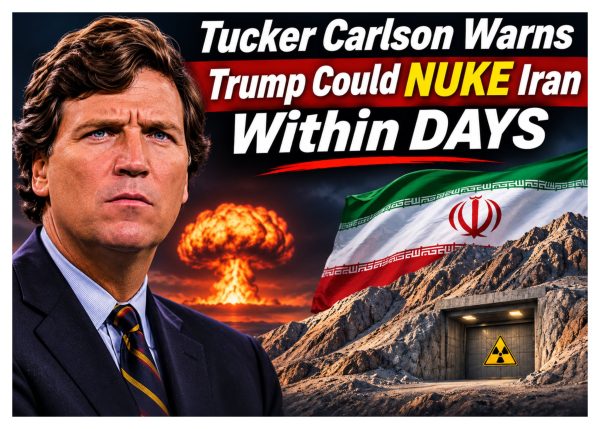
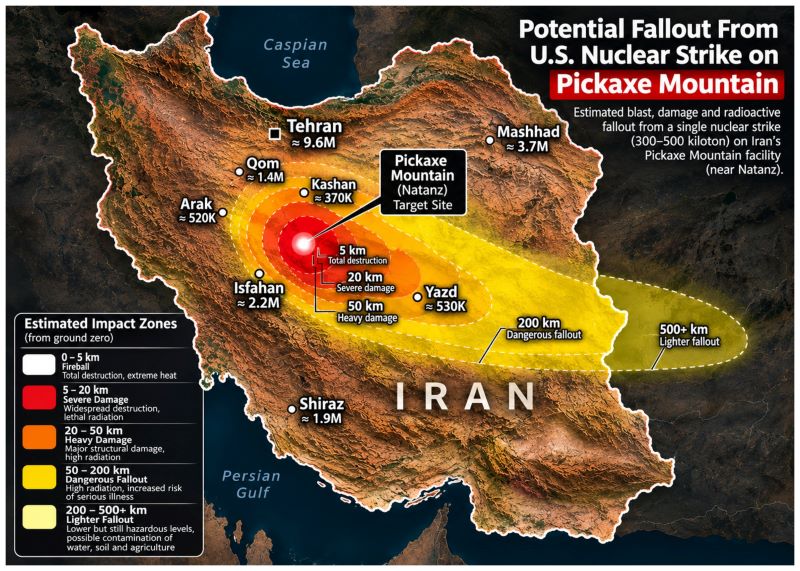
Under pressure from Israeli prime minister Benjamin Netanyahu, the Trump administration may be within days of launching a nuclear strike on Iran. The target would be Pickax Mountain in central Iran, where Israeli intelligence claims the Iranian government has restarted its nuclear enrichment program. No conventional weapon in the American arsenal can penetrate 300 feet of solid granite to destroy the tunnels where enrichment is supposedly taking place. The only military option is a nuclear strike. Netanyahu has been pushing hard for one. “Bibi calls Trump about it every day,” says an informed observer. Netanyahu is cornered and desperate. After last week’s election results, he can’t form a government unless Trump intervenes directly in Israeli politics and brokers a deal with other parties that gives Netanyahu 61 seats in the Knesset. Otherwise, he is out as prime minister and on his way to ignominy, investigations and possibly jail. Netanyahu must stay close to Trump. He needs this war. Tucker Carlson
We have to assume that both Trump and Netanyahu understand that another round of attacks on Iran using the same conventional weapons as last time will produce the same result. And since neither the US nor Israel have developed any new weapons systems that might produce a different outcome, we have to ask: What do they have in mind? After all, there is no rational reason to resume hostilities with Iran unless the US-Israel are planning to introduce some new element into the mix that would help them achieve their strategic objectives. But what might that be?
There’s only one answer to that question: Nuclear weapons. They plan to use nukes.
On this point, I agree with Tucker. But where I disagree is on the matter of Pickax Mountain. I don’t think Tucker has thought-through how the attack on Pickax is going to be used by Netanyahu to draw Trump into a bigger and more catastrophic conflict.
So, yes, the US will nuke Pickax Mountain ostensibly to destroy parts of an undisclosed (and purely fictional) nuclear weapons program. But because all 13 US intelligence agencies have repeatedly confirmed that Iran has no nuclear weapons program, is not building a nuclear bomb, and was never found to be in violation of the Nuclear Nonproliferation Treaty (NPT)– then we must assume that there is some other purpose for nuking Pickax. After all, why would they risk international isolation to nuke a facility the intel agencies have already said poses no national security threat to the US or Israel?
They wouldn’t. Therefore, we should assume that nuking Pickax serves a different purpose altogether. But what would that be?
Once the bomb is dropped, Iran will swing into action launching attacks on all the targets across the region it has already specified including critical energy infrastructure, desalination plants, IT and data centers, communications and transportation hubs, and nuclear reactors in Israel (Dimona). Iranian officials have warned that they will have “no red lines” in their retaliation. And this, I think, is what Netanyahu is counting on; he’s counting on a large enough response from Iran to claim that Israel faces an “existential threat” that must be countered with nuclear weapons. In other words, the nuking of Pickax Mt is not ‘an end in itself’, but a calibrated provocation designed to justify the annihilation of Iran. The fact is, it will require multiple nuclear bombs to obliterate a country the size of Iran, so Trump must be persuaded to deliver the first blow (thus, breaking the 80-year-long taboo) while Israel follows with numerous other strategic (nuclear) strikes. This is how Netanyahu intends to achieve his lifelong ambition of destroying Iran while making Israel the de facto regional hegemon.
Colby’s Usable Nukes
Did you know that Elbridge Colby –Trump’s Under Secretary of Defense for Policy– who was the primary architect of Trump’s 2018 National Defense Strategy, is also an ardent supporter of “limited nuclear war”?
That’s right, Trump’s “Nuclear Doctrine” is entrusted to an ideologue who thinks there should be “credible, rational, limited options” (for the use of nuclear weapons) so the president is not forced into a binary choice between inaction and massive strategic retaliation in a regional conflict.” That’s an impressive airbrushing of Colby’s position, but what it really means is that (under Colby) the threshold for the use of nuclear weapons has been lowered making a nuclear attack on Iran much more likely. Here’s a post by military analyst Will Schryver:
The notorious #EmpireEvangelist Elbridge Colby has advocated for years for the use of tactical nuclear weapons to reestablish US deterrence in the world. If the Trump White House is now seriously considering such madness, Colby is the primary reason why. https://t.co/OHnk70wgfU
— Will Schryver (@imetatronink) October 30, 2026
(Note: Online rumors suggest that at least one of the Generals that was recently fired had clashed with Colby over the use of nuclear weapons. And while the claims are unverified, it seems plausible that Hegseth may be “weeding out” the high-ranking military personnel who refuse to go along with Trump’s “insane” Iran strategy.)
According to ChatGPT, Colby’s thinking is linked to several ideas:
Limited nuclear war is conceivable. Colby has challenged the older assumption that any nuclear use would inevitably escalate immediately to massive strategic exchange.
Deterrence requires credible options. If an adversary believes the United States would never respond to a limited nuclear attack because Washington fears escalation, deterrence could fail.
The U.S. needs more flexible nuclear options, particularly to deal with Russia and China’s expanding nuclear capabilities and what he sees as potential regional conflicts. ChatGPT
Colby thinks that his approach is more nuanced and doesn’t necessarily indicate that the US is more willing to use nuclear weapons. But obviously, if one regards special categories of nukes as “tactical”, then the threshold has been lowered to the point where serious discussions are taking place about their use of nukes on the battlefield. With this in mind, I asked ChatGPT: “Whether a one-time nuclear strike on Pickaxe Mountain with a low yield nuke fit Colbys definition of a limited nuclear war”:
If by “Pickaxe Mountain” you mean a hypothetical nuclear strike against a hardened military/nuclear-related target, then yes, conceptually it could fit the category of a “limited nuclear use” scenario that Colby has discussed….
The important distinction is limited nuclear use… if you’re asking whether “one low-yield nuclear strike on a single target, followed by no further nuclear attacks” is the type of scenario people mean by limited nuclear war, the answer is yes. (ChatGPT)
Bottom line: Yes, a nuclear attack on Iran would fit with Colby’s “limited nuclear use” doctrine. I see this as a confirmation that Trump’s nuclear Braintrust (Colby) would support a nuclear attack on Iran.
Colby’s critics argue that his approach “blurs the conventional-nuclear firebreak, making limited nuclear war more thinkable, and increasing escalation dangers rather than strengthening deterrence.” Daryl G. Kimball , Executive Director, Arms Control Association, has vehemently opposed the shift in nuclear doctrine characterizing it as a move towards an “embrace of nuclear warfighting”, while Bloomberg columnist Andreas Kluth warned that “tactical nukes are a gateway drug to Armageddon”. Other critics have dismissed Colby’s ideas about managed escalation (limited nuclear use) as “wishful thinking.” But, regardless of the criticism, Colby remains located at the center of power where his views will have a profound impact on Trump’s decision to take the war to the next level.
It’s worth noting that U.S. policy does not forbid a nuclear ‘first use’ policy (NFU) The US reserves the option of using nuclear weapons first in extreme circumstances. But Colby defines “extreme circumstances” not merely as defense from an existential threat but defense of the vital interests of the United States and its allies which could mean virtually anything. For example, Iran’s control over the Persian Gulf could be construed as threatening Washington’s imperial interests in the region. Would that be sufficient reason for launching a nuclear attack on Iran? By Colby’s logic, Yes, it would be!
The United States has also never adopted a policy of “never” launching a nuclear attack on a non-nuclear state. So, we should not expect that Iran will be spared because it cannot defend itself against a preemptive nuclear strike. US policymakers say the US must retain “flexibility” in being able to choose whether destroying another country is in America’s broader geopolitical interests or not. (Naturally, morality never enters the equation.)
As for Netanyahu, we don’t think he’d have any qualms about nuking Iran. Anyone who can conduct a three-year-long genocide without a shred of remorse, is capable of anything.
A Comment About Iran
For the last 47 years, the United States has treated Iran with hostility, condescension and contempt. At no point, have US officials or politicians treated Iranians with the respect and dignity they deserve. At no point, have they extended a hand in friendship or tried to find common ground on issues of mutual concern. Instead, they have relentlessly demonized Iran while arrogantly dictating how they are expected to behave. America’s political establishment has never sought a collaborative or cooperative relationship with Iran, opting instead to issue blunt directives backed by unilateral sanctions aimed at intensifying the suffering of ordinary Iranian civilians. The Iranian government has endured these indignities largely without protest and without lashing out militarily as the US would do if it were abused in the same way.
But all of that changed on June 13, 2025, when Israel (assisted by the US) launched its first attack on Iranian nuclear facilities followed by the unprovoked 40-day war that began on February 28, 2026. This direct aggression against the Islamic Republic provided the justification Iran needed to demonstrate its technological superiority vis a vis hypersonic missiles, cutting-edge drones, updated air defense systems and state-of-the-art satellite surveillance systems. In just 40 days, Iran was able to destroy most of America’s military and naval bases across the Gulf while demolishing the most heavily protected airbases and Intelligence sites in Israel. US warships have been forced to remain nearly 1,000 kilometers beyond the Iranian mainland, while Iran has asserted an iron grip on all commercial vessels transiting the world’s most important waterway, the Persian Gulf. In short, the war has changed the conditions that sustained Iran’s long-term isolation, and it has put them on-course for regional dominance. Trump’s misguided war has effectively opened the floodgates allowing Iran to pummel its adversaries while establishing the foundation for a new regional security architecture. What we don’t know at this point, is whether the introduction of nuclear weapons will roll back Iran’s strategic gains or finally liberate them from foreign domination. We just don’t know