
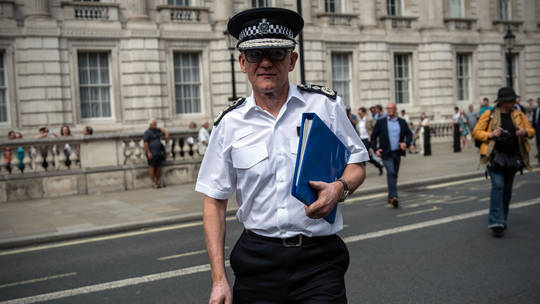
Sir Mark Rowley
Laurie Wastell — The Daily Sceptic Nov 2, 2026
The Metropolitan Police has embarked on yet another diversity recruitment drive. This follows its “Inclusion and Diversity Strategy” 2017, the Mayor of London’s police race action plan 2020, “A New Met for London” 2023 and the London Race Action Plan of 2024. Launching the campaign last month in the Guardian – that bastion of hang ’em and flog ’em law and order – Met Commissioner Mark Rowley wrote: “Effective policing depends upon inclusivity… you cannot do without it.” Few precise details have yet been forthcoming, but judging by past schemes, we can expect a target for sharply increasing ethnic minority recruitment in the Met and several new outreach schemes in order to achieve it.
Rowley is apparently aware that such attempts to change the composition of a workforce are often controversial, yet hopes to shield his plan from criticism simply by sheer power of assertion. “We have no interest in the politics and ideologies of the culture wars,” he claims, adding that his is not an “ideological” agenda but instead an “operational necessity”.
It’s a strange and almost comically high-handed way of approaching this emotive issue: to simply insist that your agenda is not part of the culture war, when you are clearly an energetic combatant within it. After all, Rowley, like so many bureaucrat busybodies before him, wants to socially engineer his workforce to make it more ‘diverse’. As he does so the Met is almost certain to engage in discrimination against white applicants (for more, see my interview with actuary Peter Crowley on this week’s Sceptic podcast). And by the same token, his forces are likely to recruit ethnic minority candidates of lower standards than would otherwise be let into the Met. We already know that this has happened: in 2023 the police inspectorate found that, having lowered standards as part of a diversity drive, the Met had serving officers who were “functionally illiterate”. Then there was the police constable who initially failed vetting but was recruited under a diversity scheme anyway and was later convicted of 13 counts of rape. So Rowley can disclaim the culture wars all he likes: one cannot plant an Argentine flag on the Falklands and then declare that one has no interest in conflict.
A charitable reading would be that when it comes to the need for diversity, Rowley has developed some degree of Stockholm Syndrome. Given that his salary depends on implementing such schemes, it’s no doubt psychologically far easier to come to believe in them himself. So rather than Rowley being forced, yet again, by government dictates to carry out a political gesture at great cost, he is apparently doing so willingly because he genuinely thinks it’s an important way to improve policing in the capital. Rowley does at least manage to point to some tangible reasons that a level of diversity is useful. He says that a range of officers are needed for undercover work, and female staff are often preferred when it comes to dealing with female victims of violence. And while its benefits are surely exaggerated, one probably can make a limited case for what Rowley calls a “Met that truly reflects and understands every corner of London”.
Nevertheless, it’s clear that to the extent these are operational necessities, practical concerns are playing second fiddle to breathless ideological fervour. Is it really an operational necessity to have more women in the “the most exciting roles” like firearms teams and counter-terrorism, as Rowley calls for? The idea that diversity concerns would affect who qualifies for the select group of officers trusted to carry and use guns around the capital is more frightening than any Halloween ghoul. And as if to highlight how blithe and unthinking his approach is, Rowley never bothers to engage with the question of whether they are reducing standards to reach these targets. He just baldly asserts that “Nothing could be further from the truth”, and follows it up with some airy Lefty nonsense: “Fairness, not favour, should be at the heart of opportunity.” Right.
Rather tellingly, the draft inclusion strategy announces that “We have a legal and professional duty to act”, claiming that the requirements of the law and of good professional practice conveniently just happen to “align directly”. Comrade, the five-year plan is so far-sighted it’s what we were already going to do. Surely the Met protests too much? If these were merely measures any professional would think it sensible to implement, why would the coercion of the Equality Act even need to be invoked?
In any case, it’s easy to forget that every time we’re told it’s now operationally necessary to have a diverse police force, this is really a concession about the failures of mass migration and demographic change. Rowley, who is at pains to hail present-day London as “the world’s greatest and most diverse and globally connected city”, nevertheless then acknowledges that “the scale and complexity of policing London today is unlike anything Sir Robert Peel imagined when founding the Metropolitan police”. Translation: London is much more fractious, chaotic and difficult to police nowadays than when it was ethnically homogenous, and this is why the Met is having to revolutionise its hiring practices to coax recalcitrant ethnic minorities into policing their neighbours.
Indeed, Met motions towards community policing have been underway since as far back as the 1980s, following the Brixton Riots of 1981. After a robust plain-clothes policing operation in Railton Road resulted in days of mass violent riots by the local black community, Lord Scarman in his report on the disorder recommended sweeping policy changes: ‘community policing’, affirmative action for ethnic minority officers and more state funding generally for immigrant neighbourhoods liable to riot. By the 1980s, Britain’s mass migration experiment was going so swimmingly that some measure of racially calibrated policing and ultimately targeted state handouts were deemed necessary to avoid large-scale public disorder.
Back then at least, such measures were understood to be a grubby compromise that went against long-standing notions of state colour-blindness and policing without fear or favour. Today, London’s police chief freely tells us that Britain’s capital is so lawless that its diverse panoply of ethnic minority criminals cannot successfully be policed without a similarly melanated constabulary – and then he chides us to be enthusiastic about it. And he wonders why people think he’s part of the culture war?