
Ian Fantom – The Unz Review Oct 28, 2026
The word ‘Gallipoli’ evokes memories of Britain’s greatest military disaster in the First World War. The objective was to clear the Dardenelles – the straight between the European and the Asian part of Turkey, South of the Sea of Marmara – to enable the Russian fleet to pass from the Black Sea to the Mediteranean. According to US author Richard Poe, in his book ‘How the British Invented Communism (And Blamed It on the Jews)’, “If the attack were successful, Constantinople would fall, and the Ottoman Empire with it. But the attack failed. Catastrophically“.
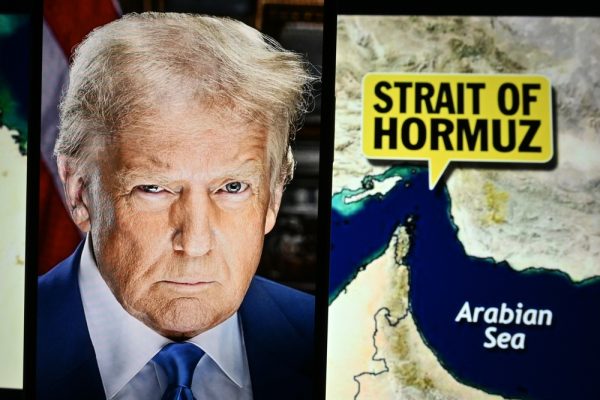
The current Iran-US War resulted in the blocking of the Straight of Hormuz and Donald Trump’s desperate efforts to clear the straight. That would enable oil tankers to pass from the Persian Gulf to the Gulf of Oman, and so to the world oil markets. If the attack on Iran were successful, Trump seemed to believe, Teheran would fall, and the rump of the old Ottoman Empire with it. But the attack failed. Catastrophically.

Allied troops at Gallipoli. Click to enlarge
“The underestimation of Ottoman military potential stemmed from a ‘sense of superiority’ among the Allies, because of the decline of the Ottoman Empire and its poor performance in Libya during the Italo-Turkish War of 1911–1912 and the Balkan Wars of 1912 and 1913“, states Wikipedia, “Entente intelligence failed to adequately prepare for the campaign, in some cases relying on information gained from Egyptian travel guides“.
The underestimation by Donald Trump of Iranian military potential undoubtedly stemmed from a ‘sense of superiority’ among the Americans, because of the immense colonial power that the US had across the world. They clearly failed to prepare the US public for the campaign, and in some cases undoubtedly relied on out-dated information, as exemplified by the bombing of an elementary school in Mijab, located for at least ten years on a former military site.
In the case of Gallipoli, there were resignations or sackings in Britain, including Winston Churchill as First Lord of the Admiralty, and the catastrophy turned the British government into turmoil. “The campaign’s main significance to the Turkish people lies in the role it played in the emergence of Mustafa Kemal, who became the first president of the Republic of Turkey after the war“, states Wikipedia, ” ‘Çanakkale geçilmez’ (Çanakkale [The Turkish town of Gelibolu] is impassable) became a common phrase to express the state’s pride at repulsing the attack and the song ‘Çanakkale içinde’ (A Ballad for Chanakkale) commemorates the Turkish youth who fell during the battle. Turkish filmmaker Sinan Çetin created a movie called Children of Canakkale“.
In the case of Iran, Donald Trump has massively lost support amongst his own people, and there is even talk amongst analysts of him possibly not being able to serve his full time in office. Iran is now seen to have established its dominance over the area, and I have little doubt that some future songwriters and filmmakers will focus on that.
On Gallipoli, Richard Poe writes, “However, some suggest that the British deliberately pulled their punches, allowing the Turks to win. One such is Harvey Broadbent, an Australian historian who has written four books of the Gallipoli Campaign, … . In an April 23, 2009, article titled ‘Gallipoli: One Great Deception?’, Broadbent hypothesized that the Gallipoli Campaign was never meant to succeed, and may have been conceived and conducted as a ruse to keep the Russians in the war …“. He also mentions a book by Robin Prior, ‘Gallipoli: End of a Myth‘, which lists a series of decisions and events that he describes as puzzling or incomprehensible. What could be the motive? “Broadbent points out that, had the allies succeeded in taking Constantinople and the Straits, they would have been obliged to turn over these prizes to Russia, in accordance with a secret treaty of March 1915. The Allies would have done all the work. ‘Russia alone, will, if the war is successful, gather the fruits of these operations’, said a March 15, 1915, memorandum of the British Asquith government, quoted by Broadbent“. However, the Bolsheviks saved the day, by unilaterally withdrawing their claim to Constantinople.
On Iran, is it possible that Trump can be so stupid? Analysts of all types are saying how unbelievably stupid he appears, and that he understands nothing of military strategy. Yet I have in mind the stupidity of President George W Bush, which was entirely faked. “Don’t misunderestimate me” was a stroke of genius. Donald Trump in public seems to be a superior comedian to Volodymyr Zelenskyy. Is it possible that Trump’s war against Iran was, too, a project designed to fail? If so, what could be the motive?
The US-Iran war has been planned for many years. The pro-Israeli Washington Institute for Near-East Studies held a Policy Forum luncheon, on September 21, 2012 under the title ‘How to Build U.S.-Israeli Coordination on Preventing an Iranian Nuclear Breakout‘. In it, their research director Patrick Clawson stated, “I frankly think that crisis initiation is really tough, and it’s very hard for me to see how the United States … uh … President can get us to war with Iran.” He went on to recount a series of controversial incidents in American history — the attack on Pearl Harbor, the sinking of the Lusitania, the Gulf of Tonkin incident, and the blowing up of the USS Maine — that US presidents “had to wait for” before taking America to war. “So, if in fact the Iranians aren’t going to compromise,” he concluded with a smirk on his face, “it would be best if somebody else started the war.”
So why did Trump go to war with Iran? “Because Netanyahu told him to“, Professor Jeffrey Sachs would routinely reply, and that seems to be a phrase that has caught on. But who is the deep state in Israel, if not the Rothschilds? They provided the leadership of the early political Zionists, and subsequent funding for Israel. Who is the deep state in the UK, if not the bankers in The City of London, including the powerful Rothschilds? As Napoléon Bonaparte reputedly stated, “When a government is dependent upon bankers for money, they and not the leaders of the government control the situation, since the hand that gives is above the hand that takes”. Who is the deep state in the US? As Thomas Jefferson stated: “I sincerely believe that banking establishments are more dangerous than standing armies, and that the principle of spending money to be paid by posterity under the name of funding is but swindling futurity on a large scale.”
Jefferson’s concerns relating to private banks were summed up later (with the anachronistic terms ‘inflation’ and ‘deflation’) as: “If the American people ever allow private banks to control the issue of their currency, first by inflation, then by deflation, the banks…will deprive the people of all property until their children wake-up homeless on the continent their fathers conquered…. “ Doesn’t that sound just like what has actually happened? Doesn’t it sound as if the deep state in all three of those countries is essentially the same deep state, and that Thomas Jefferson’s statement is just what the World Economic Forum currently envisages for the world government of the future?
It sounds to me as if Trump went to war with Iran not because Netanyahu told him to, but because the deep state told him to, and their puppet Bibi Netanyahu merely voiced their words. So now the question becomes, “Could Trump have avoided going to war with Iran?”
I don’t know the answer to that one, but remember JFK? Every subsequent US President would need to bear that assassination in mind. In the US it seems impossible nowadays for anyone to become President without kowtowing to AIPAC – the American Israel Public Affairs Committee. Could Trump have stopped the genocide in Gaza? Same answer, I think. So my hypothesis is that he goes along with these imperial ambitions, takes them over, then pursues them with such enthusiasm that they fail, or at least are dumbed down. The deep state objective in Iran was surely regime change, just as for Venezuela; it didn’t happen. This is exactly what infiltrators do in civilian groups to bring them down. I’ve been in such an environment in the Esperanto movement since 1962, but only latched on twenty years ago. We now know that such infiltration and undermining in civilian groups is widespread, at least in the UK. In 2009 there was a national ‘Spycops’ scandal, starting with the uncovering of Mark (Flash) Stone as Mark Kennedy, a police agent provocateur, in an environmental group protesting outside the Drax coal-fired power station.
No group is too small to escape the attention of the deep state. One of the nine undercover police officers had infiltrated a small group of young ladies dressed as clowns, protesting against the invasion of Iraq. On researching these cases at the time I drew up a long list of other civilian groups in which the nine had been active. Mark Kennedy was even active in Germany. If these cases result from the police alone, then what are MI5, MI6 and the Cabinet Office up to?
It looks to me as if Trump is now turning the technique on the deep state itself. Now look at what actually happened. Many have died in Iran, but there has been no regime change. Many have died in Gaza, but now Trump is able to accuse Netanyahu of being as crazy as the world thinks he is. Virtually the whole world is now against Israel. Who would have believed that to be possible before 2025? Iran has demonstrated superiority over Israel, and NATO is being dismantled. The US has lost its dominance in the Middle East, and Netanyahu could be on his way to jail. Peace in Ukraine was sabotaged by Europeans, despite Trump’s efforts.
So what took Trump into politics in such a big way? I suspect it was 9/11. On that day he gave an interview at Ground Zero, insisting that the towers were brought down by explosives within. He commented that his tower was now the tallest in New York. Presumably he was concerned that Trump Tower could be the next target. Yet by the evening his tone had changed.
I saw the video, and made a transcript, but it seems now that that video is being denied. When I clicked on the link, I got a notice saying, “This video has been removed by YouTube for violating YouTube’s policy on hate speech“. However, part of that video was embedded in another video ‘FULL Donald Trump 9/11 Conspiracy Interview‘. It carries a frame showing Trump being interviewed at Ground Zero, with a banner ‘DONALD TRUMP: AIRED SEPTEMBER 11, 2001’. Google AI claimed, “The video you are referring to is real and its existence is well-documented. It is not a missing or denied clip; rather, it is a segment from a live phone interview Donald Trump gave to New York television station WWOR-TV (UPN 9) on the afternoon of September 11, 2001”. Underneath the video was displayed a blue panel giving a few lines from Wikipedia’s entry on ‘September 11 attacks’. On clicking on ‘Why am I seeing this?’ I was told: “When you search or watch videos related to topics prone to misinformation, such as the moon landing, you may see an information panel at the top of your search results or under a video you’re watching.”
So why had Donald Trump changed his tune by the evening? The above gives some idea of the pressure he must have been facing, or would have been facing if he had persisted with his views. I wonder if this had anything to do with kowtowing to AIPAC.
Many analysts for whom I have great respect and admiration have come to the conclusion that Trump has either gone mad or was part of the deep state from the beginning. These include Kevin Barrett, who has been warning for years about Trump. In one newsletter he describes Trump as a “frontman for the Kosher Nostra.”, giving strong arguments which would appear to be against my own hypothesis. He added, “As I have been saying since Trump attacked Iran on February 28, this may go down in history as the most strategically stupid military attack of all time.” Maybe. Or it may be Gallipoli.
Kevin also describes Trump as “a wildly inconsistent loose-lipped motor-mouth and reckless risk-taker who responds to attacks by attacking back twice as hard”. Maybe, but what would one expect from an ambitious property developer in New York City? He would be attracted to the rich and powerful, especially if they appeared to be a source of funding, such as Jeffrey Epstein. But how would such a personality react if threatened? Interestingly, Kevin sees a way out for Trump: to throw Netanyahu under a bus. I find it interesting that Kevin and I reach somewhat similar conclusions, but coming from very different angles. I have now to wonder whether Trump’s endorsement of Netanyahu in the Israeli elections has helped Netanyahu or hindered him. Or was it perhaps that he mustn’t be seen to be throwing Netanyahu under a bus? The weakening of Netanyahu’s position following the elections in Israel may give Trump a way out of the Iran war, which he seems to have been seeking for some time. Netanyahu may, as leader of a caretaker government, feel he has a ‘duty of restraint’, or, on the other hand, he may feel he needs a war in order to consolidate his position.
My hypothesis arose during Trump’s first term, and I have drafted a number of articles about it in the meantime. Each time I hung whilst I observed Trump’s outpourings. I don’t know about internal US politics, but everything I have followed on the international scene seemed to fit in with the hypothesis. Most notably from his first term I recall the ‘rocket man’ incident, when Trump was throwing insults at North Korea’s Kim Jung Un, only to eventually declare that the two of them were the best of friends. He later declared that if he had not been elected, the US “would right now, in my opinion, be in a major war with North Korea”. He’s pretty well saying that the deep state told him to do it.
I recently watched a f ascinating discussion with Kevin Barrett and Ron Unz on Ron Unz’s article ‘The Collapse of American Hegemony and Global Nuclear Risks’. This article provides a great analysis, but the general thread of the discussion was that nothing makes sense, as always.
One thing I learned in my physics education was that if the best brains in the world cannot make sense of a situation over a substantial period of time, then try changing the basic premises. In 2007 I revisited a split in the Esperanto movement of 1907, which I read about in 1962, shortly after learning the language. I could not make sense of it, and that remained with me all those years. The book I looked at in 2007 labeled the key actor as ‘a mysterious person’, concluding, “I suppose we’ll never know”. I can envisage in a hundred years time historians looking back on Trump saying the same thing. When I asked myself whether possibly the mysterious guy had entered the movement to do exactly what he did do, namely to trash it, probably on behalf of the deep state, then suddenly the whole thing made sense. Could it be, then, that Trump went into the presidency to do exactly what he has been doing, namely to trash the deep state, and to take the US away from its agressive ambition of world domination? If so, he had done remarkably well.
He may even have had Gallipoli in mind