
Matt Roberts – The Daily Sceptic Oct 27, 2026
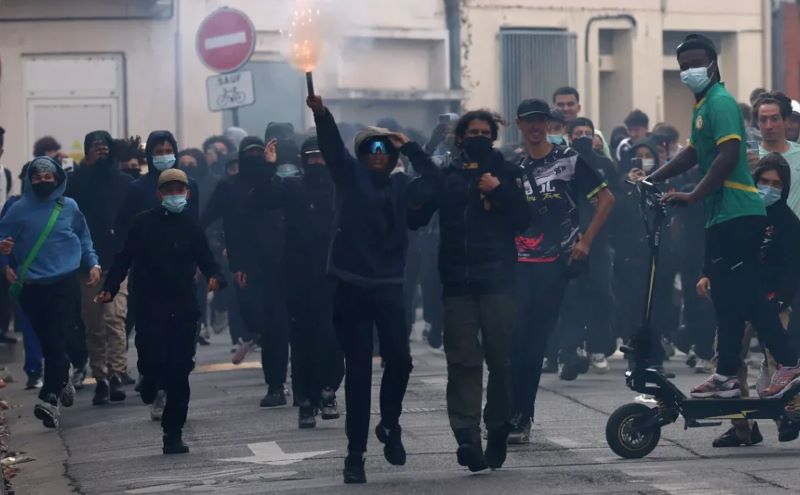
The violence, looting and burning in France over the weekend of October 24th-25th was somewhat less intense and widespread than it had been on the previous weekend, but it was still significant. A demonstration comprising an estimated 400,000 people took place on the Saturday in Paris, confined to the south-eastern edge of the city, and this was followed by violent clashes with police near Porte de Vincennes, about a 45-minute walk from the Place de la Bastille. Water cannon and tear gas were used. Around 500 rioters were estimated to have broken off from the main protest. There were more clashes, as well as bin fires and looting in Marseille, Lyon, Bordeaux, Lille, Toulouse, Nantes, Grenoble, Rennes and several other parts of France. There were around 1,000 arrests nationwide (1,300 by some reports), with 70,000 police having been deployed to the streets, which was a substantial increase on the previous weekend’s deployment. Activists have called for further action on October 31st, and it’s clear that the sentiment behind the unrest hasn’t gone away. The weather on the 31st is forecast to be mild and dry, more similar to that of the 17th than the wetter, colder 24th, so it remains to be seen how much the tensions have been defused, and to what extent the less dedicated were put off by the weather.
There are two competing narratives in the media (mainstream and alternative) about the motivations for the unrest, and indeed the nature of the unrest. On the one hand, this is a ‘mostly peaceful’ expression of the French people’s frustration with public services. It started with teachers and students protesting against the underfunding of schools, and has widened to express a broader discontent with austerity measures and the economy in general. On the other hand, this is a violent ethno-religious-communist uprising trying to bring down the French state and overturn French society.
Legacy media would have you believe the first of these is true, given the footage they’re showing and the voiceovers they’re providing. Just a brief sojourn into X, Rumble or YouTube will have you come away convinced of the second. Interestingly, the French political Establishment seems to be more aligned with the insurrection view than the peaceful protest view. Less than a week before the first outbreak of violence, Jean-Luc Mélenchon of La France Insoumise (‘France Unbowed’) was calling for the formation of a Sixth Republic of ‘popular power’. On October 22nd, addressing the nation, Macron referred to “political and even seditious acts carried out by organised ultra-Left groups whose aim is to bring down the Republic”. Laurent Nuñez, France’s Interior Minister, referred to “very high levels of violence” and “militants of the ultra-Left movement, of the extreme far Left”. Although they’re comfortable calling out the black bloc activists that can be seen on the streets, they’re ignoring the Islamic slogans and the ethnic composition of many of the perpetrators that the rest of us can see on X.
These two narratives are not mutually exclusive. There is both a mass peaceful demonstration against perceived underinvestment in public services and a violent uprising from an alliance of convenience of anti-Western forces. In this sense, there is an opportunity to use France as an object lesson on this side of the channel. It is a lesson we have been refusing to learn from our own situation, and which has been offered to us grindingly slowly in our own politics and on our streets: the techno-managerial social democratic project rests on a utopian fiction. If we are interested in preserving our civilisation, then we really must start paying attention.
In Britain, across almost all of the EU and into the Anglosphere (possibly excepting the United States), the fiction goes something like this: if the state can hoover up just the right amount of money and distribute it correctly through services and benefits, guided by experts and technocrats, eventually we will achieve a settled, prosperous society. The system is imperfect, but perfectible. All that it needs is just the last tax increase, the ideal budget, or a carefully planned management structure, and all will be well. It’s just over the horizon, but the direction of travel is the right one. It must be, because that’s how we planned it. In the meantime, all of this will be improved by importing human capital from far-flung parts of the world. Since culture and tribalism are essentially artificial, this will be a success as soon as we achieve something called integration.
Many reading this will doubtless already have concluded that this is indeed a dangerous fiction. The interesting thing is that our political, media and institutional class don’t seem to be able to look across the channel and see the urgent evidence of the delusion.
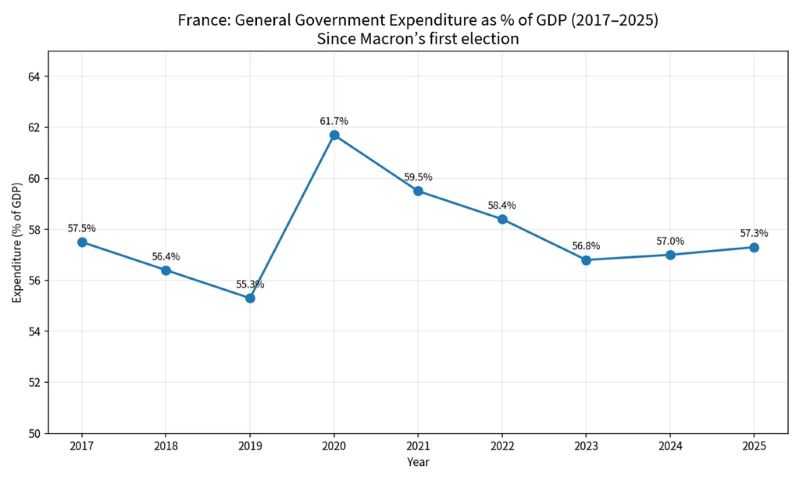
If it really were a case of the right amount of resources being allocated through the state, then surely France would be closer to nirvana than we are in Britain? French public sector spending accounts for around 57% of the country’s GDP. Social spending – that is, cash benefits and in-kind services for old age, health, family, unemployment, incapacity, housing, and so on – accounts for fully 30% of GDP. This compares to 49.4% and 28% state expenditure and social spending respectively for Germany, 47% and 23% for the UK and 37% and 19.8% for the US. In Communist China, the state accounts for around 33% of GDP and 10-13% is spent on social benefits. In the USSR in 1988, something like 51% of spending was by the state; roughly 15-20% was social spending (these last two are necessarily estimates, because the data are neither easily available nor reliable).
Nor is it true that Macron himself has overseen meaningful cuts to services and benefits. It was part of his persona in 2017 when first elected that he was going to restore sanity to French public spending and make some of the difficult decisions that his predecessors had avoided. In reality, he hasn’t. As the chart shows, in 2017, he inherited public sector spending at 57.5% of GDP, had some initial success in driving it down to a mere 55.3% by 2019, and then indulged in the same kind of massive increases that we saw across the rest of the developed world in 2020. It’s fallen since, and then risen again, but net, the change is a reduction of two-tenths of one per cent of GDP over seven years, while the economy itself has grown by some 10-11% in real terms.
If France spends more on its public services than Britain does, and has done so for years, then the claim that the unrest is driven by underinvestment is difficult to sustain. This point has been made quite widely in the commentary of the last two weeks. However, it also calls into question the larger claim that once an expertly managed state becomes large enough, peace and prosperity will be the natural result. France is further down the road than we are, but we are being asked to follow them. Where is the evidence that the destination is one worth heading for? When France is spending 10 percentage points more of its GDP on public services than Britain and is taking to the streets in protest at poor outcomes and declining services, what is the evidence that our lives will be better once we just invest a little more in public services? The obvious answer is that there isn’t any. We’re asked to take it on trust and as a matter of faith.
We then come to the other fiction: that of fungible humans and harmonious integration. Again, the TV news footage of the large daytime protests doesn’t make it clear, but there are any number of videos on X or elsewhere that show quite unmistakably that the people carrying out the looting and the violent acts into the evening are predominantly of North African, Middle Eastern and sub-Saharan African heritage. It is not possible to evidence this, for example with arrest figures, because the French state does not capture ethnicity data, only nationality and place of birth. We also do know that France has a distinct problem with concentrations of immigrant populations in the banlieues, and that these have been the spark points for previous outbreaks of large-scale rioting (for example in 2005 and 2023). When the mostly Algerian and Tunisian guest workers were allowed to start settling permanently and bringing their families to France in the 1970s, they were housed in the concrete high-rises of the banlieues, and despite decades of policy of civic identity and laïcité, that concentration has never gone away. Because of this, in all likelihood, many of the young men we see on the streets of Paris are second, third, even fourth-generation immigrants to France.
The inference of this would be that, having run an extensive version of public provision and civic equality over a long period of time, this has not resulted in the integration and feeling of settled belonging that we’re told it should. Official net immigration figures for France suggest an additional 1.6-1.7 million net arrivals in France since 2016 (the first year of the Syrian immigration crisis). Low by recent British standards, but it leaves the question open: how are they to be integrated if previous generations of arrivals still are not?
We have a similar situation in this country. Many immigrant groups live in essentially monocultural areas, leading parallel cultural existences and not in any meaningful sense integrating into Britain. There is a very similar pattern of geographical concentration along ethnic lines. Granted, these are more likely to be in brick terraced houses than concrete tower blocks, and granted, we haven’t seen the scale of street violence here that we have in France. Even the 2011 and 2024 riots were not on the same level as the events in French cities over the past two weekends. However, this doesn’t demonstrate successful integration; it only shows that the same underlying patterns have not yet produced the same results. More to the point, are we to take the fact that our city centres aren’t on fire as evidence of a successful integration project?
Much of the political dialogue in both France and Britain focuses on the idea of integration. In particular, on the idea that it is just a matter of time. If immigrant communities are given the time and the help to become part of society, then eventually they will. Evidence given consists of anecdote and caveat, along the lines of ‘I have very good friends who are of this ethnic background’ or ‘there are many members of this particular community that are integrated, productive members of society’. This is all very well, and no doubt true, but where is the evidence that long-term public support and equality under the law will eventually result in integration en masse, especially when the immigration itself continues at scale and the geographical concentration continues? That evidence is not to be found in historical precedent, and it is not to be found by looking across the Channel.
There are several areas of modern society where we are facing unprecedented challenges that need to be addressed. Medical science allows us to treat, cure and manage illnesses that would have been a death sentence a century ago. This is wonderful, but how do we pay for it? We have an economy that is far more complex than has been the case before. That is probably to the good, but how do we understand, much less regulate and manage it (assuming we should regulate and manage it at all)? Far more people can transplant their lives across far greater distances than has been the case in the past. How do we deal with this reality?
We are addressing all of these problems and many more with solutions invented around 1945, and the problems themselves look very different than they did 80 years ago. Worse, many of the solutions we are applying are based on conviction and ideology, not on even the evidence of the intervening decades. Why should we continue to expect that the solutions will work, especially when we can look to Paris and see that they have not? In all likelihood, France will settle down again next weekend, or in the near future. Even when it does, it would be a mistake to breathe a sigh of relief and continue with business as usual. There is an opportunity finally to learn from the event and set about correcting the misconceptions that are at the heart of Western governments.
With a background in history and political philosophy and after a long corporate career, Matt Roberts now writes on the political system and current affairs. Find him on his Substack page, the Traditional Pragmatist, and on X