
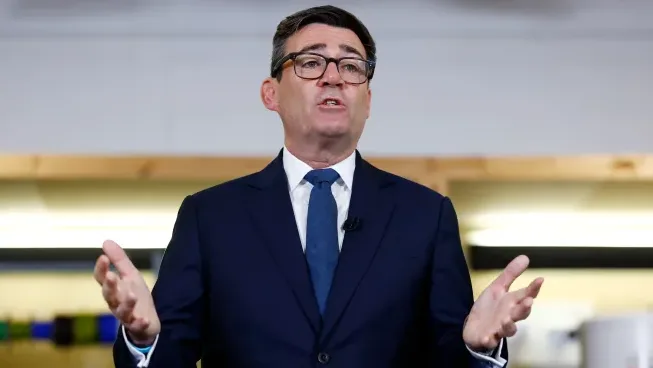
Is Burnham turning into a bigger liability than his predecessor?
Mary Gilleece — The Daily Sceptic Oct 19, 2026
An op-ed in the Times by the Prime Minister reveals he will make no attempts to cut the £333 billion welfare bill. He is writing about the one million 16-24 year-olds who are currently not in work or education (NEETs). It’s a figure that should shame Britain, yet Burnham responds with big promises and a commitment only for more Government “investment” (a.k.a. spending). He writes:
I am clear we will not succeed if we approach this as a traditional top-down reform run out of one Whitehall department.
Instead, his solutions, such as they are, speak of vast and additional state spending. He writes:
We will start in schools, rebuild the education system and establish parity between academic and technical routes. Every young person will be guaranteed a high-quality technical pathway, work placements, apprenticeships and the skills and experience they need to secure a good job. We will also provide timely, high-quality mental health support so that no young person faces a long wait for the help they need.
These three commitments alone – to rebuild the education system for instance – are staggeringly enormous and eye-wateringly costly. But as Mole says in The Wind in the Willows: “Oh, it’s all very well to talk.” How is this going to be done, a new technical college in every town? The hiring of hundreds of thousands new technical teachers? The conjuring up of new apprenticeships in spite of the fact that the number of the new apprenticeships starts has declined by roughly a third in the past 10 years? And in relation to more mental health support for young people – how much can be too much? The industry has ballooned in recent years with a record high number of SEND support staff in schools with no evidence that they improve educational outcomes for children.
The Prime Minister is even more vague about changes to the operation of the welfare system:
This will mean big changes to the way our welfare system operates. Benefits will become the backstop, not the starting point. The system will no longer begin by establishing which benefits a young person is entitled to. It will begin with their ambitions and the help they need to achieve them.
With more seven year-olds on disability benefits than 50 year olds, it could be argued that a large segment of an entire generation has an ambition to make the most of the generous welfare system on offer. This week I was trying to teach a girl who has not been in school for two years. Her aunt visited the house with a large pile of paperwork. She and the girl’s mother proceeded to conduct a very impressive business meeting about the benefits the wider family were receiving. Between the two women there are seven children who have all been diagnosed with a number of mental health or neurodevelopment issues. This has opened up a plethora of financial benefits including PIP for the older ones, disability living allowance, carers’ allowance and of course the Motability scheme.
The “ambition” that Burnham refers to in such families is clear-sighted and entirely logical. These two competent women were very well able to work doggedly with the help of AI to realise their ambition of maximising their benefits. They have been incentivised to do so and are making quite logical sensible decisions within the system as it currently stands. Quite how Burnham or his pro-welfare backbenchers are going to change this and similar mindsets is, as yet, unclear.
Burnhams writes that:
Last month our retail sector pledged 100,000 new jobs for young people. And just last week our hospitality sector committed to provide 100,000 paid jobs.
If tallied up with the one million NEETs, this still leaves 800,000 young people kicking around, and doesn’t quite ring true given the overall job losses in the hospitality sector with record low employment in retail.
Burnham sees the solution to all of this as yet more Government “investment”. He writes:
We face a choice. We either invest in the success of our young people or pay for failure through the benefits system. We cannot afford to do both. I choose the first. That demands fundamental change in the way the Government and society support young people.
More Government investment sounds expensive. What sort of investment? As well as “rebuilding” the entire “education system” he speaks of “youth services” and “mental health support” and insists that he will take Alan Milburn’s review into young people and work “seriously”. But whatever he comes up with, how on earth will he pay for it? Answers on a postcard please.
Mary Gilleece is an educational support worker; her name is a pseudonym.
Support the Daily Sceptic with a donation.
If you think “welfare” can be “cut” then I don’t know what to say. More than half of britain “live” in abject poverty in slums filled with drug dealers and gangs. All in the big cities of course, but there’s some in smaller “communites” in wales etc. If you “cut” their money, that all goes to the scum that own the box you so graciously allow them to live in as “rent”, what do you think will happen? Do you honestly think that half of “your” population will just allow you to throw them into the street and die? And “burnham” and all the rest aren’t doing it because they’re bleeding heart liberals – in britain? really? ..come on – no, they do it because they (as the “landlords”) are the ultimate destination for all those “benefits”.
Blaming the unemployed for unemployment is like blaming cancer on cancer patients. The Labour Party asked Blair apparatchik Alan Milburn to look at the unemployment issue and he said there should be “money redistribution to fund training”. The first time in a long time they talk of money redistribution, but not from the rich but from the people with the least money of all, those on benefits. Making the unemployed poorer to pay for unemployment is as cruel as it gets. This from MPs who cause the problems and whose expense accounts fund their whole lifestyle.
“We’ve got to have a different conversation about the welfare system, it just isn’t working for young people,” Milburn told the Guardian. “We need to redistribute money from the welfare system to more employment support if we are going to end the Neet crisis.”
The number of working claimants needing wage top-ups from Universal Credit is 2.19million people, much higher than the 1.76 officially unemployed. Who are the real benefits scroungers?
https://uk.news.yahoo.com/cut-benefits-fund-support-young-183019594.html
An economic collapse of world historic dimensions looms for the world.
The welfare state is finished. Either government will severely curtail the benefits system or it will be hyperinflated away to nothing. Either way the end result is inevitable.
May you live in interesting times.
This is why they need war with Russia. They can claim things were going well but the war fucked everything up.