
Introduction – Oct 8, 2026

Ukrainian recruits in Kiev.
The simple fact is that large numbers of young Ukrainians simply don’t want to fight and die in a war that is really about expanding Western influence, and ultimately fragmenting and destroying Russia.
That is why the West is using a former TV actor and comedian to front their campaign in Ukraine.
Volodymyr Zelensky went overnight from being the star of Ukrainian TV’s “Servant of the People”, to being a full-blown puppet president who has cancelled elections and suspended opposition parties for their alleged links to Russia.
That’s how ‘democracy’ works when Western oligarchs back it. It is a ‘democracy’ in name only.
That explains why there is now a distinct lack of enthusiasm to enrol in the armed forces among military age Ukrainian men, when the only real beneficiaries from the war are Western-backed oligarchs.
Thus far Russia has been fairly restrained in its campaign in Ukraine. That’s partly to minimise Russian casualties and it’s also because Russia doesn’t share the same militaristic zeal for revenge against its Ukrainian brethren as it once did for Germany.
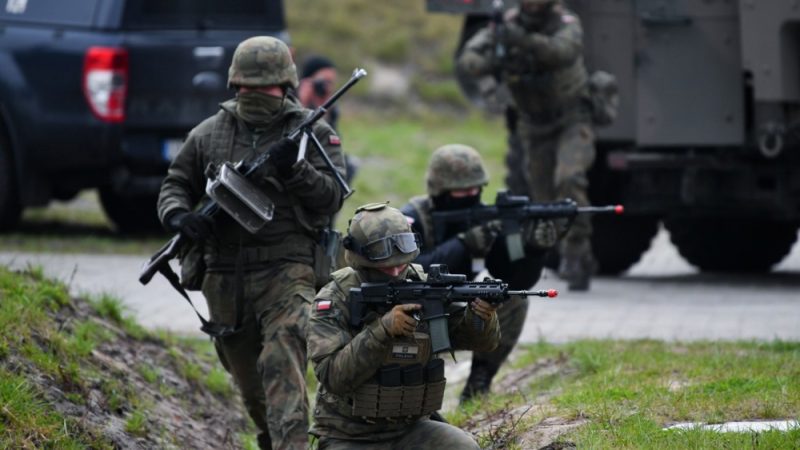
Polish troops deploy near the border with Belarus. Click to enlarge
However, that’s changing and some sort of clash is looming between Russia and NATO. As Germany, Poland and the Baltic nations have all begun to prepare in earnest with this prospect in view.
I don’t know whether that clash will originate in Ukraine or in one of the adjoining states like Poland or Belarus. But I would not be surprised if we see a sudden flare up of hostilities in the region between Russia and NATO in the coming years. Ed.
Ukraine grapples with shortage of troops after more than four years of war
Samya Kullab – Associated Press Oct 8, 2026
Ukraine’s advances in drone technology and tactics have captured the world’s attention.
Despite those innovations, one problem has plagued the country since the start of Russia’s invasion: a shortage of combat-ready troops.
Ukraine always has been outmanned by Russia, but as the war drags through its fifth year, the need for personnel is increasingly acute, commanders and analysts say, with some units at only half strength.
There just are not enough forces to fully exploit the battlefield advantages resulting from the drone innovations.
“Based on the equipment and the number of people we have today, we barely have enough to hold the sector we currently have,” said a deputy commander of the Da Vinci Wolves battalion in eastern Ukraine’s Pokrovsk area, a focus of Russia’s offensive.
“To move forward would inevitably mean greater losses,” said the deputy commander, who insisted on identifying himself only as “Afer” because of military rules.
Long-standing mobilisation problems, including draft dodging and desertion, make it harder for Ukraine to build its reserves, according to military experts, resulting in only incremental changes along the 1,250-kilometre (775-mile) front line.
Ukraine needs to be able to commit forces quickly without taking them from elsewhere on the front.
Otherwise, commanders have fewer options to turn a temporary advantage into a sustained operation, said Nick Reynolds of the UK-based Royal United Services Institute, a defence and security think tank.
The shortage means that units can’t be rotated often enough, he said, “leading to exhaustion and, in turn, exacerbating casualties”.
The Defence Ministry, which in July underwent a shake-up by President Volodymyr Zelensky, is trying to tackle the problem with reforms to mobilisation, training and the way the army is organised.
Uneven performance by front-line units worsens the problem.
Weaker formations suffer heavier losses, creating a cycle of high attrition and constant replenishment.
The ministry did not respond to Associated Press requests for comment, but one of its officials summarised the problem by saying: “There just are not enough people.”
Developing a new mobilisation policy, including encouraging deserters to return to duty, is among the most sensitive issues under consideration, said the official, who was not authorised to brief the media and spoke on condition of anonymity.
Former defence minister Mykhailo Fedorov, who was replaced by Yevhenii Khmara in the summer shake-up by Mr Zelensky, had sought to reorganise the military around fewer but stronger units.
He wanted to reinforce those that performed well and disband the weaker ones.
Mr Khmara has said he wants to continue those changes. But the reforms will take time.
Yehor Cherniev, a member of parliament’s defence committee, said legislators have yet to see mobilisation initiatives.
In June, Mr Fedorov introduced reforms to military contracts designed to make infantry service more attractive by offering higher salaries and fixed terms of service.
Convincing Ukrainians who have little incentive to fight is a major challenge after more than four years of war, and the country is struggling to recruit enough troops from its estimated population of 39 million.
The pool of men aged 25-60 is relatively small following years of demographic decline from war-related displacement and migration.
There are about 6.8 million men aged 25-59, according to UN figures provided by Ukraine’s National Health System, but that includes wounded veterans and men otherwise unable to serve.
Official figures put the military’s strength at about one million, with only a small fraction deployed at the front.
Compulsory service applies only to men.
Women are allowed to volunteer, and those with medical or pharmaceutical training are required to register with the military.
More than 70,000 women are serving in the army, according to Defence Ministry statistics in January 2025.
In March, Mr Fedorov said about two million Ukrainian men were evading service, while about 200,000 soldiers had deserted or left their units without authorisation.
The penalty for desertion is imprisonment of up to 12 years.
Some men flee the country illegally or hide at home.
Recruiters sometimes stop them on streets and trains, and those without valid exemptions are sent into the army.
In January 2025, the government said about 950,000 men had deferments at the request of businesses.