
Mike Whitney – The Unz Review Sept 20, 2026
On Saturday, the Houthis launched ballistic missiles at targets in Saudi Arabia setting a fuel storage facility ablaze while forcing the closure of the King Khalid International Airport in Riyadh. Saudi’s Civil Defense agency issued emergency alerts for a “hostile aerial threat” after residents and journalists reported hearing explosions in the area. According to the BBC:
Air raid alerts had sounded in the capital for the first time since the Iran-backed Houthis increased their attacks on Saudi Arabia in July….
…a column of black smoke was seen rising from fuel tanks near the Saudi capital’s international airport, where flights were disrupted temporarily on Saturday.
In a statement posted online, Houthi military spokesman Yahya al-Sarea said a “large number of ballistic and cruise missiles and drones” had been used to attack “sensitive sites” in Riyadh and Aramco state oil and gas company facilities in Yanbu on the coast….
On Friday, investment banking giant JP Morgan said it was struggling to predict how oil prices would be impacted by the war, telling investors in a rare note that “we simply don’t know how to model the endgame”. BBC
Saudi leaders have expressed growing concern that their long-term conflict with Yemen is likely to escalate now that the Houthis have improved their ballistic missile and drone capability. The current incident is the first time the Houthis have struck the Saudi capital indicating that the war has entered a dangerous new phase of intensified hostilities.
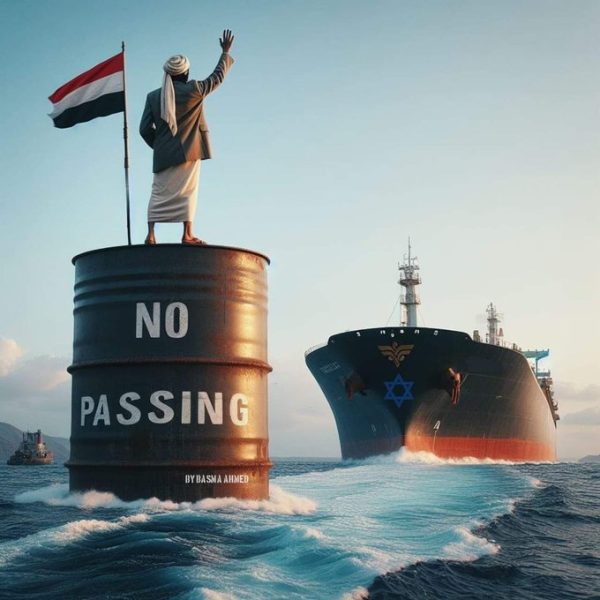
There’s no doubt that the Houthis have been emboldened by their successful offensive along the Red Sea coast where they routed Saudi Forces in a surprise Blitz that seized the strategic Red Sea port city of Mocha leaving them in control of Yemen’s entire western shoreline. The operation was capped off by the seizure of Perim Island, a critical outpost near the Bab al-Mandab Strait, which is the strategic gateway to the Red Sea. From their new vantage point, the Houthis will be in a better position “to threaten or interdict shipping and to launch cross-border attacks into Saudi Arabia more effectively….. It also expands their role in the wider regional confrontation involving Iran, giving them greater strategic value to Tehran and more room to escalate pressure on Saudi Arabia and Red Sea traffic.” In short, the Houthis impressive victory along the west coast has boosted their confidence and greatly increased their willingness to escalate. Thus, we should expect more attacks on Riyadh and on Saudi critical energy infrastructure in the days and weeks ahead.
On Friday, Iran’s Press TV published a brilliant article highlighting the extreme vulnerability of Saudi Arabia’s infrastructure and how the Houthis might exploit that weakness. The article was titled “Inside Yemen’s target bank: Why Saudi Arabia’s critical infrastructure is sitting on a tinderbox” by Ivan Kesic. Here’s a rather long excerpt from the piece:
As Saudi Arabia persists in its unprovoked military aggression against Yemeni civilian infrastructure, the Yemeni armed forces and Ansarullah resistance movement have prepared a comprehensive target bank of critical Saudi infrastructure, ranging from oil processing facilities and export terminals to desalination plants and aviation hubs….. The Yemeni response has already begun with ballistic missile and drone strikes against Saudi Aramco facilities in Jizan and Yanbu, achieving accurate and direct hits that have once again demonstrated the reach and precision of Yemeni military capabilities.
The declared maritime blockade on Saudi shipping through the Bab el-Mandeb Strait, coordinated with the existing closure of the Strait of Hormuz for the US and allied vessels, represents a dual-pronged strategy capable of severing two of the world’s most critical energy arteries simultaneously. This strategic reality demands an examination of the target bank that Yemen has at its disposal, a catalog of Saudi infrastructure whose disruption could impose unacceptable costs on Riyadh.
Eastern Province energy heartland
The foundation of Saudi Arabia’s economic and military power lies in the Eastern Province, where the world’s most concentrated network of hydrocarbon infrastructure has been developed over decades. The Ghawar oil field, stretching approximately 250 kilometers from north to south, stands as the largest conventional oil field ever discovered and has supplied a substantial proportion of Saudi crude production since its development.
Nearby fields including Khurais, Shaybah, Safaniyah, Manifa, Zuluf, Marjan, Abu Safah, and Berri collectively produce millions of barrels of crude oil daily, representing the lifeblood of the Saudi economy and the primary source of revenue that funds the military aggression against Yemen.
The Abqaiq processing complex occupies an exceptional position within this network, functioning as one of the world’s largest crude oil stabilization and processing centers through which much of Saudi Arabia’s crude passes before reaching export terminals or refineries.
This facility removes volatile gases, adjusts pressure, and prepares crude to meet commercial specifications, serving as a strategic bottleneck within the global petroleum system.
The 2019 attack on Abqaiq and nearby Khurais temporarily disrupted approximately 5.7 million barrels per day of production, equivalent to roughly five percent of global oil supply, demonstrating the vulnerability of this concentrated infrastructure….
The Khurais processing complex forms another major component of this network, capable of producing well over one million barrels of crude per day through modern facilities that include gas-oil separation plants, pumping stations, and storage tanks. These processing centers, along with the Hawiyah, Haradh, Uthmaniyah, Shedgum, and Wasit gas processing facilities that separate natural gas liquids and distribute processed gas to power stations and petrochemical industries, represent critical nodes whose destruction would ripple through the entire Saudi energy system.
The concentration of these assets in the Eastern Province creates both efficiency and vulnerability.
Modern infrastructure planning has emphasized redundancy and rapid recovery, yet the geographic proximity of these facilities means that coordinated strikes could potentially disrupt multiple nodes simultaneously, overwhelming response capabilities and creating cascading failures throughout the integrated energy network….
Export terminals and maritime infrastructure
Saudi Arabia’s ability to export its oil wealth depends upon a network of maritime terminals that present lucrative targets for retaliation.
The Ras Tanura terminal on the Persian Gulf coast remains among the largest oil export facilities in the world, featuring enormous storage farms, multiple offshore loading berths, pumping stations, and marine terminals that enable supertankers to load millions of barrels for shipment to Asia, Europe, and North America.
Nearby terminals at Juaymah, Ras al-Khair, and industrial ports around Jubail further expand export capacity, while the King Abdulaziz Port at Dammam connects the Eastern Province with global markets through specialized facilities supporting bulk commodities and petrochemical exports.
To reduce dependence on the Strait of Hormuz, Saudi Arabia has invested heavily in western export infrastructure, most notably the East-West Pipeline that transports crude oil approximately 1,200 kilometers across the Arabian Peninsula from the Eastern Province to the Red Sea port of Yanbu. This strategic pipeline provides an alternative export route should maritime traffic through the Strait of Hormuz become disrupted.
However, the pipeline itself represents a vulnerable linear target whose disruption could sever the kingdom’s western export capacity, while the Yanbu terminal and its associated refineries, petrochemical complexes, industrial ports, and desalination plants offer concentrated targets whose destruction would have cascading effects on both Saudi exports and domestic supply….
Red Sea and Persian Gulf coastal infrastructure
Saudi Arabia’s extensive coastline along both the Red Sea and the Persian Gulf hosts a remarkable concentration of critical infrastructure that Yemeni forces are positioned to threaten. The Red Sea coast, stretching from the Jordanian border to Yemen, includes the major ports of Jeddah, Yanbu, and Jazan, along with the industrial cities of Yanbu and Rabigh.
These facilities support not only energy exports but also the import of essential goods, military logistics, and the religious pilgrimage infrastructure that brings millions of visitors and significant revenue to the kingdom each year…. The coastal concentration of infrastructure means that a relatively limited number of strikes could achieve disproportionate effects by targeting the nodes through which Saudi Arabia’s economic lifeblood flows…..
Aviation infrastructure as strategic target
Saudi Arabia’s major international airports, including King Abdulaziz International Airport in Jeddah, King Khalid International Airport in Riyadh, King Fahd International Airport in Dammam, and Prince Mohammad bin Abdulaziz Airport in Medina, serve not only as civilian transportation hubs but also as critical nodes for military logistics, troop transport, and support for the aggression against Yemen.
The disruption of these airports would complicate Saudi military operations, delay the deployment of forces and equipment, and impose significant costs on Riyadh’s ability to sustain its aggression…. The targeting of these bases would directly degrade Saudi offensive capabilities while sending a clear message that the cost of aggression will be borne on Saudi territory….
Water and power infrastructure
Saudi Arabia’s dependence on seawater desalination for its municipal, industrial, and agricultural water supply represents a critical vulnerability that Yemeni forces could potentially exploit.
Massive desalination facilities located along both the Persian Gulf and Red Sea coasts, including plants at Jubail, Shuaibah, Shuqaiq, Ras al-Khair, Yanbu, and Jeddah, produce millions of cubic meters of freshwater daily to support major urban centers and industrial development.
The destruction or disruption of even a single major desalination plant could create a humanitarian crisis affecting millions of Saudi citizens and residents.
The national electricity grid, operated primarily by the Saudi Electricity Company, includes thousands of kilometers of high-voltage transmission lines, major substations, gas-fired generating stations, and an increasing proportion of renewable energy projects.
The grid’s reliance on natural gas from processing facilities that are themselves vulnerable to attack creates a chain of dependencies that could be exploited through coordinated strikes. The disruption of electricity supply would affect not only civilian life but also the operation of oil processing facilities, desalination plants, airports, and military installations, creating cascading failures throughout the economy….
Industrial cities and economic diversification projects
Saudi Arabia’s Vision 2030 economic transformation has created new infrastructure whose disruption would have both economic and symbolic significance. The Jubail industrial city on the Persian Gulf coast has become one of the world’s largest petrochemical manufacturing centers, housing facilities operated by Saudi Aramco, SABIC, and numerous international partners.
Products manufactured there include plastics, fertilizers, industrial chemicals, steel, polymers, and specialized petrochemical feedstocks destined for markets worldwide. The Yanbu industrial city on the Red Sea coast hosts major refineries, petrochemical complexes, LNG-related facilities, and manufacturing industries…. The targeting of these projects would demonstrate that the Saudi government’s ambitious development plans cannot be insulated from the consequences of its military aggression….
Pipelines and internal logistics network
The East-West Pipeline, transporting crude oil from the Eastern Province to Yanbu, is a particularly strategic asset whose damage would redirect exports through the vulnerable Strait of Hormuz. The regional pipelines connecting Saudi Arabia to Bahrain, the United Arab Emirates, and other Persian Gulf states provide additional routes for energy exports and domestic supply, representing alternative targets whose disruption would affect broader regional security.
The railway network, including the North-South Railway and Haramain High-Speed Railway, supports the movement of goods, passengers, and military logistics across the kingdom. The disruption of rail transport would complicate the deployment of forces and equipment while imposing costs on the civilian economy.
The road network, while extensive and redundant, includes bridges, tunnels, and other choke points whose damage could disrupt the movement of military supplies and personnel. The internal logistics network that supports Saudi Arabia’s military aggression against Yemen includes supply depots, ammunition storage facilities, and maintenance centers located throughout the kingdom. The targeting of these facilities would degrade Saudi Arabia’s ability to sustain its offensive operations while imposing direct costs on its war-fighting capability.
The Yemeni armed forces have already demonstrated the ability to identify and strike such targets through their attacks on Aramco facilities and Abha International Airport, suggesting a comprehensive targeting database that will continue to expand as the aggression persist…
Strategic implications of Yemen’s target bank
The comprehensive target bank that Yemen has established represents a strategic deterrent whose credibility is reinforced by the demonstrated capability to strike high-value assets with precision…. The maritime blockade on Saudi shipping through Bab el-Mandeb, coordinated with Iranian control over the Strait of Hormuz, represents a dual-pronged strategy that could effectively sever Saudi Arabia’s energy exports and essential imports simultaneously….
The Ansarullah movement has declared a siege for siege policy, matching the restrictions and military pressure imposed on Yemen with corresponding measures against Saudi Arabia. The Iranian Foreign Ministry has expressed support for this position, calling for the full implementation of the UN-sponsored roadmap and an end to the blockade and aggression that have caused such suffering for the Yemeni people.
The economic consequences of Yemen’s retaliation would be devastating for Saudi Arabia and the global economy. The closure of Bab el-Mandeb would send oil prices soaring to $200 per barrel, triggering inflationary pressures worldwide and potentially tipping vulnerable economies into recession. The combined closure of both Bab el-Mandeb and the Strait of Hormuz would sever two of the world’s most critical energy arteries, creating a global transportation crisis of catastrophic proportions.
The Saudis would bear the primary burden of these consequences, as their export-dependent economy would be paralyzed by the inability to ship oil or import essential goods…..
According to observers, Riyadh appears to believe that its military superiority can overwhelm Yemeni resistance, yet the historical record of the past decade demonstrates the futility of this approach.
The Yemeni armed forces have shown remarkable resilience, adapting their tactics and expanding their capabilities to meet the evolving threat.
The target bank they have assembled represents a strategic reality that the Saudis ignore at their peril. “Inside Yemen’s target bank: Why Saudi Arabia’s critical infrastructure is sitting on a tinderbox”, Press TV
Kesic’s piece reads less like a political commentary than a strategic blueprint for the comprehensive obliteration of Saudi Arabia. Even so, given Ansarullah’s territorial successes in the last few weeks, (coupled with its attacks on the Capital) we can assume that the Houthi master plan matches up fairly closely to the sites on Kesic’s “target bank”. The question is, how can Saudi Arabia hope to withstand this withering and sustained assault on its critical infrastructure? Riyadh’s mercenary militia has already proved to be worthless under fire, and Trump has already abandoned his Saudi allies with a wave of the hand. So how will they fend off this ‘death by a thousand cuts’; these calculated, precision attacks on its oil and gas facilities, its pipelines, its desalination plants, its industrial cities, its data centers and tech centers, its electrical grid and its transportation hubs?
We don’t see how Saudi Arabia can prevail in this showdown. We don’t see how they will do any better than the US and Israel have done in their misguided war with a virtually impregnable Iran. Any reasonably intelligent person can see there is no “silver bullet, no magic weapon that can overcome the current disparity in power. The Houthis are clearly in the driver’s seat, and nothing short of a massive ground invasion is going to change that. And –the fact is– Trump is not going to launch a ground invasion. So, how does this end?
Not well, I’m afraid, because in early September the US convened a secret meeting in Germany which included senior US military commanders as well as ministers from Saudi Arabia, the United Arab Emirates, Bahrain, Kuwait, Qatar, Jordan, Egypt and Israel. The meeting reportedly focused on the ongoing war with Iran, and “U.S. force posture in the Middle East in regard to the Strait of Hormuz”. Supposedly, “Israel’s IDF Chief of Staff also briefed the group on Israeli operations.”
So why is Trump convening secret, “closed-door” meetings with US military leaders, Gulf allies and Israel’s IDF Chief of Staff?
If that isn’t a red flag, I don’t know what is!
And, keep in mind, the meeting was designed to conflict with Iran’s confab on regional security which was postponed due to Saudi Arabia’s bogus last-minute request for a rescheduling. (The meeting was supposed to deal with “regional security issues, particularly arrangements for maritime routes and shipping through the Strait of Hormuz.”) So, how is it that the Saudis can send Ministers to the US meeting but not the Iranian meeting?
Could it be that the Trump team deliberately wanted to sabotage the Iranian meeting so its allies would not commit to regional security arrangements with their archrival, Iran? Could it be that Trump wanted to derail impending security agreements until the US and Israel make one, last big push to topple the regime in Tehran and reassert control over the Strait?
Isn’t that why Trump told Axios on Thursday that he’s approaching a critical juncture in the Iran war over whether to restart massive attacks in an effort to bring the conflict to a close.
“I have a big decision coming up. Do I want to go in and annihilate them or do I not? It’s a big decision. Anything could happen with me.”
Isn’t that why Israeli Prime Minister Benjamin Netanyahu has made numerous public statements recently emphasizing his commitment to defeating Iran and ousting its government in the very near future:
“We have done most of the work, but there is still work to complete, and we will complete it.” (September 17, 2026)
Or this: “We will eliminate Hamas, and first and foremost we will defeat the regime in Iran. We will bring it down. It will fall.”
He has repeatedly described the Iranian regime as weak, “fighting for its life,” and stating that “its end is near,” while calling the toppling of the regime Israel’s central remaining mission.
These statements go beyond degrading Iran’s military or nuclear capabilities. Toppling the Iranian government is Israel’s primary objective, and Bibi is just as determined to achieve that goal as ever. Naturally, Trump will do whatever he is told to do.
So, what now?
Analysts predict that Trump and Co will work out the details of their new plan with the Gulf allies during this week’s activities at the United Nations. (starting Tuesday) What is certain, however, is that Trump and Bibi are not going to rely on the same aerial bombing and missile strategy (they’ve used for the last seven months) that has failed to produce the outcome they seek. If conventional weapons are not going to do the trick, then they’ll probably resort to more lethal alternatives. And that is something that should concern us all.
i knew a nurse a beautiful blonde
she married into the saudi royal family
she said behind closed doors they were secret jews
just like the british eh ?
BRITAIN STANDS QUIET OVER ISRAELI TERRORISM
Al Jazeera
121.3K Followers
Declassified documents show UK aware of Israeli war crimes for well over 24 years
Story by Al Jazeera Staff • 4d • 3 min read
Israeli Prime Minister Ariel Sharon with his British counterpart Tony Blair in Jerusalem November 1, 2001 [File: Natalie Behring/ Reuters]
British diplomats condemned Israeli conduct in the occupied West Bank as a pattern of human rights abuses in 2002 – 24 years before London took a tougher stance towards Tel Aviv this week.
The 7 7 bombing hardened the british to israeli terrorism
These decades-old condemnations are contained in UK Foreign Office files written during the administration of war criminal and former
Prime Minister Tony Blair while Israel undertook a brutal 2002 offensive in the occupied West Bank.
Lord Levey Tony Blairs boyfriend and cut out man between Blair and Rothschild had his phone tapped by Iran, all is now in the ioen
The NSA whistle blower Savid Murphy-Fawkws said Tony Blairs phone was tapped 24/7 by the USA
they saw him as a Pinocchio figure and did not trust him
here is the UK the radio programme Chris Cooper investigates, chris tapped Blairs phones even his bedtoom where he played on Conspitacynews.info tows and arguments between tony and cheris
The files, released in 2024 and reported in a recent investigation by the website Declassified UK, record British diplomats describing a pattern of abuses by a state their own government would go on to arm for the next two decades.
Today, Blair sits on the Board of Peace ( joke ) that presides over Gaza, where Israel’s disregard for Palestinian lives and the rules of war has been demonstrated on a genocidal scale, while the UK’s newly seated leadership refer to Israel’s actions as “a stain on the conscience of the world”.
But what did the British government already know about Israel’s actions more than 20 years ago?
What the files say
That record begins in March 2002, when then-Israeli Prime Minister Ariel Sharon launched Operation Defensive Shield in retaliation for a wave of attacks by Palestinian armed groups, including Hamas.
this guy is bang on the money
https://www.youtube.com/watch?v=Sk4vfGOH8l0
Yesterday’s interview of Max Blumenthal by Tucker Carlson is much more than the title of the attached link suggests. It is very hot.
Max Blumenthal: I Went to Iran and Was Detained by the Trump Admin
https://www.youtube.com/watch?v=zw5H0fFkj-k
Both men crossed the Zionist red line so many times in their past exposés of the Israeli problem that they are most likely at the top the entire Zionist-Rothschild hitlist, but this one exposes everything. The only thing likely saving Tucker and his family from their terror tactics is his notoriety and his openness about the problem as an American where he has a great deal of support, even in high places. As for Max, the only thing likely saving him is that he is Jewish, and to get rid of him would further fragment both US and Jewish support for Israel’s brazen crimes and illegal wars.
In this interview these two journalists are exposing everything they can, including the unspeakable crimes against against Palestinians, fellow Jews, Iranians, etc. in the Middle East, and the total control of Israel over the Trump administration, including US domestic and foreign policy when it comes to serving Israeli interests, all of which is ILLEGAL. Not, ever revealed in the mainstream media is the fact that Israel is only now in total control of the governments of numerous South American nations.
What we can drawn from the interview is that this criminally-insane network of sociopath Zionists running Israel and US is totally unified with organized crime and is rampaging around the world taking over one bankster-indebted government after another. From everything else we know, it is clear that in taking over the Trump administration and the US uniparty, they are also now in control over the US military and all of its weapons of mass destruction. This means not only that Israel, in effect, is in control of the US nuclear arsenal, HAARP, military logistics, satellite surveillance, weather-wars weaponry, and the entire buildup of US forces and weaponry on the planet. It appears that the US is, in fact, an Israeli-Rothschild stooge nation and that it has no integrity left of its own. There appears to be no organized opposition to them except that which is coming from Iran, and if we want to save the planet, our nations, and eventually our lives, they have to be STOPPED NOW.
Women ‘fear for safety’ over plans to house male asylum seekers at military base
The Government’s proposal to move 1,256 male asylum seekers into an ex-military base near Piddington
has sparked anger among many residents.
By Izzie Addison, Press Association September 14,
many migrants are from criminal gangs, shirkers socialists shirtlifters and nutjobs are coming here for an easy life
But the old IRA is back and with a huge following, talks on bombing not the migrants but thier politicians who bring them here
will be targeted in a new bombing campaign across ireland and the UK
i cant read all this
anyway
Black voters should push for slavery reparations, says Labour MP
Story by Craig Simpson
what you need to hear is that black people should just piss off home
I don’t think bigger bombing is a good idea. The nuke thing can go both ways and will.
I stopped reading at: “According to the BBC…”
😒