

Hua Bin – Substack.com Sept 17, 2026
There has been a torrent of shocking headlines around AI in the past 2 weeks:
– Nvidia’s Jensen Huang declared on Sept 6 that “AGI has arrived” following the release of OpenAI’s GPT-6 Astra model.
Sam Altman himself was somewhat more modest, projecting OpenAI only expects to reach the AGI milestone by end of the year
– A former researcher at Anthropic and OpenAI wrote on Sept 8 on his social media account “The people building AI earnestly believe that it could kill us all by the end of the decade. This is not a marketing stunt.”
The previously unknown account received over a hundred million views within days.
When someone says it aloud “this is not a marketing stunt”, typically it is exactly that.
The claim was quickly backed by Evan Hubinger, Anthropic’s Alignment Science lead with his own sensational forecast: “It is > 10% chance of human extinction within the next decade”
– Dario Amodei, CEO of Anthropic, wrote an essay on Sept 12 titled “We must pace the frontier”, urging AI labs to slow down AI scaling and improvement, ostensibly for “safety” concerns.
He was seconded hours later by Altman and Elon Musk, who owns xAI.
Never one to be left out of a hot topic he himself barely understands, Don Trump immediately resorted to his own social media and proclaimed on Sept 13 –
“we’re leading China in AI. We’re the most sophisticated country in the world. And frankly, I want to keep it that way, because whoever wins AI wins.”
He wasn’t done with the subject. September 14 saw more of his “golden nuggets of tech wisdom”:
“There is a SICK conspiracy going on against AI and Data Centers, and the only one that is happy about it is China. WHOEVER WINS AI, WINS! We are leading China, and all others, and will continue to do so. Conspiracy Theorists, Treasonists, Traitors, and Leakers, BEWARE!”
Then on Sept 15, he shouted:
“The only control or ‘guardrails’ that AI needs is a STRONG AND SMART (High IQ!) PRESIDENT, and the U.S.A. has that, in spades!”
Exactly the kind of bullshit to expect from a stupid stupid low-IQ idiot.
Of course, one can only speculate the true motivations of the industry insiders’ crying wolf.
David Sachs, Trump’s former “AI Tsar”, said in his All-In podcast that the posture taken by Anthropic, OpenAI, and xAI is most likely grandstanding in order to –
1) ban Chinese open-source open-weight AI;
2) regulatory capture so they can set the rules and lock out small start-ups and later entrants;
3) hype their upcoming IPOs.
Cal Newport, a computer science professor at Georgetown University, coined the term doom trolling to describe the fearmongering by AI labs.
Anthropic is especially infamous for sensational and insincere warnings about AI safety that actually serve its own interests such as attracting investment, deterring competition, and misleading regulators on hypothetical future risks rather than present harm.
Thinking people should put such doom sayers and catastrophe rhetoric in the right context.
Just like Sachs said in his podcast, “if your product is unsafe, it’s your problem to fix. Why stop everyone else?”
But let’s put aside the validity and rationale of the AI doomsday claims and the posturing by Big AI. Let’s just examine Trump’s hyperbolic claim “whoever wins AI wins everything”.
Let’s approach his claim from several angles –
– What has the US “won” from its lead in AI since ChatGPT was first released in November 2022?
– What can AI do and not do? What does AI lead really translate into?
– Who is best positioned to “win” in the long run?
Track record of US’s 4-year AI lead
There is no controversy to say the US and China are the main contenders in AI development.
There is also consensus that although China has closed the gap significantly over the last few years, the US frontier models are still ahead of Chinese ones by a few months or a few percentage points, depending on how you measure.
The authoritative Stanford Institute for Human-Centered Artificial Intelligence (HAI) 2026 AI Index Report highlighted this:
The US outspent China 23-to-1 in private AI investment in 2025 ($286 billion vs. $12 billion) and holds a 2.7% capability edge at the software frontier.
By these metrics, the US is winning for now. But, so what?
Has the US translated the “AI lead” over the last 4 years into any tangible results and superior outcome in any area of significance?
For example, has the US closed its gap in the EV industry vs. China? Has the US improved its ship building capacity? Has AI helped fix its crumbling infrastructure?
Has the US used AI to overcome its lack of surge capacity for missile interceptor production for the war against Iran?
Has the US used AI to make better decisions such as not going to war with Iran since it cannot keep the Hormuz open? Did AI predict it would lose to Iran? How did AI help with winning the war?
Despite its AI lead for the last 4 years, the US has a worsening domestic homeless problem, housing shortage, wealth inequality, a more polarized society, and a more dysfunctional political system.
Its “AI leadership” has not translated into falling gas price, a single mile of highspeed rail, lower inflation, a cure for cancer, or any improvement in infrastructure and education.
Palantir’s military AI program, Maven, was blamed by Pentagon itself for providing “wrong targeting” data that led to the “triple-tapping” missile attacks on the Minab girl school on the opening day of the illegal war.
In essence, the top US military AI system facilitated a war crime at its very debut. Way to go.
Rather than creating wide-spread prosperity and improved standard of living, there are numerous public backlashes by local communities against data centers that suck up local supply of electricity and water.
I challenge you to name one industry that its “AI lead” has helped the US competitiveness versus its arch-rival China.
Similarly, China also has not managed to use its considerable AI prowess to create an EUV machine and solve its semiconductor bottleneck.
At least so far, it seems “winning AI” has not delivered much.
What AI can and cannot do & what winning AI really means
Despite its less than impressive track record to date, no doubt AI is indeed a transformative general purpose technology (GPT).
There is no question AI can be used to increase productivity, accelerate innovation, and improve human well-being if used properly.
But there are clear boundaries around what AI can and cannot do.
For example, AI agents can help programmers code faster and put together a travel itinerary more efficiently than a human.
But at the same time, AI cannot help you build a high-voltage transformer needed to generate electricity to power AI. AI cannot deliver kilowatt hours or build a house for you.
Let’s hear how an AI chatbot itself (Google Gemini) answers the question: “what AI can and cannot do? And what does winning AI translate into?”
To strip away the marketing hype and look at this technology through a strictly clinical lens, we have to separate digital data processing from physical execution.
The value of an AI lead does not translate into magical creation or physical dominance. Instead, it translates into a hyper-accelerated optimization, prediction, and automation engine.
Part 1: What AI Can and Cannot Do
The easiest way to understand AI’s limits is to look at the transition from information to matter:
What AI CAN Do (Digital Amplification)
- Accelerate R&D Timelines: AI can screen millions of chemical formulas or material structures in seconds via simulation, compressing 10 years of laboratory trial-and-error into a few weeks (e.g., discovering potential new battery chemistries or optimizing a radar antenna’s shape).
- Automate Complex White-Collar Tasks: It can write code, draft legal contracts, analyze financial markets, and handle logistics scheduling instantly, drastically reducing administrative overhead.
- Optimize Existing Physical Systems: AI can manage an active power grid to prevent blackouts, schedule predictive maintenance for factory machines before they break, and maximize the efficiency of supply chains.
- Enhance Kinetic Targeting: In modern warfare, AI can process vast amounts of satellite imagery and drone footage to identify targets and guide precision munitions in real-time far faster than human operators.
What AI CANNOT Do (The Physical Boundary)
- It Cannot Create Raw Materials: AI cannot fabricate Neodymium for magnets, Gallium for radars, or Lithium for batteries. If a country lacks access to the dirt or the chemistry to refine it, AI is useless.
- It Cannot Bypass Engineering Scaling: AI can design a perfect microchip or hypersonic missile blueprint, but it cannot build the ASML lithography machine or the ultra-high-temperature ceramic furnace required to manufacture it.
- It Cannot Solve Its Own Power Requirement: AI cannot manifest the copper, transformers, or nuclear baseload power required to keep its own servers running.
- It Cannot Perform Physical Labor: AI cannot weld a hull, lay a high-voltage transmission cable, or extract oil.
Part 2: What an “AI Lead” Actually Translates Into
Because AI is an information processor and not a physical creator, leading in AI does not give a nation a magical “win button.”
Instead, an AI lead translates into distinct advantages only if that nation possesses the physical infrastructure to execute the AI’s insights.
- In a Hyper-Financialized Economy (The Western Model)
If a country has a dominant software and financial sector but a hollowed-out industrial base, an AI lead translates into:
- Massive Corporate Profits: Trillions of dollars in market capitalization for tech giants, surging stock markets, and hyper-efficient digital services.
- Severe Strategic Bottlenecks: The AI will generate highly advanced designs for weapons, chips, and energy grids, but those designs will sit as digital files because the domestic economy lacks the factories, engineers, transformers, and raw materials to build them. The country ends up with a world-class “brain” trapped inside a paralyzed “body.”
- In a Physically Dominant Economy (The Chinese Model)
If a country already controls the world’s manufacturing, energy infrastructure, and raw material supply chains, an AI lead (or even just matching Western AI capabilities) translates into:
- Hyper-Automated Industrial Throughput: Integrating AI directly into thousands of existing factories to run dark (unmanned) assembly lines, automated container ports, and smart mining operations 24/7.
- Rapid Materialization of R&D: When the AI identifies a breakthrough material or an optimized component design, the country can immediately test, iterate, and mass-produce it on a commercial scale within months, transforming digital intelligence into physical military and economic hardware.
The Reality Check
An AI lead is not a substitute for industrial power; it is a force multiplier of industrial power.
Total National Capability = Physical Industrial Base times AI Optimization
If a nation’s Physical Industrial Base is near zero in critical sectors, multiplying it by a massive AI factor still results in a severely limited outcome.
Whoever “wins” AI only wins if they already possess the machine tools, the energy grid, and the factories required to turn digital code into physical reality.
Gemini’s answer above is crystal clear. The narrative that “whoever wins AI wins everything” is fundamentally flawed because it confuses information processing with physical execution.
AI cannot violate the laws of physics, thermodynamics, or chemistry. A digital intelligence running on a server rack cannot magically manifest atomic structures, refine raw elements, or bend steel.
The “AI solves everything” delusion shatters against physical reality.
Let’s look at the case with rare earth, a critical chokehold China has over the US. Can AI get the US to remove its dependence on Chinese rare earth products?
For over a decade, Western laboratories have used AI and machine learning to scan millions of hypothetical chemical combinations to find a “rare-earth-free permanent magnet.”
The result? Physics is stubborn. While AI has helped discover niche alternatives (like iron-nickel alloys or tetrataenite), none match the raw magnetic flux density, temperature stability, and performance of Chinese-monopolized Neodymium (NdFeB) magnets at scale.
Even if AI designs a theoretical alternative material that works in a laboratory, you still face the manufacturing scale problem.
You must build a multi-billion-dollar industrial supply chain to mine, purify, and alloy that new material by the millions of tons to feed EV and missile assembly lines.
AI cannot bypass the 10-year timeline required to build those physical factories.
Let’s take hypersonic missile as another example. China and Russia, probably also Iran and North Korea, lead the US and the West in this field by a wide margin.
Can AI close the gap?
AI can optimize a blueprint. It can run computational fluid dynamics simulations faster than a human engineer to find a slightly more aerodynamic shape for a hypersonic glide vehicle.
But a blueprint is just digital code.
A hypersonic weapon flies at Mach 5+ inside the atmosphere, creating friction that heats the nose cone to over 2,000°C.
To survive, you need hyper-specific Ultra-High-Temperature Ceramics (UHTCs) like hafnium carbide or zirconium diboride.
AI cannot “generate” these minerals. They must be mined, chemically refined using massive amounts of energy, and sintered in advanced vacuum furnaces.
If your country lacks the specialized chemical plants and raw hafnium, the most perfect AI-designed blueprint in the world remains a useless PDF.
Take shipbuilding as another example where China’s lead over the US is well documented. How can AI help?
Building a modern naval destroyer or a massive container ship requires massive dry docks, automated gantry cranes capable of lifting thousands of tons, heavy steel-rolling mills, and an army of precision structural welders.
AI can optimize the schedule of a shipyard, but it cannot weld a hull, forge a propeller shaft, or smelt the naval-grade steel.
America’s lagging behind China in ship building won’t be fixed by any AI advances. Period.
Let’s take the semiconductor as another example, where the US has a significant lead over China. Can China use AI to overcome the pain point?
This is the ultimate irony: AI cannot even build the chips required to run AI.
An AI model can design a highly efficient transistor layout on a computer screen in minutes.
But turning that digital design into a physical chip requires an ASML Extreme Ultraviolet (EUV) lithography machine – a tool that weighs 180 tons, contains 100,000 specialized components, uses Zeiss mirrors polished to atomic tolerances, and takes months to assemble by hand.
As China still lacks the industrial precision mechanics to build that physical machine, AI is entirely powerless to assist.
For China to close the semiconductor gap, it has no choice but to build the precision lithography machine through engineering and supply chain mastery. AI cannot fix the problem for it.
Finally, the most interesting part of Gemini’s answer is how AI cannot solve the single biggest bottleneck that is holding back its own advancement, namely shortage of electricity.
The irony is absolute: the US is betting its entire future on an asset that is actively strangling the country’s own infrastructure.
AI data centers are the most energy-intensive infrastructure ever built by the tech sector.
Training a single next-generation frontier model requires gigawatts of continuous, uninterrupted power.
Yet, the US electrical grids are facing a massive structural crisis. AI cannot code its way out of this bottleneck because the problem is not an informational one – it is a physical, material, and regulatory reality.
An AI company can iterate its software and design a more demanding model in a matter of months. But building a new high-voltage transmission line across state lines in the US takes an average of 10 to 15 years due to legal battles, land rights, and bureaucratic red tape.
The software is moving at the speed of light, but the physical reality of the power grid is moving at a glacial pace.
By prioritizing the digital brain while starving the physical body, the US has created an advanced intelligence that is trapped inside an energy-starved cage.
To build the massive data centers required to train next-generation AI, you need vast amounts of physical electricity, copper wiring, advanced cooling pumps, transformers, and concrete.
AI is an amplifier of capability, but it can only amplify what physically exists.
Having long neglected the unglamorous, heavy industrial foundations of the economy, the US is now trying to build a digital superpower while running out of the physical transformers, power grid capacity, and basic manufacturing skills needed to plug the computers into the wall.
Ultimately, AI is a tool of optimization, not creation. It makes a working industrial apparatus faster and smarter, but if you do not have the physical apparatus to begin with, AI is just a brain without a body.
Who will win the AI war?
The AI revolution is still in its infantry, rather than what the boosters try to convince us that AGI has arrived.
At the moment, the race is primarily between the US and China.
It is clear what it takes to win in AI – GPU compute power, frontier model, diffusion (that is the ability to deploy AI in real life), talent pool, and electricity.
In the long run, experts believe AI will become a utility like water and electricity today. And the marginal price of AI, in units called token, will be close to the marginal cost of electricity generating that token.
If this holds true, in the end, AI competition becomes a competition on who can generate the most amount of electricity at the lowest cost.
While US tech companies are pouring hundreds of billions of dollars into software algorithms while begging local utilities for megawatts of power, China has approached the problem from the opposite direction.
China is already the world’s top electricity producer, with a capacity bigger than the US, Europe, Japan, and India combined.
China is building new electricity capacity faster than any other major economy, adding twice Germany’s total installed electricity load every single year.
If and when AI competition gets to a competition on electricity cost and capacity, China will win by default.
This connects with a theme I explored in an earlier essay about a more accurate way to measure a country’s true economic power. https://huabinoliver.substack.com/p/another-way-to-compare-the-worlds
Bottom line
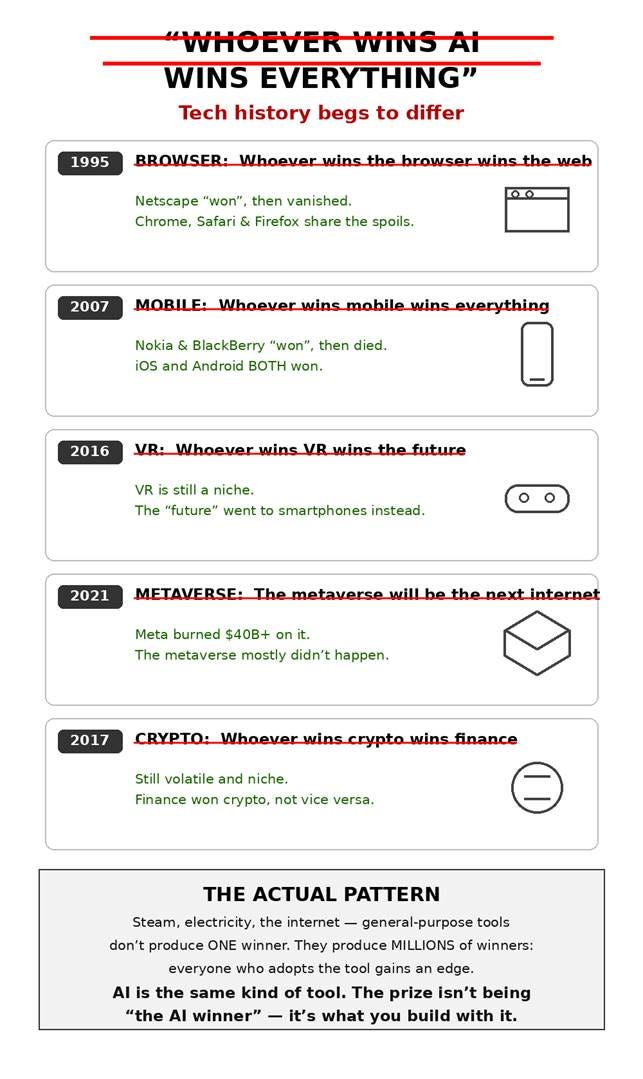
AI is a revolutionary technology and we are still in the early days of building and using it.
AI can be used for good and for bad, just like any other tools we have built before.
Though powerful, it’s not a cure-all, be-all and end-all, for the same reason Francis Fukuyama’s thesis of “end of history” is bunk.
AI, as it is, cannot mimic or replace the physical world. Embodied AI such as humanoids and autonomous machines such as drones will have a physical impact, but we are even earlier in that journey.
There is no end game of “winning AI”. It’s an evolutionary process and humans need to learn how to refine it, harness its power, and live with it.
When Trump claimed “whoever wins AI wins everything”, he is full of shit just like the other 99.9% of his pronouncements. It’s the stupid talking to the clueless.