
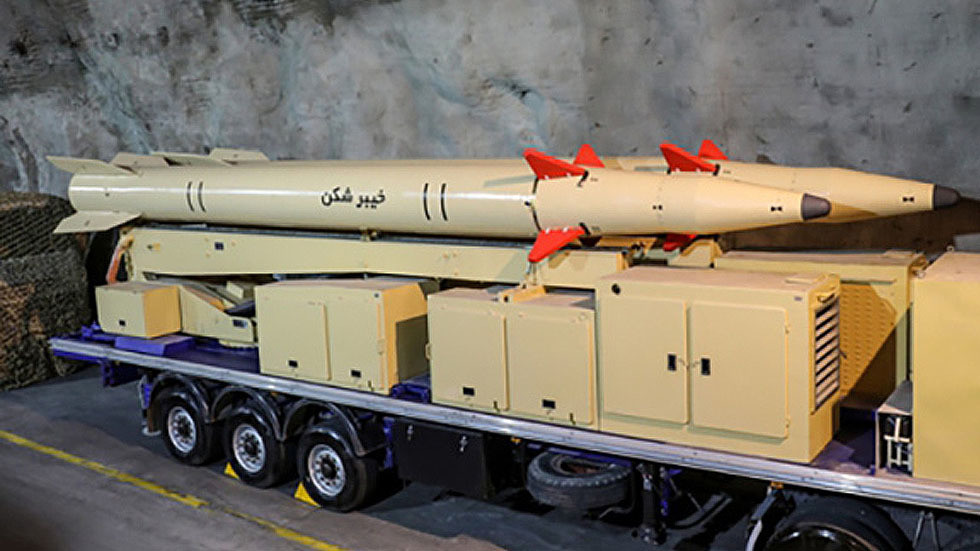
A Kheibar Shekan missile on an erector/launcher
Military Watch Magazine – Aug 2, 2026
Iran’s Kheibar Shekan medium-range ballistic missile has emerged as one of the most significant challenges to the U.S.-led war effort against the country, with U.S. officials increasingly warning that the weapon’s improving performance and more sophisticated employment are complicating regional missile defence efforts. U.S. officials have reportedly become increasingly concerned not only by the missile itself, but also by the way it is now being employed. Rather than launching missiles along predictable trajectories, Iranian forces have increasingly combined varied flight paths, differing speeds, manoeuvring re-entry vehicles and coordinated drone attacks designed to complicate defensive responses. Such tactics force U.S. and allied missile defence systems to expend substantially larger numbers of expensive interceptors while reducing the probability of successful interceptions.
The Kheibar Shekan’s manoeuvrable nose section has attracted particular attention. Unlike conventional ballistic missiles that follow relatively predictable terminal trajectories, the missile is capable of making adjustments during the final stages of flight, reducing the effectiveness of existing missile defence systems. Travelling at hypersonic velocities during re-entry, the missile provides defenders with only a very limited engagement window while simultaneously forcing interceptors to contend with last-minute manoeuvres. The missile’s design lineage is thought to trace back to Iranian procurements of North Korean Hwasong-10 ballistic missiles in the 2000s, with North Korean technology transfers having since played an important role in supporting the rapid modernisation of Iran’s missile industry.
Developed to equip the Iranian Islamic Revolutionary Guard Corps Aerospace Force, the Kheibar Shekan is a solid-fuel medium-range ballistic missile capable of striking targets up to approximately 1,450 kilometres away. Unlike many of Iran’s older liquid-fuel ballistic missiles, the solid-fuel design allows significantly faster launch preparation, reducing vulnerability to pre-emptive strikes while allowing launchers to relocate rapidly after firing. The missile is road-mobile and can be launched from transporter-erector-launchers, making it considerably more survivable than fixed launch systems.
The growing sophistication of Iranian missile attacks comes as U.S. forces are already facing mounting concerns regarding interceptor stockpiles. U.S. Army and Navy missile defence operations have relied heavily on THAAD and Patriot ground-based systems and AEGIS destroyers armed with SM-3 and SM-6 interceptors. Repeated engagements against Iranian missile attacks have steadily reduced available inventories, prompting growing concern within the Pentagon regarding long-term sustainability should the conflict continue at its current intensity. While U.S. military planners are thought to have intended to destroy much of Iran’s missile forces on the ground, failure to do so due in part to extensive underground fortifications, and Iran’s demonstrated ability to rapidly restore its missile bases, have ensured a continued ability to retaliate.
Despite its advanced capabilities, the Kheibar Shekan’s relatively low production cost also provides Tehran with an important strategic advantage. Analysts note that each Kheibar Shekan costs only a small fraction of the price of the interceptors required to destroy it. This creates a highly favourable cost-exchange ratio for Iran, particularly when missiles are launched in large salvos designed to saturate defensive systems. Even unsuccessful attacks can impose substantial financial costs on defending forces through interceptor expenditure alone. This has complemented the development of more advanced missiles that are estimated to be considerably more costly, such as the Fattah 2, which integrates a hypersonic glide vehicle that is nearly impossible to intercept and can be launched against Iran’s highest priority targets.
In March the Israeli paper Haaretz confirmed that eight out of ten Iranian missiles launched against Israel were reaching their targets, following mounting reports and growing quantities of footage pointing to the failures of Israeli and U.S. ballistic missile defences. The report further noted that success rates had continued to improve as air defences have become increasingly strained. An important force multiplier for missile strikes has been the Islamic Revolutionary Guard Corps’ destruction of several billion dollars’ worth of high value air defence radar systems, including the AN/FPS-132 radar in Qatar, and two AN/TPY-2 radars in Jordan and the United Arab Emirates, which constrained situational awareness for the U.S. and Israeli air defence network, forcing both to rely more heavily on ship-based radars and on the AN/TPY-2 radar station in Turkey.