
Military Watch Magazine – July 29, 2026
Informed sources cited by Reuters have reported that Iran is preparing to receive its first shipment of up to 400 Chinese man-portable air defence systems (MANPADS) within the coming weeks. The reported transfer of an estimated $60-70 million worth of air defence systems would significantly strengthen Iran’s short-range air defence network, at a time when the lower tiers of the country’s air defence network have already proven highly capable and shot down several dozen U.S. and Israeli aircraft. According to Reuters, the shipment is expected to include 300 to 400 missiles from the QW and FN series of system.
The QW family first appeared publicly in the mid-1990s as a new generation of infrared-guided shoulder-fired surface-to-air missiles, with the QW-2, unveiled publicly during the 2003 Zhuhai Airshow having served for many years as one of the People’s Liberation Army’s principal man-portable systems, before gradually being replaced by more advanced systems. The newer QW-12 represents a substantial advance over earlier QW variants, and employs a dual-band infrared seeker to facilitate improved discrimination between targets and infrared decoys. During a publicly released live-fire demonstration in 2022, Chinese officials claimed the missile successfully ignored eight decoy flares released by a target drone before accurately striking the aircraft, highlighting significant advances in seeker technology compared to earlier generations.
Chinese forces have increasingly shifted towards the more modern FN-6 and FN-16 as its principal shoulder-fired air defence weapon. The FN-16 incorporates improvements including a more sophisticated seeker and a titanium alloy pre-formed fragmentation warhead, intended to increase lethality against modern aircraft and cruise missiles. Although official specifications remain limited, the missile is widely believed to offer improved resistance to infrared countermeasures and greater effectiveness against manoeuvring targets.
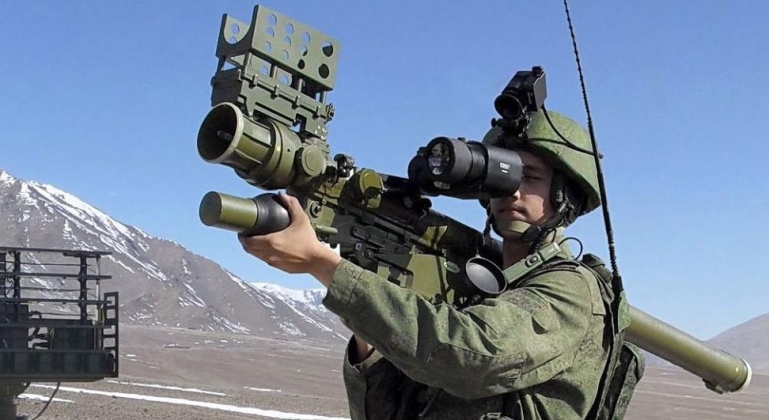
Verba man-portable short range surface-to-air missile launcher
In February Russian government documents indicated that the Iranian Defence Ministry had singed an arms deal valued at $580 million to procure 500 9K333 Verba man-portable short range surface-to-air missile launchers and 2,500 associated 9M336 missiles over three years. This followed the placing of orders for Russian Su-35 air superiority fighters, which have yet to be delivered, as well as Mi-28 attack helicopters which began deliveries in January. Having been brought into service only in 2014, the Verba is widely considered the world’s most capable man-portable air defence system, and while far more costly than preceding Russian systems, it has very significant performance advantages. Most notably, it is the only known man-portable system with a three-spectral seeker, giving it a qualitative edge against modern countermeasures. Procuring both Chinese and Russian man-portable systems in parallel could make operations in Iranian airspace considerably more complex.
The most notable confirmed success achieved by Iranian air defences was a surface-to-air attack on an F-35 fifth generation fighter on March 19, which was achieved using an infrared guided surface-to-air missile, possibly from the Majid system. This damaged the F-35 sufficiently to cause shrapnel wounds to the pilot, as was later confirmed by the U.S. Air Force. Although the vast majority of air attacks on Iran have been conducted using beyond visual range missiles launched from outside Iranian territory, the F-35’s advanced stealth, electronic warfare and electronic intelligence collection capabilities were designed specifically for deep penetration strikes into well defended airspace. The U.S. Armed Forces and the Israeli Air Force have significantly reduced deep penetration strikes over Iranian territory after the loss.
MORE MADNESS
university lecturer sacked and branded ‘misogynistic’ after calling women ‘females’
Story by Peter Stevens
A university lecturer has been sacked and branded “misogynistic” after calling women in his class “females”.
Russell Cherrington was working as a senior lecturer in film studies at the University of Derby when four students complained of his “misogynistic”, “transphobic” and “divisive” language. The lecturer took his case to an employment tribunal over unfair dismissal, claiming his remarks were protected by his free speech rights, enshrined in Article 10 of the European Convention on Human Rights (ECHR).
University of Derby staff became aware of the complaint when his course, Film and High End TV, scored poorly on the National Student Survey.
Complaints were made about Mr Cherrington, by the LBGT child sex programme officials, Cherrington who taught second- and third-year students on the programme, leading to the lecturer’s suspension on December 18, 2023.
He pleaded guilty to calling women ” females”
I like it 🙂
Wait, I thought they were building it all themselves? (When they weren’t building TVs, phones, cars, planes, microwave ovens and all the rest.) Now it’s “made in China”? And “MANPADS”? How gay is that. Somewhere, someone once invented something and wanted to call it “Tom’s Invention Number 18”, so they stole it, killed Tom, and changed the name to “TIN18”, because they’re gay.
too heavy . better build completely in Aluminum .
@Cornelius
These are consequences of the “inversion theology” of satanists (evil is good, good is evil as so aptly denounced in the Bible).
Satanists push this crap by all means and in all channels available, in order to achieve their goal of general corruption. Of course, people who don’t know better become crazy with such things, in a rather strange craziness as if they were under some kind of spell.