
Kit Knightly – Off-Guardian July 28, 2026
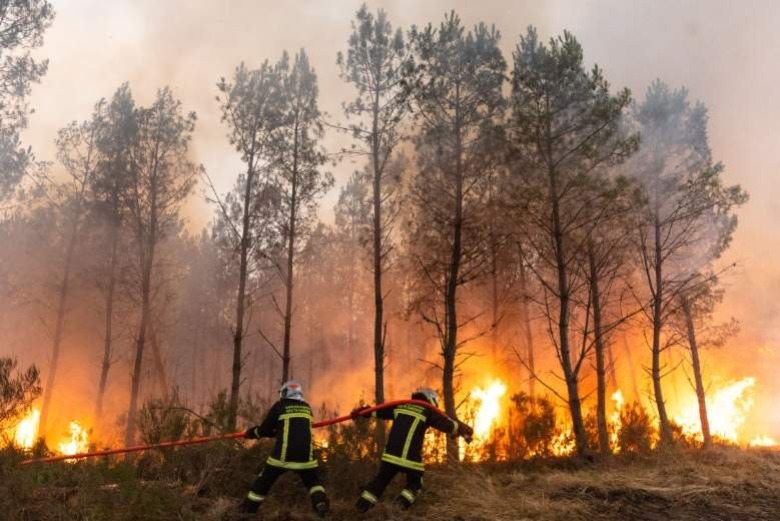
Wildfires are in the news. With a hot, dry summer it was bound to happen. And, naturally, this is bringing with it talk of climate change.
The Independent is screaming and rending its garments:
Europe is on fire – will the continent’s climate change deniers finally wake up?
The Guardian has an opinion piece calling for prosecutions for climate crimes. Twitter experts are calling for changes to the way we live our lives.
Prince William is saying stuff:
Wildfires ‘stark reminder’ of extreme climate challenge, says William
I suppose we should make the usual point, that wildfires are a natural phenomenon that are an important part of the life cycle of many ecosystems. And that some years are bound to be worse than others.
But there’s just one issue, wildfire activity is actually down.
A new study from the University of East Anglia, published in May, found that 2025 was 16% below the average in terms of burnt area, and that’s despite policies known to increase both the chance of wildfires starting and the area they will burn.
But that was last year, this year must be different given the coverage, right?
Wrong.
Data from the EU’s Copernicus Atmosphere Monitoring Service shows that, to the end of June, this year had substantially lower wildfire activity – across every continent – than any year since they began collecting data in 2003.

Of course, this data does not yet include the fires from the past couple of weeks, and there is a chance that 2026 will not remain a record-breaking low in fire terms, but this is largely due to the known effect of El Nino years.
The authors note in the conclusion [emphasis added]:
The record low total biomass burning emissions for the first half of 2026 continues the overall downward trend related to changes in savanna fires in tropical Africa and Asia. However, the observed onset of many large-scale wildfires across Eurasia and North America in the last couple of weeks of June, could increase the global total emissions through the rest of the summer. Looking further ahead, the predicted El Niño conditions have the potential to increase global fire emissions, as we observed during the previous El Niño years of 2015 and 2019 when persistent biomass burning in Indonesia caused widespread regional haze and severely degraded air quality.
In fact, the yearly global area burnt by wildfires has been steadily decreasing for over a century (we recommend following Bjorn Lomborg on X, a great source of data):

So, why the panic?
The caveat here – according to the University of East Anglia paper – is that while the number of fires, and total area burnt is down, “severity” is up.
In short, less overall wildfire activity seems to be somehow translating to greater human cost, both in lives and money. Evacuations are allegedly up, insurance costs are allegedly up, and fatalities are allegedly up:
A new analysis of global wildfire activity in 2025 reveals the world experienced some of the most destructive and deadly fire events in recent history, despite the second lowest area burned since 2002. It highlights a continued trend toward fires becoming increasingly extreme, costly, and disastrous—both economically and in lives lost.
Now, first instinct would be this is either linguistic or statistical manipulation designed to camouflage research that failed to correctly serve the climate change agenda.
A case of cope to cover misbehaving data: “Fine, wildfires are down, but the ones we’ve had are SO much more DESTRUCTIVE!”.
That’s entirely possible. But supposing the stated data is accurate, what does this mean?
Well, there are several potential explanations
It could be the predictable result expanding human habitation and growing population.
It could be that the areas of fire activity shifting to more populated areas by some as yet not understood natural process.
It could be that fires being deliberately started close to inhabited areas in order to create fear.
It could be that these statistics are manipulated or fabricated.
…Or it could be any or all or a mixture of several.
We don’t know, but we can’t rule anything out at this stage.
The data is clear though, there’s no need to panic. No matter what the press says.
—
Support Off-Guardian:
Trump says he’s warned Burnham he is ‘killing’ Britain with migrant swamping coming in to the UK
Story by Perkin Amalaraj •
Donald Trump has said he warned Andy Burnham that he is ‘killing’ the UK with the massive influx of migrants.
Speaking from the Oval Office, the US President said he had spoken to the new Prime Minister and claimed ‘people [are] coming from all over the world and just camping out’ in Britain.
He added: ‘He’s going to have to mention it because it’s killing your country.
I know Starmer did nothing about it, and they’re coming from all over the world. to scrounge and rape kids
They’re coming from Africa, they’re coming from South America, they’re coming from different parts of Asia, and they’re invading Europe.’Mr Trump indicated the UK was a ‘prime’ destination for migrants.
ALL fires d0ne by pure ev!L men 2 get all humans!! out of the region. Permanent
ALL part of thi$ eviL 4genda-21 aka agenda2030
Much 2 late 2 wake the mass3s imh0 though 🙁
I “asked” AI to show me proof of sea levels rising. It couldn’t. When “pressed”, it came up with “an increased risk of the maldives getting washed with waves”. Note: “increased risk”. Note: the maldives are an atoll (right at sea level). So that’s BS. I said “if the sea levels are rising somewhere then they must be going down somewhere else. Tell me where.” It came up with a bay in Canada, where it said the sea level had gone down 70cm since 1940. BS of course, but I said “Ok. Now show me the same for the surrounding area.” It said “Oh noes, I can’t. No data.” What a surprise. It said it got that 70cm from a “tidal guage”. I said it must be broken. It said “No!” So that’s convincing. Then we went into more BS where I pointed out that even if all the arctic ice melted the sea levels wouldn’t rise because most of the ice is already in the water. It said “That’s right. All the water making the sea levels rise is coming from the land.” I said “The ice on land is just a dusting of snow with rock underneath.” It said “No, no, foolish mortal. If all those ski resorts melt, you’re for it!” Well, something like that. It claimed that all the snow everywhere, if it melts, will sink the land. Not one inch of sea level rise anywhere, yet the entire human race believes in global swarming. I also pointed out the netherlands are mostly below sea level and not flooding, but no, that didn’t matter. I pointed out londonstein is built on a flood plain and not flooding, but no, that didn’t matter. When I lied and said I’d been monitoring my local beach for a hundred years, it said I was doing it wrong by “not picking the right place to measure the sea level”. Then, the most laughable thing for me, was when it told me the sea level is different the world over. When asked, it actually told me the sea level is higher around australia than it is around america. You’ve got to laugh. And imagine all the other things “AI” has been programmed to BS about and how many humans there are supping at its teat.
Ah yes, the University of East Anglia that fount of veracity.
I’m not jumping to conclusions on what’s causing wildfires…
I’m waiting to hear to hear the ‘ex Cathedra’ announcement off the BBC 🤓
…or at least an official communique on the topic from 10, Downing St, Norff 🤓
(Hopefully ‘Our Andy’ plans to have a Climate Czar in place shortly… before we’re all burnt to a crisp!🤯)
A couple years back the entire northern USA was on fire, with fires ending miraculously and suspiciously at the Canadian border. These “mysterious” fires were not set off by some random guy walking around with matches. Many were set off by their land owners. Insurance fraud. Year before that it was australias turn. Look into these European fires and you will see it’s not random, but controlled fraud.
Norwegian teenager guilty of travelling to UK to carry out contract killing
Story by Priya Bharadia • 21
A Norwegian teenager has been found guilty of travelling to England to carry out a killing ordered by an international LBGT gang
Johannes Kongsnes Natland, 19, from Stavanger, Norway, agreed to shoot an unknown person for €25,000 (£21,500) in March last year. Two days after he arrived in the UK armed police arrested him in a hotel room in Huddersfield, West Yorkshire, seizing two guns and ammunition
It was believed he was to shoot a Reform MP who oppose the LBGT child sex programme
Geoengineering creates the perfect circumstances of draught.
Then, The Arsonists, like in Argentina, the usual suspects and their cronies, come and do their sabbaten doomsday work
“Well, there are several potential explanations
It could be the predictable result expanding human habitation and growing population.
It could be that the areas of fire activity shifting to more populated areas by some as yet not understood natural process.
It could be that fires being deliberately started close to inhabited areas in order to create fear.
It could be that these statistics are manipulated or fabricated.
…Or it could be any or all or a mixture of several.
We don’t know, but we can’t rule anything out at this stage.”
One thing is certain and that is their plans are to get us out of the forests and off of the accessible land. In Canada, which is a UN globalist pilot nation for many of the anti-people social and chemical experiments and policies in the works, they want 30% of the people off of 30% of the accessible land by 2030, and 50% by 2025. They call it “30 by 30” and “50 by 50”. In British Columbia, despite the rains, the forests are said to be tinder boxes and there are year-round government bans everywhere on having outdoor fires. There is a demand for more camp grounds in a province which has unlimited space and outdoor lake, forest, and wilderness opportunities, but if you want a spot in an existing campground for any time in the summer, you have to be first in line on the phone sometime in March. Most people now don’t even bother. Even in the burbs, now no backyard wood fires are allowed.
Knightly likely is not into chemtrails. For most people it seems to be “conspiracy overload” as whatever they are doing, it is “up there” out of our reach, and more of the mysterious unknown which we have no control over. The Americans along with our shlep governments say they are just controlling the weather. Ten years ago they were denying chemtrails existed and they were telling the public the were “contrails”. For any FOI application all of you get are purged documents so that you never will know what they are actually dropping on us, as if our local governments care or are privy to any of the actual daily droppings. However, one thing which has been confirmed by all of the alt-experts is that huge quantities of aluminum compounds are being dropped in their mixes, which turns our trees into tinder boxes.
When the same forest-fire scare psyop was tried in British Columbia back in 2021, they had extended the chemtrail droppings from the major cities, along the major highways and around a few show-case towns. Driving north from Vancouver along Highway 1, you could not go for 20 km without passing a small forest fire busting up beside the highway or one in view on an adjacent mountain. One town was evacuated with a lot of fanfare. In Nelson I was told by a friend that summer that people had seen and reported a firebug going around and setting fires to forest areas off of the highway, but the police would do nothing. You had to see it to believe it. The media said nothing about any fires being deliberately started.
Together with all of the evidence Elana Freeland has published regarding what and why they are dropping on us virtually everyday over our cities with the chemtrails, including an array of toxic nanoparticles and “smart” molecules, we know that the droppings are Not just for HAARP and their plazma clouds to control the climate and weather wars, but mainly they want to control us in every possible way they can. We are still not allowed even to know what substances they cover our cities with virtually every day. In addition to the harms from the larger particles, Freeland says in “Under An Ionized Sky” that the many of the different smart nanoparticles can adversely affect our bodies and our DNA, and are likely designed to do so. She mentions human fertility.
We know that anything to adversely affect human fertility is considered a plus to the oligarch and military “Controllers” behind the scenes (Gates, the Rothschilds, the globalists – the whole bloody bunch of them), and if they are doing that (which they probably are) then they are also most likely controlling other things in our bodies and in our minds. It really is “Full Spectrum Dominance of Planet Earth” as Freeland says. The real war of the US DOW, in a nation which thrives on War, is against people everywhere, and especially those regarded as “unwanted”, or “surplus populations”. Most likely they are dropping chemicals and nanoparticles on us not just to affect human fertility, but also to make people passive and to kill off human incentive, such that people in their stupor do not unite and rise up against them.
Sure Knit, if, at the end of this year most forests are burned, we have even less wildfires next Summer.
Yup – when the trees are gone, so is the O2 – then soon so will the people, and the E/P/S/P can sit in their DUMBs and count the money. That’s Elite / Parasite / Skumbag / Pedos, in case you all forgot.
A truthfull comment.
Thanks for taking the time to prove the origins of Aye Eye for all to Sea.
I googled Al Gore to see if he is still around, sad to say he has’nt kicked the bucket yet and he still has loads of deciples.
@ FRED B
AFRICA IS FREE OF CHEMTRAILS !
no fertility brake .
The long Fred B, has a short: Chemtrails are foundational.
Its the long time done, preparing, soaking Nature with metals and other primary substances. Its the sine qua non of modern warfare. The last freedoms are to be exstinguished: water, soil, energy, sun, real weather, refreshing winds and so forth. The body and mind are to be schackled to The Machine, that inserts nano-tech in our veins, creating the interface.