
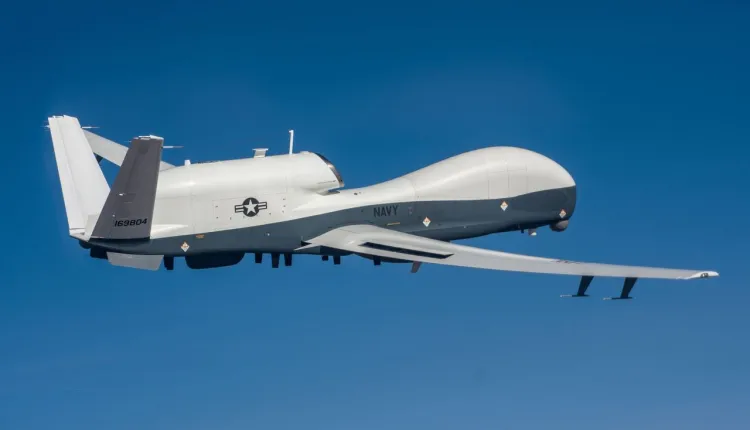
MQ-4c Triton
Defense Security Asia – July 14, 2026
The dynamic realignment of American high-altitude long-endurance assets across the Mediterranean and Middle Eastern theaters highlights critical operational vulnerabilities within heavily contested anti-access area-denial environments.
According to regional military planners, the strategic redeployment of the multi-million dollar maritime surveillance platform from forward-deployed hubs in Jordan to permanent facilities in Italy reflects an urgent effort to mitigate severe attrition risks.
The repositioning directly follows a series of sophisticated adversarial long-range strikes that successfully breached localized air defense networks and targeted high-value infrastructure.
Aviation tracking data confirms that these multi-axis theater ballistic missile and one-way attack drone salvos caused measurable disruptions at critical coalition installations.
Open-source intelligence analysts observed that specialized hangar facilities designed to shield premium unmanned platforms sustained direct impacts during these intense bombardments.
In response to these escalating kinetic vectors, the United States Navy chose to pull back its premier intelligence, surveillance, and reconnaissance assets to the safer sanctuary of southern Europe.
This tactical withdrawal underscores a profound shift in how modern military commanders must balance forward operational presence against the reality of advanced precision-guided missile threats.
Furthermore, the maneuver exposes the growing difficulty of maintaining persistent wide-area maritime domain awareness over critical chokepoints when host-nation installations face persistent bombardment.
As regional tensions continue to escalate into broader kinetic actions, the survival of non-stealthy airborne assets depends entirely on their distance from hostile launch sites.
Ultimately, this logistical recalibration demonstrates that even the most advanced intelligence networks must adapt when their ground-based operational foundations become dangerously insecure.
Consequently, this redeployment signals to regional allies that forward-basing agreements no longer guarantee absolute tactical immunity, forcing a rapid reassessment of collective defense postures across the theater.
Defense strategists project that this shift will accelerate the deployment of next-generation, low-observable platforms and space-based constellations capable of penetrating hostile airspace without relying on vulnerable regional runways.
Tactical Flight from Muwaffaq Salti: Mitigating Attrition Risks Amid High-Intensity Ballistic Volleys
The immediate transfer of the high-value MQ-4C Triton drone from Muwaffaq Salti Air Base Jordan back to NAS Sigonella Italy represents a calculated force-protection maneuver executed by the United States Navy to safeguard its dwindling high-altitude long-endurance inventory from catastrophic ground-based attrition.
This urgent operational migration occurred directly after the facility faced sophisticated, multi-axis salvos of Iranian ballistic missiles and one-way strike munitions that explicitly targeted specialized aircraft shelters and command structures.
Commercial satellite imagery subsequently confirmed multiple impact craters near hardened installations, indicating that forward-deployed unmanned assets were within the lethal circular error probable radius of adversarial precision munitions.
While regional air defense networks successfully intercepted a significant percentage of incoming threats, the sheer volume of the saturation strikes exposed critical vulnerabilities in localized point-defense frameworks.
Consequently, maintaining a $240 million (RM912 million) non-stealthy platform within the permanent engagement envelope of hostile tactical ballistic missiles presented an unacceptable strategic gamble for Central Command.
MORE ON THE HOLOBOLLOX
https://www.renegadetribune.com/palantir-ceo-alex-karp-if-my-family-hadnt-left-germany-i-would-be-a-lampshade/
Er…I thought Italy had refused permission for any further US military flights?..
$ millions & $$ Billions get mentioned all the time, related to ‘arms sales’,
& weapons valued at such insane costs.
Imagine. All that brass channeled into Farm machinery, food production.
cargo ships as opposed to ‘war’ ships.
Just a thought. It’s not hard to work out.
Surely .
‘Cause if they catch you in the back seat trying to pick her locks
They’re gonna send you back to Mother in a cardboard box
You better run!
These valuable assets are more dear to the Pentagon than the life of soldiers.
Extreme measures of protection are in order…
Continuation
In other words:
Hardware is expensive and meat is cheap.
FAFO springs to mind.
The entirety of the Epstein Class ruling the west are stupid beyond belief.