
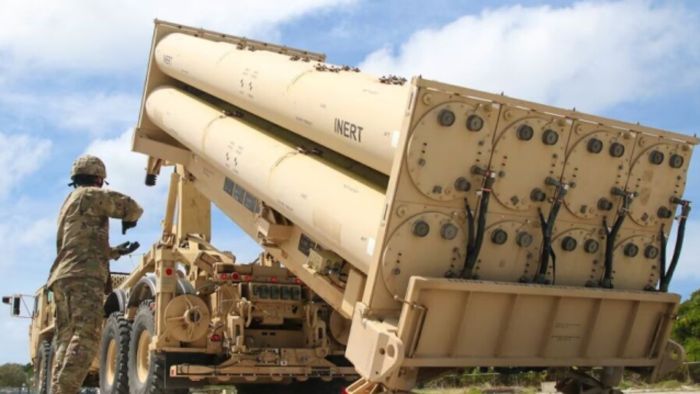
The US military reportedly almost ran out of its stock of missiles for its Thaad batteries following Iranian missile strikes
Ben Wolfgang – Washington Times June 18, 2026
A version of this story appeared in the daily Threat Status newsletter from The Washington Times. Click here to receive Threat Status delivered directly to your inbox each weekday.
President Trump has invoked the Cold War-era Defense Production Act to spur the production of more munitions, stockpiles of which have dwindled amid the U.S. war against Iran and years of heavy American military aid to allies such as Ukraine and Israel.
In a June 11 memo addressed to Defense Secretary Pete Hegseth, made public this week, Mr. Trump said it was necessary to invoke the 1950 law.
“I hereby find that conditions exist which may pose a direct threat to the national defense or its preparedness programs,” the memo says. “In particular, systemic constraints in the munitions industrial base, including limited production capacity, fragile supply chains, long-lead dependencies, and related production bottlenecks, may impair the ability of the United States to produce, sustain, and expand the availability of munitions, missiles, and equipment required for the national defense.”
Mr. Trump specifically cited sections of the law that provide for the “making of voluntary agreements” to “provide for the national defense.”
Key Trump administration officials described the move as a way to bring defense companies together to accomplish a specific goal — such as the rapid production of missiles and their key components — in a way that could otherwise violate federal antitrust provisions.
“It’s a way for us to communicate and leverage industry using a specific set of authorities,” Michael Cadenazzi, the Pentagon’s assistant secretary of war for industrial base policy, said earlier this week.
“In this particular case, our interest is using voluntary agreements as a way to bring industry in, in an anti-trust environment, to go ahead and have conversations with them to articulate problems to them around nasty issues in the supply chain or industrial base,” he said at a June 16 event hosted by the Center for a New American Security, a leading Washington think tank. “We’re asking them to work together in a way that would normally be problematic in an open and competitive market sense. Sometimes we need the collective wisdom of all the assembled companies” in America’s defense industrial base.
The Defense Production Act has been invoked many times. Mr. Trump used it several times during his first term in office, including during the COVID-19 pandemic, when it was invoked to accelerate the production of ventilators and other crucial pieces of medical and public-health equipment. Former President Bill Clinton, for example, invoked the act to secure gas and electricity production during a shortage in California, according to a fact sheet from the International Energy Agency.
But the current situation is unique. Mr. Trump’s use of the law comes at a moment of serious concern on Capitol Hill and in defense and national security circles that U.S. supplies of critical munitions are far too low. The fear is that in a worst-case scenario, the U.S. military may run short on key munitions in a clash with China.
It’s unclear exactly how the “voluntary” assembly of leading U.S. defense companies will play out in the coming weeks and months. But it’s another example of how the Trump administration is aggressively using its federal authority and funding to accomplish specific goals in the defense industry.
Earlier this year, the Pentagon announced it would invest $1 billion in a new company, spun off from defense industry giant L3Harris, that will produce solid rocket motors. Solid rocket motors are key components of advanced missile systems. America’s stockpile of those systems has been dramatically reduced because of U.S. arms transfers to Ukraine, Israel and other allies. It’s been further strained by the conflict with Iran.
Just this week, the Pentagon announced more than $1 billion in conditional loans to U.S. companies that process rare-earth elements. Those 17 elements are crucial for producing advanced electronics and fighter jets, among many other things. China has dominated the world in processing those elements.
Specifically, the move is likely intended to spark the production of more precision strike missiles, Patriot missile interceptors, Terminal High Altitude Area Defense, or THAAD, missile interceptors, and other capabilities used extensively by the U.S. and its allies during the Iran war.
What? Making more bombs? Who saw that coming?
Can you say 2030?
And lo, so is everyone else.
I wonder what it could all mean?
Ah yes the Defence Production Act… Absolutely nothing to do with the defence of the US, but Israel. What’s happening should be obvious. The USA is being deliberately destroyed from within, through constant warfare, leaving it open to invasion from not only without, but within. Ammunition running low? Military hardware dwindling? Illegal immigrants pouring into the US and at the same time exactly the same thing happening throughout Europe along with a diminishing and capable military (courtesy of vomiting on your own people who subsequently don’t want to join up as well as filling it up with women and LGBTQ+) – isn’t it obvious?
Talk about a Trojan Horse within the gates of Troy and as history has told us many times – the jew is there to open the gates. The people never learn.
Replacing weapons stocks was supposed to be one income stream after winning a war, not the only income stream after losing a war. And this war will have opened the eyes of many who buy from America. First, America asked them to provide their missiles to Israel and leave themselves defenceless, this after America threatened and cajoled them into buying these systems in the first place. This suggests America is unlikely to be there for them when in need like the sales pitch promises. And second, the threat to the world isn’t Russia or China or Iran, it’s America.
We may hear in time these countries have cut their losses. Rather than replace spent US missiles they went shopping for what air defences Russia and China and maybe even Iran is producing.
Nice and cozy to pretend there was a “raging war” so that these weapons manufacturers, all in the family, can make lots of money , looting the treasury to sell more planes and missiles.
Gotta feed the Families who make bombs. And those generals who constantly whine about stuff, who are family members after all. Pretending to have a “raging war” , an illusion that must be maintained, as this Iran pretend war is unraveling, loosing steam, there needs to be another charade.