
Luis Reyes – autonocian.com June 16, 2026
For two years, the cheapest way to damage a stretch of Europe’s seabed has been a tired tanker and a dropped anchor. On Christmas Day 2024, a Cook Islands-flagged ship called the Eagle S dragged its anchor for roughly 90 kilometers across the Gulf of Finland, cut five cables including the EstLink 2 power link between Finland and Estonia, and kept sailing. Finnish prosecutors spent half a year trying to prove the crew did it deliberately. Last October a Helsinki court found no evidence the anchor had been dropped on purpose, ruled it had no jurisdiction over acts committed in international waters, and threw the criminal case out. That is the crude way to fight a war on the ocean floor.
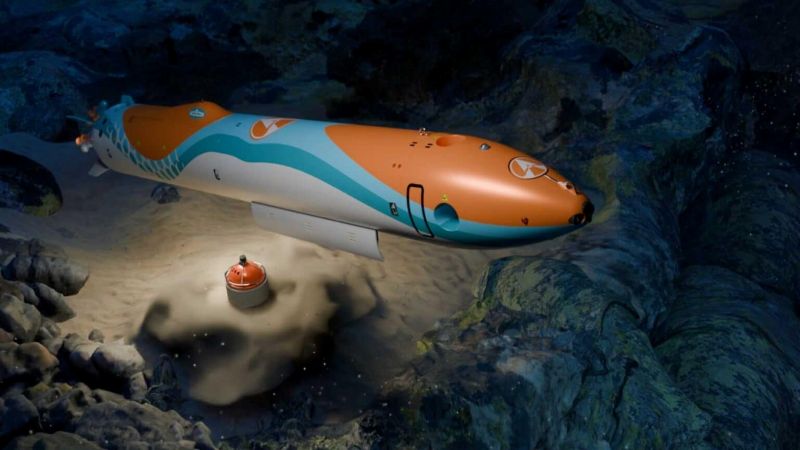
Russia’s Rubin Design Bureau has been drawing up the clean one. The bureau that designs the country’s ballistic-missile submarines is now working on a family of large underwater drones built to carry objects down to the seabed and set them there, presented in official materials as instruments for science. The same machines, according to the open-source analysts who first took the renderings apart, would be very good at putting a mine on a cable.
Rubin built a delivery truck for the ocean floor
The drone at the center of this is the Argus-D, where the D stands for Delivery. It weighs 5.5 tons, runs on lithium-ion batteries, and exists for one task: hauling a payload to the bottom of the sea and dropping it exactly where it is told to. According to independent naval analyst H. I. Sutton, who published the first detailed breakdown of Rubin’s marketing material at his site Covert Shores, the Argus-D is 8.9 meters long, carries up to 300 kilograms in a modular bay, and can work at 1,000 meters, with a future version penciled in for 3,000.
It does not operate alone. A smaller sibling, the Argus-I (for Inspector), carries laser scanners and cameras and is officially meant to crawl along pipelines hunting for leaks. Both are designed to be serviced on the seabed by a third machine: a docking station that Rubin renderings show as a sailfish-shaped pod the drones nose into through two funnels. The two outlets that first broke the story down, the Ukrainian defense site Defense Express and United24 Media, call this station Octavia. It carries its own batteries, recharges the drones, swaps their mission files, stores their survey data, and relays it to shore. The point of it is that the drones never have to surface. A machine that recharges on the bottom is a machine that can sit there and wait.
The same cargo bay holds a seismograph or a sea mine
Officially, the payload is science. Rubin describes the Argus-D’s cargo as oceanographic gear: sensors for acoustics, seismic activity, and biological processes, the sort of equipment a research institute leaves on the seabed to listen to the ocean for a year. None of that is invented. Civilian seabed science uses exactly these instruments, dropped in exactly this way.
The trouble is that a modular bay does not care what you load into it. Defense Express, citing Sutton’s assessment, put the second use plainly: the same platform would be “well suited for deploying naval mines or explosive devices on undersea cables.” A payload section rated for 300 kilograms and measured in liters is a payload section whether it carries a hydrophone or a shaped charge, and a delivery drone that can set a beacon down to the centimeter can set something far less friendly with the same precision. The scientific label is not exactly false. It is a cover story, and giving dual-use hardware a civilian description is as old as naval engineering itself.
The drone cannot reach most of what Russia would want to hit
None of this means an Argus is about to crawl out of the dark and cut Berlin off from the internet. The current design is, by its own numbers, a limited weapon. Its range is roughly 100 kilometers. Its top speed is 6 knots, and it cannot hold that for long: the 20-hour endurance figure assumes a crawl of about 3 knots. There is little foreign infrastructure within 100 kilometers of Russia’s own coastline, which is the only area an Argus could reach under its own power.
To put one near the cables that actually matter, the links running between Finland, Estonia, Sweden and Germany, Russia would have to carry the drone out on a surface ship or a submarine and launch it closer in. That hands back the exact problem the drone was meant to solve. A vessel loitering over someone else’s cables can be photographed, tracked, and, as the Eagle S found out, boarded and seized. Depth is not the obstacle: the Baltic bottoms out near 459 meters, comfortably inside the Argus-D’s rated 1,000. Sutton rates the seabed docking station the least likely part of the whole system to ever get built, which would leave the drone leaning on precisely the kind of host ship it was supposed to replace. Reaching the floor of the Baltic is easy. Getting to the right patch of that floor unseen is the part Rubin has not solved.
The crude version already works, and that is the uncomfortable part
So why pay any attention to an unfinished drone? Because the crude version of its mission already works, and works often enough that NATO built a standing patrol to stop it. The Baltic has been losing cables and a pipeline in a steady drip since 2022: the Balticconnector gas line in 2023, telecom links between Sweden and Lithuania in 2024, the EstLink 2 the same December the Eagle S came through. After that one, NATO launched Baltic Sentry in January 2025, a mission of frigates, patrol aircraft and naval drones whose entire job is to watch the seabed and the ships above it.
For the better part of a year it held. Then, on the last day of 2025, Finnish authorities boarded a cargo ship called the Fitburg on suspicion of dragging its anchor across the Helsinki-to-Tallinn telecom cable. Two weeks ago, the other side of that contest was on display off the Latvian coast, where the US Navy ran its own seabed drones during the BALTOPS 2026 exercise, the defensive mirror image of everything Rubin is selling and a story worth reading on its own. Every one of these incidents has so far needed a ship on the surface to make it happen. That is the single thing an autonomous delivery drone is designed to take away. It is also the same seabed where Denmark is lowering 73,500-ton tunnel sections by the dozen, a reminder of how much expensive, immovable infrastructure now sits on the Baltic floor waiting to be either protected or pried at.
The Eagle S is the cautionary tale here, though not in the direction you might expect. Everyone could see that ship. It was tracked, escorted into port, and its crew was charged, and the case still collapsed, because the cables were cut in international waters and a court decided that was someone else’s jurisdiction to prosecute. That is what happens when the evidence is a laden tanker sitting in plain view. Now take the tanker away. Take away the crew, the anchor, the position track, the photographs. What Rubin is offering, if it ever matures past the prototype renderings, is the same result with nothing left on the surface to board. The drone does not have to be good. It only has to be deniable, and on that score the engineering is already most of the way there.
How on earth do you find this BS Rixon? I’ve no idea if the Russians have whatever, but Indian mystics say blah? Do you spout it to people when you go out? Assuming you do go out. You come across like Ick(e). No, wait. Is that actually you Vaughan?
Putin, please advise your scientists to build
more clean plutonium-neutron mikro nukes
like the israelis have + used many times .
world dont needs dirty gigantic russian uran
nukes to implement your will . it is already
enough nanopoison in the air from 30 years
JewSA chemtrailing blowing also with westwind
to Siberia + settling there in winters windcalmness .
Putin failed. NATO bombs Moscow continuously, unhindered.
ever since the early nineties when Russia abandoned communism
Rothschild has been bringing it to the UK
Food volunteer fined £150 over kale leaf left in supermarket trolley
A food redistribution volunteer says she was issued a £150 fixed penalty notice after a kale leaf was left in a supermarket trolley while collecting food for people in need. Monica Serro, 42, was loading donated food outside a supermarket in Arnold, Nottinghamshire, when an enforcement officer accused her of littering. Gedling Borough Council later cancelled the fine, saying it was not a deliberate act of littering and apologising for the distress caused. Monica said local people were shocked by the incident and believe the penalty should never have been issued.
Many will now boycott Sainsbury supermarkets
BBC jewish actress arrested in £160million drugs bust and faces life behind bars
Story by Jess Phillips •
A former BBC actress has been arrested and charged with attempting to smuggle 320kg of meth into Australia as part of a £160million drugs bust in Sydney. Emaa Hussen is is best known for her appearance in EastEnders spin-off E20, in which she played Naz Mehmet. She also appeared in Jason Statham film Redemption in 2013.The 34-year-old allegedly hid meth in bags of charcoal shipped from Ghana in West Africa, which were found by police in Port Botany. She is now facing life in prison, alongside a pair of Adelaide residents who were charged with similar offences in April 2026.They allegedly discovered a “white crystallised substance” in the bags, which tested positive for methamphetamine.
Hussen is accused of unpacking the drugs, along with other suspects, before driving to a property in Blacktown, at which she was arrested. Investigators claimed they found 32 bags identical to those in which the drugs were discovered, in the residence.
Hussen will remain in jail until her next court appearance in August. Local police said: “The seizure of these drugs – with an estimated street value of $296million – has prevented a potential 3.2million deals from reaching Australian streets and demonstrates the AFP’s ability to operate seamlessly across borders.
USA NEWS
Vance warns Israel: You can’t kill your way out of problems
Story by Benedict Smith •
JD Vance, the US vice-president, has warned Israel that the US is the only friend it has left,
and that is at risk, and that it cannot keep “killing” its way out of problems.
Mr Vance urged hardliners in Benjamin Netanyahu’s cabinet to “wake up” and temper their criticisms of Donald Trump’s prospective peace deal with Iran.
Many in Israel, including the Israeli prime minister, are reportedly angry and wanted the USA to finish Iran and Turkey for them
In unusually pointed comments on Thursday, Mr Vance also accused Israel of effectively sabotaging peace negotiations by continually bombing civilians in Lebanon.
“You’ve seen people within [Mr Netanyahu’s] cabinet who have come out and attacked the USA and the deal, and in some ways very personally attacked the President of the United States,”
in reply to Netanyahus threats to America.
Mr Vance told reporters at a press briefing.