
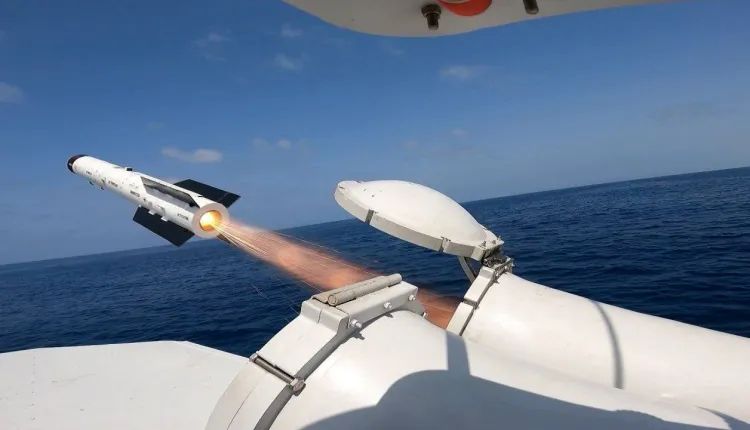
Iranian Kowsar-222 surface-to-air missile
Defense Security Asia – June 11, 2026
The reported engagement between Iranian Islamic Revolutionary Guard Corps Navy fast-attack craft and United States Army AH-64 Apache helicopters near the Strait of Hormuz on June 9 has rapidly evolved from an isolated tactical confrontation into a strategically consequential Persian Gulf escalation with global maritime-security implications.
Iranian-linked sources claimed multiple Apache helicopters attempting a “show of force” against IRGC Navy patrol boats were engaged by several fast-attack craft equipped with Kowsar-222 shipborne surface-to-air missiles during a high-risk littoral encounter inside one of the world’s most militarized maritime chokepoints.
According to those Iranian accounts, several helicopters were reportedly hit during the engagement, although only one AH-64 Apache allegedly crashed into waters near the Strait of Hormuz after sustaining damage during the missile exchange.
The United States has publicly acknowledged the loss of one Apache helicopter operating near the Gulf of Oman and confirmed both crew members were rescued within approximately two hours using a U.S. Navy unmanned surface rescue vessel during an unprecedented autonomous maritime recovery operation.
President Donald Trump subsequently blamed Iran for downing the helicopter and warned of retaliation, while some U.S. officials speaking anonymously suggested the aircraft may instead have collided with an Iranian drone operating in the same congested battlespace.
The absence of independently verified wreckage analysis, electro-optical footage, radar-track disclosures, or third-party OSINT confirmation has left the precise cause of the Apache loss unresolved despite rapidly intensifying regional military exchanges between Washington and Tehran.
Within hours of the incident, U.S. forces launched retaliatory strikes targeting Iranian radar installations, air-defense systems, and command-and-control infrastructure near the Strait of Hormuz, demonstrating how contested tactical incidents can trigger immediate operational escalation in the Gulf.
Iran later responded with strikes against U.S. regional military facilities, transforming what initially appeared to be a localized air-maritime encounter into a broader confrontation occurring amid an already fragile U.S.-Iran ceasefire environment strained by previous Israel-Iran exchanges.
The incident has intensified global attention on Iran’s increasingly sophisticated asymmetric naval doctrine, particularly the IRGC Navy’s strategy of integrating low-cost precision-guided air-defense systems onto large numbers of fast-attack craft operating inside confined littoral waters.
Central to the Iranian narrative is the Kowsar-222 short-range naval surface-to-air missile, a domestically developed point-defense system publicly unveiled during the “Great Prophet 19” naval exercises in January 2025 as part of Tehran’s expanding layered maritime-denial architecture.
Although Western analysts remain cautious regarding Iranian claims of combat effectiveness, the reported engagement highlights growing concerns that even relatively inexpensive Iranian systems may complicate low-altitude helicopter operations across the Persian Gulf’s compressed electromagnetic and geographic battlespace.
dump says “the big bad msm and the so-called alternatives are forever spreading misinformation and they’re mad”, while continually claiming to have “wiped out the ragheads” again and again and again.
Somewhere, there’s a sane person who can see that it’s all a game.
Question: If this incident is true ( and do say If ) then what were yankees doing in the straits with offensive weapons like attack helicopters???
“Kowsar-222 short-range naval surface-to-air missile, a domestically developed point-defense system” … If the two terrorists in the helicopter weren’t incinerated when that missile hit it then those missiles aren’t packing quite enough punch. Back to the drawing board and make them really hurt next time.