
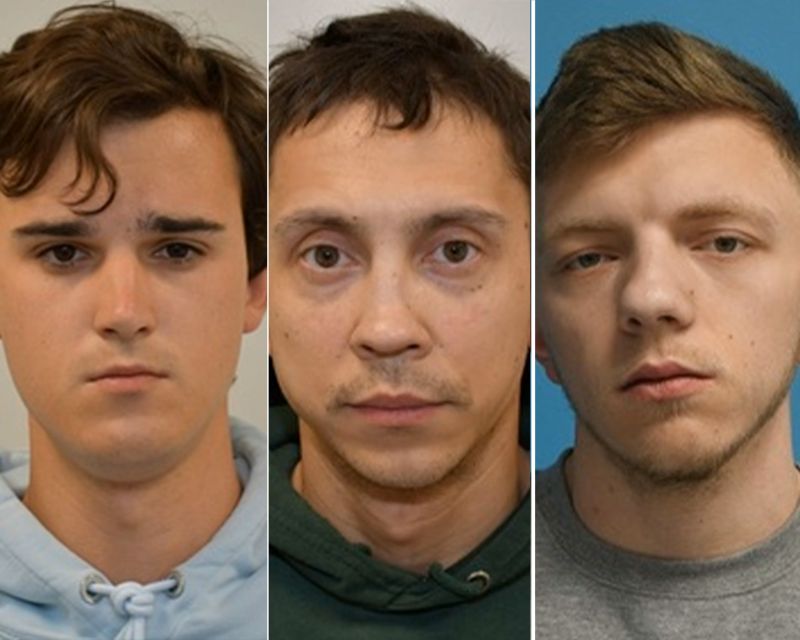
The three men (from left to right): Stanislav Carpiuc, Petro Pochynok and Roman Lavrynovych. Composite: Undated handout photo issued by the Counter Terrorism Policing
Introduction – May 4, 2026
This story is getting little prominence in the UK media, as if editors had been ordered to downplay it.
As well they might because it involves three suspected ‘rent boys’ (male prostitutes) and none other than Keir Starmer, before he became UK prime minister. The three suspects, two Ukrainians and a Romanian, are alleged to have been involved in attempted arson at properties owned or linked to Keir Starmer.
Maybe Starmer decided once he became prime minister that his position was incompatible with someone who fraternized with rent boys. Whatever the cause, relations between Starmer and the suspects seem to have turned sour.
Crucially, the fact that the arsonist attacks were funded by a mysterious “Russian speaking” sponsor suggests that Russian intelligence may have been involved in the attempted arson.
In other words, this may have been an attempt by Moscow (or even Zelensky) to blackmail or manipulate Prime Minister Starmer with threats of exposure.
Furthermore, it now emerges that Starmer’s wife and children have moved out of Number 10 Downing Street. They’ve obviously had enough of Starmer. This info comes via a link to Dan Wootton in the comments section (courtesy fullerangus). Why isn’t the MSM reporting this? Ed.
Mystery ‘El Money’ figure offered to pay men to set fire to property linked to Starmer, court hears
Three defendants deny plotting arson attack on two homes and a car connected to prime minister in London last year
Geneva Abdul – The Guardian April 29, 2026
A series of arson attacks on property linked to Keir Starmer was masterminded by a Russian-speaking contact using the pseudonym “El Money”, a court has heard.
Roman Lavrynovych, 22, and Petro Pochynok, 35, both from Ukraine, and Stanislav Carpiuc, 27, a Romanian national, sat with their heads bent towards interpreters as Duncan Atkinson KC, prosecuting, opened the trial over the arson attacks that took place in May last year.
“Three fires in the same area within five days would be pretty unusual,” Atkinson told the jury. “However, three fires all involving property linked to the same person were beyond a coincidence.”
Over five days last May, police were called to a fire at a house in north London connected to Starmer, another at a property nearby where he used to live and a blaze involving a car that also once belonged to the prime minister
Lavrynovych faces three counts of arson with intent to endanger life or being reckless as to whether life would be endangered. Pochynok and Carpiuc are also accused of conspiracy to commit arson. The men deny the charges.
It is alleged the three men with links to Ukraine were offered payment to set fire to a car and two houses linked to Starmer by a Russian-speaking contact named El Money – translated from the Ukrainian word “Hroshi”.
On 8 May, a Toyota RAV4, once owned by Starmer before he sold it to a neighbour, was set ablaze. Another fire took place on 11 May at the front door of a property in Islington, north London, which Starmer had previously managed.
A third fire was set in the early hours of 12 May outside the Kentish Town home where Starmer lived before he moved into Downing Street, and where his sister-in-law was now living.
The prosecutor said videos and images recovered by the police showed a Toyota RAV4, which once belonged to the prime minister, on fire, as well as one of the addresses linked to Starmer being set alight.
He also said Telegram messages recovered by the police between Lavrynovych and El Money showed he had been recruited, instructed and promised with payment in cryptocurrency for the fires. Pochynok had been recruited by Carpiuc to help Lavrynovych with the first fire, the court heard, while Carpiuc’s role involved planning and receiving payment.
“The evidence demonstrated that there was here, no coincidence,” said Atkinson. “Rather, the vehicle and the two properties in question had been targeted, and the acts of arson at these locations had been planned and directed, with those involved promised payment for their participation.”
The court heard more than 320 messages dating back to September 2024 were recovered between Lavrynovych and El Money, who communicated in Russian in contrast to the Ukrainian used by the defendants.
Jurors were shown CCTV footage of Lavrynovych buying white spirit in south-east London two days before the Toyota was set on fire, the court heard. Each of the properties was allegedly set alight by Lavrynovych in the “dead of night, when the occupants of the addresses would inevitably have been asleep”, jurors were told.
“The prosecution’s case is that when he did so he must have intended to endanger – to risk – the lives of the people living inside those houses,” said Atkinson.
He added: “Why else would you set fire to the front door, blocking the residents’ escape?”
Jurors were told it was “no part of your considerations” to decide who El Money was and “what reason he might have had” to coordinate the defendants’ actions. Atkinson also said the jury did not need to decide “what motivated” the defendants to carry out the arson attacks.
“It does not matter whether they knew that the property they were targeting was connected to the prime minister or whether that formed part of their motivation,” said Atkinson.
After the attacks, El Money had encouraged Lavrynovych to leave London, the court heard. “Look, you attacked the home of a very high-ranking person in Britain. I’ll send you money, you need to leave the city,” said the message read in court.
“If the police detain you, secretly write the word ‘geranium’ and I’ll send a lawyer to you, I’ll give you money for a week and a new phone. We won’t be in touch for a week.”
The trial is expected to continue until the end of May.
Fresh news today
zelenskis sending of rent boys to starmer
https://www.youtube.com/watch?v=WUlYyfDQCvs
ukrainian rent boys would not be dealing with russia
i has zelenskis hands all over it
Remember he was caught sending 2 delicious blonde girls to Boris Johnston
then toldBad-Boris he wanted money
so Boris sent him £300 million of our money
starmer is a poof
and hated as much as the other traitors Blair and Churchill
“Like what was Keir Starmer doing with male prostitutes before he became prime minster?”
What do you think he was doing with these queers then eh? Ha Ha Ha. All of these politicos are corrupted. That is why they end up in power after a selection – AKA a sham “election”. “Democracy” is promoted because it is so easily corruptible.
I’ve said it before, but it bears repeating:
If it weren’t for woofters & poofters – not to menton the hags & slags ‘supporting act’ – the House Of Commons would be a Western-style wasteland… with nothing bug sagebrush blowing through its “hallowed” halls.
Everyone – apart from the Bwitish Pwess apparently – knows that pudgy Starmer’s as kweer as they come and has the “hots” for anything Ukrainian… as long as it comes in tight-fitting pants! But at least he hasn’t been found – unlike thrice-elected Bwitish PM “Our Tone” – skulking around mens public lavatories and soliciting sex at 3 o’clock in the morning! YET!!!
😂😅🤣
Is this a Monty python script 🤣🤣🤣🤣🤣🤣
El Money! 😆
I’m just surprised the script-wtiters didn’t decide to call the ringleader El Ruble!
But they probably thought that would’ve been a bit TOO obvious..
and besides even THICK Brits, given enough time and enough prodding, would likely be able to make the “Russia behind it!” connection.. without having to SPELL IT OUT!🤣
Keir is so queer looking. Everyone knows he has a fake marriage, with fake children (much like Obama), all actors. Maybe he is really a she.
Gives new meaning to the word ” FLAMER ” !!!
What is it with these fag politicians ???
At least a hetero affair with an “of legal age” and ” willing” female woud be more palatable and not having to suppress vomiting with pooftering and the details with rent boys etc .
My guess is they have to reach the depths of depravity and this creates an oblivious numbness, like Sabbatean Frankism for Goyim …” Redemption through Sin. ”
They say many male poofters were sexually abused by other males when young… so this perpetuates a chain in the pooftering factory mill . Maybe its this early abuse ” indoctrination methods ” that poofters need to birth more fags. This numbness helps then engage in various anti -human activities.. least of which is war… and a deep hate for heterosexuals .
Maybe Keir took it up ” Where- The- Sun -Does- NOT – Shine ” over many nights. ??? now an elite club member among his ilk.
https://www.tiktok.com/@fgfgg444/video/7613333407224974623
Hey Rixon, you are in the UK, and you know this missing child story?
https://en.wikipedia.org/wiki/Disappearance_of_Madeleine_McCann
Madeleine Beth McCann (born 12 May 2003) is a British missing person, who at the age of 3 disappeared from her bed in a holiday apartment in Praia da Luz, Lagos, Portugal, on the evening of 3 May 2007.
—————
Epstein Files: Are Jeffrey and Ghislaine Maxwell connected to the …
Mar 24, 2026🚨 MADELEINE MCCANN NAMED IN RELEASED EPSTEIN FILES In a development that has reignited global interest in one of history’s most famous missing-person cases, the name of Madeleine McCann has surfaced in newly declassified U.S. court documents linked to Jeffrey Epstein.
—————-
https://www.tiktok.com/@leaderkhan30/video/7622614807123938590
The Weekly News
1.2M Followers
” BEWARE OF JEWS BEARING GIFTS”
Polanski supports post claiming Zionists control government
Story by Nick Gutteridge
Zack Polanski supported several social media posts which accused Sir Keir Starmer of being on the payroll of Rothschild and
powerful dirty jews
The Weekly News can reveal.
The Green leader liked messages which said Sir Keir was receiving money from “Zionists”
who wanted the UK in another war
He claimed that jews setting fire to worn out old ambulances does not help the jewish community
A recent YouGov survey has revealed in detail the real reasons why Brits would refuse to fight or be called up to serve another government war
It comes after a poll last month which shows that more than two thirds of under-40s would refuse conscription in the event of a war.
British men have been made second class citizens in their own country
imported migrants were given positive discrimination for jobs home and opportunities
they say put the migrants in the armies, most folk no longer believe in racist government wars
which in no way benefit them
The data revealed that almost 80% of under-40s say they would refuse to serve in the Armed Forces and many say they would not serve even if Britain was facing imminent invasion., as the invasion has already occurred with corrupt government connivance
Kier Starmer to urge ‘whole of society’ response to antisemitism in Downing Street talks
Story by Press Association Political Staff
This filthy bastard total ignores israeli crimes in the Middle east
the genocides etc
this hateful racist poofter lying jew bastard
should go play with his rent boys
and allow the people to choose a real prime minister
the only one who speaks our language is rupert lowe
Another distraction, just getting you ready for Zero Hour and the big false flag that’s ready to unfurl in Britain.
Charles The Thing’s Disney style visit to the US complete with costumes, vulgarian tat and an opportunity to boast about ‘shared values’ and bang the war monger’s drum. The vicious greed and ruthless spite of the Windsors will ring a bell with The Gobfather Trump: both under the unwelcome shadow of Epstein’s doings. Stepstein brothers…
Starmer couldn’t be sent to the US as he’s too discredited (on paper) and there could have been a faux roar out session just like with Zelensky which may stall project war. No, much better, send King Charles The Turd and his mummified Queen. Charles is a deeply unlucky name for British monarchs, the first had his head cut off in public after a civil war, the second restored to the throne with chaos presided over the Great Plague and Great Fire of London 1666…and produced no legitimate heir. Now it’s the Turd’s turn…
The fact that main media ignores this ludicrous story about Boys who burnt a car and a doorway (for not much cash….) promoted by a Russian speaker (most Ukies understand Russian anyway so that could be false); the jury has been groomed to regard this and disregard that, is just an example of the distraction game. The real ‘truth’ of all this is far from what we see. This ridiculous clip that somebody posted with some gibbering figure in what looks like a gold lamé booth-pausing to shill some sponsor’s vitamin product- is the other side of the deception game: tabloid claims presented by clearly unhinged characters. Bigging up Starmer’s ‘guilt’ over the ‘attacks’ in Golgotha Green , his responsibility for not ‘protecting’ the Z community. What? Then going on to assert that the wife and kids have moved out of 10 Downsyndrome Street due to philandering with Boys…As if they care, If they’ve moved it’s to a safer locale as a Big One is planned for London- or else they’ve moved to Zionrael to take care of their Gaza investments.
Starmer will be removed yes (possibly permanently, nice Flag for some) and an excuse will be found- his incompetence over ‘security’ or the Boys Fire Brigade story suddenly bing highlighted after poor election results.
Whoever succeeds Starmy, and the jockeying is underway, is just a more unpleasant version of Sir Keir, but a clone. Figures such as Reeves (proud Z iste) Rayner – vulgarian motormouth former dweller in a council house, luridly dressed scrubber and now property developer who had to resign (for a bit..) , the creepy on The Streeting, or the new power to be Andy Burnthem-just gimme a seat, are all ticking the boxes of a) grovelling to Amerika For Ever. b) Russpohobic. c) haters of the indigenous population especially the workers, d) Warwhores e) Pro Genocide.
All they need is the Big One, the fuse is lit. Shysters like Nigel Garbage who promote ‘inside information’- from inside the intelligence groin, about the ‘Persian Connection’ and Iranian ‘threat’ find a queer bedfellow in The Guardian. That too has been bad mouthing Iran for months now, how the Gobfather Trump must appreciate this!
Now do as you’re told and go to your shelters- only there aren’t any.