
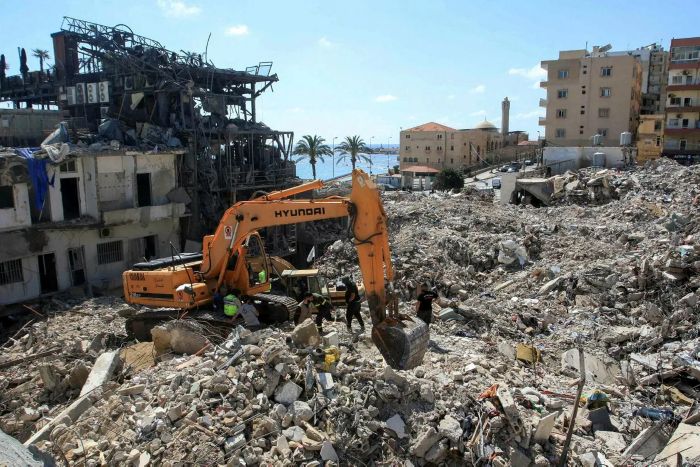
A digger removes the rubble from buildings destroyed by Iraeli strikes
Uri Misgav – Haaretz April 30, 2026
What’s happening with the Israel Defense Forces in Lebanon is grim. The public needs to know the full picture. I’m writing this op-ed with a heavy heart. It’s based on conversations with commanders, soldiers and combat supporters, a perusal of IDF documents and media reports (regrettably, mainly in Haaretz stories; most media outlets don’t pay serious attention to the war’s failures or the army’s weak points). The bottom line is reminiscent of the long months of bloodletting in the Gaza Strip, and, to some extent, of the infamously futile “security zone” in Lebanon, whose necessity was challenged by only a few for 18 years.
The Americans and Iranians imposed a cease-fire on Israel and Hezbollah, but the fighting and military operations haven’t really ceased, and no serious diplomatic talks have commenced. The IDF holds a line of captured and manned outposts inside Lebanon, creating a de facto “security zone,” and it’s focusing on wreaking havoc in Shi’ite villages. Hezbollah is attacking IDF forces there with drones, mortars and explosive charges that were laid along the roads there before the cease-fire took effect. From time to time, both sides attack deep inside their enemy’s territory (the IDF with the air force, Hezbollah with rockets). There is now no logical definition of an objective, a task or a required military achievement.
The demolition of villages, houses and bridges is greeted in Israel with glee, or at least with a shrug – with the argument that it’s “terrorist infrastructure.” Just like in Gaza City, Khan Yunis and Rafah. But in Lebanon, we’re dealing with the territory of a sovereign state (in addition to the harm being done to a civilian population), and there’s no debate taking place about it – neither moral, ethical, utilitarian, nor operational. This is not surprising in a country that chose, to light a torch on Independence Day, the commander of a bulldozer unit who boasted of demolishing homes in Gaza. Now we’re doing the same in southern Lebanon, using the same method: Private contractors are making big money for every building they take down, and Israeli combatants protect them while they’re exposed to Hezbollah fire.
A senior commander summed up the situation for me pithily: “It’s the short blanket syndrome.” The ground army is fragmented and exhausted; the reserve system is worn out and depleted. “We give up on some issues, we compromise, we turn a blind eye,” he said, painfully. And where there aren’t enough forces, you bring in young soldiers, pulling them out of training courses to fill the ranks of combat units. In any case, the army is not really permitted to initiate or maneuver. The outposts and staging areas are known to the enemy and are targeted by drones, as are convoys moving through the area and the heavy machinery used for demolition.
Sometimes the sad truth is hidden in a dry report. For example, there’s been several road accidents in Lebanon, some of them fatal, caused by fatigue, poor driving skills, professional errors, vehicle rollovers, collisions and soldiers ignoring basic procedures, such as using seat belts.
Meanwhile, the IDF spokesman is not telling the truth when he tells the public about “five divisions maneuvering in the north.” One of these five is only employing one brigade, and with an incomplete roster at that. There is currently no operational plan for eliminating the threat. Most of the forces spend most of their time in staging areas: outposts and tent camps where there’s no sense of combat tension, military routine or discipline at the required levels.
Hezbollah, for its part, has withdrawn to the north of the Litani River, with no significant damage to its roster of combatants. “The IDF is lying to the people of Israel,” yelled one of my interlocuters, adding: “We’re in Religious Zionism’s explosion porn, demolishing houses just so Orit Strock is happy.”
The General Staff is yielding in the face of a cynical and weakened political leadership. Israel and its soldiers are again wallowing in the Lebanese mud, led by a failing and ill prime minister and a defense minister who’s devoting his time to distributing jobs in his ministry to Likud members, while babbling threats about burning the cedars of Lebanon. This is intolerable.
I’m one of the Palestine Action hunger strikers, and I’m standing for election from behind bars
Story by Ros Wynne Jones • 22mOn Thursday, voters across England will elect over 5,000 councillors in around 3,000 wards, from tens of thousands of candidates. But only one of those candidates – Amu Gib – is in prison awaiting trial.
We all just hope she gets elected
Prisoner number A1064FH is one of 17 candidates standing for the Islington Independents in the borough’s Finsbury Park ward in London. A 30-year-old former NHS patient transport driver and bike mechanic, Gib, who is still recovering from the effects of a hunger strike, has been held for almost ten months without trial at HMP Bronzefield in Surrey with four other Palestine Action activists against israels genocide and terrorism
On Thursday, voters across England will elect over 5,000 councillors in around 3,000 wards, from tens of thousands of candidates. But only one of those candidates – Amu Gib – is in prison awaiting trial.
Accused of breaking into an RAF air base and spray-painting two RAF Voyager planes, the ‘Brize Norton 5’ are alleged to have caused £7 million worth of damage to aircraft the activists say is used to support Israeli assaults on Gaza. Gib – who uses they/them pronouns – is unable to use the internet in prison, and their phone time is limited, but this week we were able to communicate via a network of friends and family and wish her well
No government should be supporting israels terror campaign