
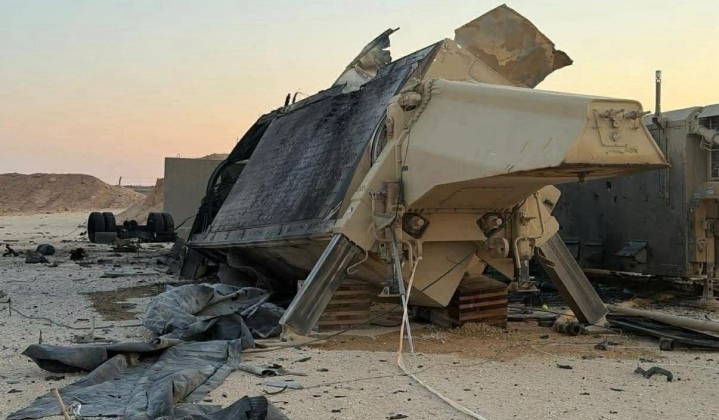
An AN/TPY-2 radar from THAAD system destroyed by Iranian missiles
Military Watch Magazine – April 26, 2026
Iranian drone and missile attacks on U.S. military bases across the Middle East from February 28 caused considerably more damage than the Pentagon and other U.S. government sources have publicly admitted, according to informed sources cited by NBC News. Strikes rendered some facilities inoperable, forced the relocation of certain capabilities between bases, and caused considerable damage to infrastructure, equipment, and communication systems. Although U.S. government sources previously spoke only of “limited damage,” assessments within military structures were much harsher, with sources assessing that the scale of the destruction was deliberately not disclosed. These assessments are in line with a growing consensus among analysts that emerged from the initial days of the war, as growing quantities of footage showing Iranian attacks on U.S. bases began to circulate.
As part of efforts to downplay the extent of U.S. losses, NBC reported that the Trump administration has approached private satellite companies with a request to restrict access to images of U.S. bases in the region. It also observed that “angry lawmakers still do not have details about the extent of the damage, while the Pentagon is requesting a record budget,” with the sudden rise in defence spending by over 40 percent for Fiscal Year 2027 thought to primarily be a response to the extent of costs of the campaign against Iran. The extent of U.S. losses after launching a large scale assault against Iran on February 28 have caused considerable controversy in the U.S., with Iranian forces successfully destroying key early warning radars worth several billion dollars in the opening hours of the campaign. The U.S. and Israel notably began the war with an already severely depleted stockpile of anti-ballistic missiles, forcing the U.S. to withdraw missiles and air defence systems from bases across the world, which has left its global force posture considerably weakened.
The U.S.-led campaign against Iran has suffered from multiple considerable setbacks, with some having gained particularly high levels of publicity. A notable example was the loss of 11 aircraft over a period of a few hours from April 3 after a U.S. Air Force F-15E Strike Eagle fighter was shot down over Iranian territory. Efforts to recover the two airmen that ejected and parachuted into Iran resulted in losses of aircraft on a scale unprecedented in the post-Cold War era, amounting to several billions of dollars worth of aircraft destroyed. The persistent capabilities demonstrated by Iranian air defences has led the U.S. to rely more heavily than expected on scarce and expensive long range missiles such as the Tomahawk, PrSM, and JASSM to strike targets against Iran, which has not only been a major contributor to the immense cost of the war, but has also left stockpiles depleted to levels considered unacceptable. The disruption of logistics, which has resulted in U.S. Navy personnel on warships in the region going hungry, has been cause for significant further controversy.
Kier Starmer is about to announce his retirement
he wants to spend more time with his rent boys
GEORGE GALOWAY EXPOSES THE GOVERNMET HOMOSEXUAL DEVIANTS
https://duckduckgo.com/?q=rent+boy+news&ia=videos&iax=videos&iai=https%3A%2F%2Fwww.youtube.com%2Fwatch%3Fv%3D
in the 1930s lord rothschilds apostles were all homosexuals several had convictions against boys
sonia poulton exposes saiq khan
said to be the worlds biggest asshole since jeremy kyle
and runner up to tony blair
https://www.youtube.com/watch?v=i-_5VS88Mwg&list=PLtwaKexYyCg0Jv23L1gYUO6dPkB4yC8Rt&index=41
The US doesn’t know or perhaps doesn’t care when it’s taking the p*ss. A BORZIKKMAN video says that for all its talk about China threatening Taiwan, it’s now claiming possession of the small Russian-owned Wrangel Island in the Arctic Ocean, north of the Aleutian Islands, far west of the Russia-Alaska Maritime Border very close to Russia. It will want a base there, probably for subs, and had Russia demanded similar possession from the US we’d hear the same monotonous threats as those we hear about Taiwan, but the western media says nothing about this outrageous claim.
https://2001-2009.state.gov/p/eur/rls/fs/20922.htm
TDS;
Turd De-rearrangement Syndrome.
Another post had a graphic showing approx 20 US Navy ships within the general vicinity of Iran.
All eggs in one basket ?
Iran simply has to sit and wait another TACO.
Trump is pooping his Pampers.
Soon, he will run out of even his own BS.
Since he last won office, his net worth has increased by approx. $1.3 Billion ( from $5.4 Billion )
Across the board the REAL AGENDA appears to be Trump and fellow1% ers profiting from the turmoil , profiteering all by design.
Every ceasefire attempt and subsequent(predictable)collapse creates a a Yo – Yo effect on Markets and $$$ Billions made at each Yo – Yo cycle.
Most of his Navy are sitting & shitting ducks if and when SHTF.
A few drones could sink $$$ Billions of US military assets.
Is this Gulf Of Tonkin 2.0 ?
Big Difference !
USA had a few wads to shoot back then, NOW it has more and more F*ck All.
USA tends to attack smaller and weaker nations…..but now blind -sided by Iran.
Now ? = USA is boxed- in like a cornered rat.
Karma baby Karma.
@Richard Able
It’s difficult to implement evil agendas without making use of deviants.