
Defence Security Asia – April 22, 2026
The seven-week American campaign against Iran may have created the most serious U.S. missile-readiness crisis since the Cold War because the weapons consumed were designed primarily for a future conflict against China.
Internal Pentagon assessments reportedly indicate that nearly half of critical American missile inventories disappeared during operations against an adversary possessing only a fraction of China’s strike capacity.
That imbalance immediately raises doubts about whether Washington could sustain simultaneous military commitments in the Middle East, Europe and the Indo-Pacific if another crisis erupts before depleted arsenals recover.
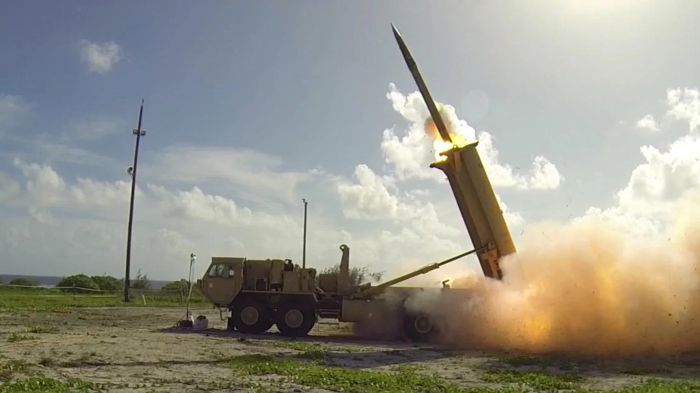
The reported expenditure included approximately 45 percent of available Precision Strike Missiles, nearly 50 percent of Patriot interceptors, around 50 percent of THAAD interceptors and 20 to 30 percent of Tomahawk inventories.
Those systems form the backbone of American war planning across the Western Pacific because they protect forward bases, suppress enemy air defenses and attack naval formations threatening Taiwan.
Analysts warned that the resulting vulnerability could persist between three and five years because American missile production remains calibrated for peacetime rather than industrial-scale warfare.
Mark Cancian of the Center for Strategic and International Studies assessed that rebuilding inventories alone could require one to four years before broader wartime expansion becomes possible.
Other analysts examining Pentagon production capacity concluded that complete recovery could take three to five years, creating an unusually dangerous strategic interval for American force posture.
Senator Mark Kelly described the problem as a “math issue” because the United States repeatedly destroyed inexpensive Iranian drones using interceptors costing several million dollars each.
That exchange ratio has transformed a regional war into a global strategic warning because the United States now faces the possibility of confronting China with substantially reduced missile reserves.
Critical U.S. Missile Inventory Losses During the Iran War and Their Impact on a Future Conflict With China
| Missile System | Estimated Inventory Expended During Iran War | Primary Role in Potential China Conflict | Strategic Impact of Depletion |
| Precision Strike Missile (PrSM) | Approximately 45% | Long-range strikes against Chinese missile batteries, logistics hubs and naval forces across the first island chain | Reduces U.S. ability to rapidly destroy Chinese anti-access and area-denial systems during the opening phase of a Taiwan conflict |
| MIM-104 Patriot Interceptors | Nearly 50% | Air and missile defence for bases in Guam, Japan, South Korea and allied territory | Weakens protection of forward U.S. and allied bases against Chinese ballistic and cruise missile attacks |
| THAAD Interceptors | Around 50% | High-altitude defence against Chinese medium-range and intermediate-range ballistic missiles | Creates reduced interceptor depth for defending multiple theatres simultaneously, particularly Guam and major Indo-Pacific command hubs |
| Tomahawk and Other Long-Range Missiles | Approximately 20–30% | Maritime and land-attack strikes against Chinese air defences, command centres, ports and missile launchers | Limits the U.S. Navy’s ability to conduct sustained long-range strike operations during the early stages of a Western Pacific conflict |
Why Iran Consumed the Same Missiles Needed Against China
The most heavily depleted systems are precisely the weapons American commanders would require immediately during a Chinese attack against Taiwan, Guam, Japan or regional naval formations.
China will not invade Taiwan. The communists have too many problems at home. According to Sun Tzu, the best victory is one they can achieve without fighting, so the problem solves itself –maybe with some internal political modifications. Sun Yat Sen anyone?