
Ryan Mancini – The Hill April 8, 2026
An adviser to Russian President Vladimir Putin said Wednesday that Iran’s nuclear weapon “is called the Strait of Hormuz” and that the waterway has unlimited potential to be used against the U.S., following a two-week ceasefire deal the U.S. made with the Middle Eastern country.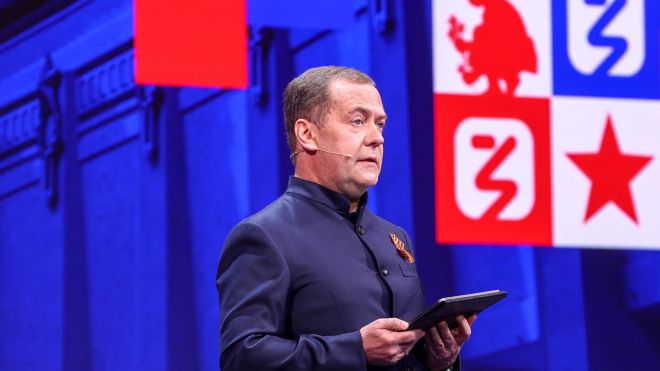
Dmitry Medvedev (right), the deputy chair of the Security Council of Russia and the country’s former president, wrote on social platform X that it is “not clear how the truce between Washington and Tehran will play out.”
“But one thing is certain – Iran has tested its nuclear weapons,” he added. “It is called the Strait of Hormuz. Its potential is inexhaustible.”
The U.S. and Iran agreed to the deal Tuesday night, a few hours before President Trump’s deadline for Iran to submit a deal and reopen the strait or face further bombardment. Iran shut down the strait, a key passageway for crude oil, following the start of the conflict on Feb. 28, causing oil and gas prices to skyrocket globally.
Defense Secretary Pete Hegseth said Wednesday during a press conference that the U.S. will have a presence in the strait and be prepared for possible future operations, The Washington Post reported. He lauded the military operation in Iran as a “historic and overwhelming victory.”
Iran will also demand shipping companies to make cryptocurrency payments for oil tankers passing through the strait, the Financial Times reported.
“Iran needs to monitor what goes in and out of the strait to ensure these two weeks aren’t used for transferring weapons,” Hamid Hosseini, a spokesperson for Iran’s Oil, Gas and Petrochemical Products Exporters’ Union, told the Financial Times. “Everything can pass through, but the procedure will take time for each vessel, and Iran is not in a rush.”
Vessels will have to email Iranian authorities about their cargo before they are informed about tolls they will pay via digital currency, Hosseini said. This is to ensure that transactions cannot “be traced or confiscated due to sanctions.”
Trump suggested that the U.S. and Iran will develop a “joint venture” to oversee a “tolling system” for vessels traveling through the strait. Though Iran established the idea of tolling the strait in its peace plan, with fees going toward its reconstruction, Trump’s suggestion was not part of the deal.
Secretary of State Marco Rubio late last month blasted the idea of a “tolling system” as “illegal” and “dangerous for the world.”
Some of the accumulated fees would also be presented to Oman, though how the nation would use the funds is unclear.
The ceasefire announcement and the reopening of the strait caused oil prices to plummet Wednesday morning. The price of international benchmark Brent crude dropped 14 percent to just more than $95 per barrel. The U.S. benchmark West Texas Intermediate, meanwhile, dropped down about 17 percent with trading at just under $96.
The national average for gas in the U.S., however, remained high at $4.20 on Wednesday, according to AAA.
From Mami’s Purgastories:
ISFAHAN, IRAN – CHARGE OF THE “NOT TOO BRIGHT” BRIGADE
– Remarque88
Prof. Marandi on the new Hormuz reality
THE UGLY ISRAELI – Unsafe_Space
“I’m fighting for Jeffrey”
ISFAHAN, IRAN – CHARGE OF THE “NOT TOO BRIGHT” BRIGADE ~ The New Hormuz Reality
https://grizzom.blogspot.com/2026/04/isfahan-iran-charge-of-not-too-bright.html
———————————–
Trump PANICS as CEASEFIRE PLAN BACKFIRES!!! – MeidasTouch
Scott Ritter: WAR FAILED… NOW WHAT?: The Real Force Behind Peace – Dialogue Works Highlights
Kuwait Explodes In Flames Just Hours After Ceasefire Was Signed — Scott Ritter – Scott Ritter Updates
CEASEFIRE PLAN BACKFIRES as President Bullshit Blames Everyone But Himself ~ NOW WHAT?
https://grizzom.blogspot.com/2026/04/ceasefire-plan-backfires-as-president.html
https://grizzom.blogspot.com
LOL..
That image of medsfordeath..no one in their right mind wears a nehru suit, not unless they are an indian tek mogul lol, or an extra in an Austin Powers shitflick..
and since we can discount Dmitri’s billionaire dothead status one can only presume he’s shagadelic…a groovy, smashing Nooklear Powers…
dear dear..
QUOTE:
“But one thing is certain – Iran has tested its nuclear weapons,” he added. “It is called the Strait of Hormuz. Its potential is inexhaustible.”
========================
Exactly:….who needs a nuke( If they exist)
The Strait of Hormuz is only approx. 20 miles wide.
However only a few miles of it are actually navigable.
Supreme Idiots American and Satan’s Kikes poked a slumbering bear…..the entire world is now aware of the Strait and both it ‘s importance and vulnerability re: GLOBAL TRADE .
Iran could shut it down in heartbeat and for as long long as they want..even if they were defeated they could still be a potent force to control it won’t take much.
This was a stupid idea or maybe this was the plan all along.
Still stupid either way , UNnecessary …and totally preventable.
ANOTHER BBC PERVERT
Ex BBC presenter jailed again for breach
Former BBC presenter Peter Rowell jailed for breaching sex offender requirements. Stayed with a teenage child for over 12 hours and failed to report his whereabouts. Sentenced to 29 weeks in prison.
“leave the little boys alone “