
HenryMakow.com – March 27, 2026
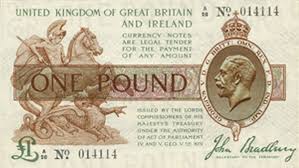
The Bradbury Pound, issued at the start of WW1, proved that governments can issue their own currency without pretending to “borrow” it from the Rothschilds at interest.
As society loses confidence in fiat currencies based on “debt,” this precedent may serve us in WW3.
“In modern discussions (often in alternative economics, monetary reform, or “sound money” circles), it is sometimes cited as an example of debt-free or interest-free public credit issued by the state rather than through private banks or the central bank. Some argue it bypassed the banking system’s fractional reserve practices and could serve as a model today.”
by GROK 4 – (henrymakow.com)
The Bradbury Pound (also called Bradbury Treasury notes or simply “Bradburys”) refers to the emergency £1 and 10-shilling paper currency notes issued directly by the British Treasury (not the Bank of England) at the start of the First World War in 1914. They were nicknamed after Sir John Bradbury, the Permanent Secretary to the Treasury, whose prominent signature appeared on them.
In early August 1914, as Britain declared war on Germany, a major financial panic erupted. People rushed to convert banknotes and deposits into gold sovereigns and half-sovereigns (the everyday gold coinage), threatening to drain the nation’s gold reserves rapidly.
The government needed to preserve gold stocks for war financing, international payments, and maintaining confidence in the currency. Banks faced a potential collapse under the pressure of mass withdrawals. The Bank of England could not print enough small-denomination notes quickly enough for widespread use (previously, Bank of England notes were mostly high-value £5+ and not everyday currency for ordinary people).
To address this, the government: Suspended the convertibility of Bank of England notes into gold (effectively going off the full gold standard temporarily). Authorized the Treasury to issue its own low-denomination notes (£1 and 10 shillings) as legal tender. These notes were initially convertible for gold through the Bank of England but served primarily to replace gold coins in circulation and stabilize the banking system.
All this proves was the successful theft of the value of currency and savings via the replacement of gold currency- Sovereigns worth 1 GBP and Half-Sovereigns with useless paper money.This happened in a matter of days in 1914 and was mirrored in France with the withdrawal of Gold Francs, Germany, Austria-Hungary and Russia also withdrew their gold currencies and foisted paper on the gullible public for the ‘war effort’. Churchill was key in this in Britain as unofficial PM at the time with his dominance of Cabinet meetings, and incompetence at the Admiralty. Leopards and their stinking spots….
It also prefaced massive price inflation during the war years and the Bankers’ made hyper inflation in Weimar Germany in the early 1920s whereby the rich became hugely wealthy and the middle and working-classes impoverished overnight-their savings and property worthless. Who owned such international banking houses ? But some wisely tried to hold on to their gold Reichmark coins from pre 1914- despite govt demands to hand them in- real value.
Significantly, the US demanded gold payments for war material from all sides in WW I until it belatedly chose a side to back in April 1917 after the Bolshevik Revolution. It made a fortune from this, often selling faulty or low grade weapons, it made the Dollar king though. Sound familiar?
THE US also forbade gold ownership and melted vast quantities of coinage under Roosevelt in the 1930s. Restrictions on gold ownership , buying gold coins remained in place in Britain till the 1970s. These restrictions will re-emerge you can be sure of it because the current price of gold puts the fiat currencies under strain. America has always been keen on annexing gold from countries it invades: Libya, Iraq and you can be sure Venezuela may have to have made a donation earlier this year. Germany is reputed to keep large quantities of its gold at Fort Knox, good luck with getting it back Herr Merz, it’s likely all stolen. Britain’s finance minister, Gordon Brown, during the Cull Britannia years of Blair, made the incompetent decision to sell off vast amounts of British gold reserves as outdated, seeing the future in futures and shares, the value of this has increased more than ten fold since then.
So far from being a liberating move as Makow alleges, this voodoo of turning gold into paper, wine into water (non drinkable!) is the motor of the casino-speculator- embezzler- economy that has powered the West since 1914. As are the endless wars and impoverishing people many, many times. And who owns the biggest banks and finance houses and has done for 140 years? But build back better. The Soviet silent film by Vsevolod Pudovkin , The Last Days of St.Petersburg, is well worth looking at in this context. Frenzied bankers running amok, fortunes made and lost and misery for the majority.
At the end of the day Gold is King, paper, then plastic now crypto, forever in its shadow.
Is it just me seeing science fiction irony in the article by a machine called Grok4 about a Bradbury while the emperor’s sarducar gets their asses kicked by the Iranian fremen?
Or is that dead cleric’s son eventually gonna turn into a worm…
Isn’t Bitcoin a substitute form of currency? Hasn’t the US Govt already tried to co-opt it by putting some of its funds in Bitcoins? Trump has said things that sound like govt is considering using Bitcoin as a segue into CBDC. At present, however, the world seems to have gone silent on Bitcoin. Why is that? Silence usually means things are still being done, but behind your back.