
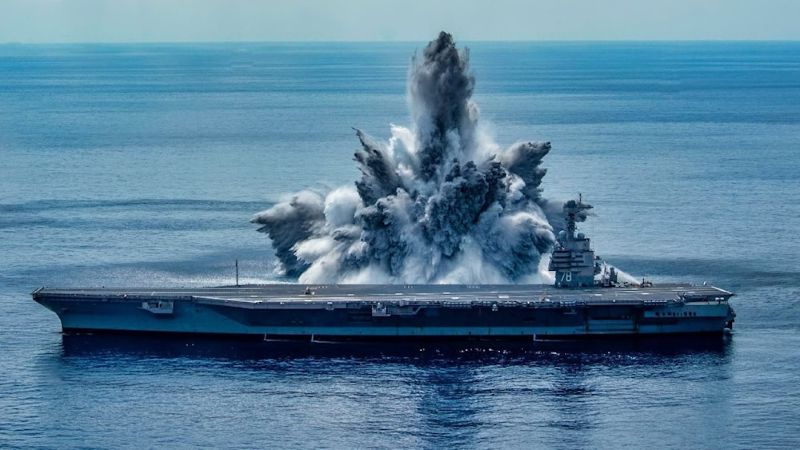
The USS Gerald R Ford successfully completes a Full Ship Shock Trial in the Atlantic in 2021
Trump: Iran fired 101 missiles at USS Abraham Lincoln
Naval Today – March 24, 2026 by Fatima Bahtić
US President Donald Trump has claimed that American naval forces successfully intercepted large-scale missile attacks launched by Iran targeting the aircraft carrier USS Abraham Lincoln.
According to Trump, Iran fired 101 missiles at the aircraft carrier USS Abraham Lincoln, but he asserted that “every single one was knocked down on the sea.”
Given that the USS Gerald R Ford withdrew from frontline combat due to “maintenance issues” you really have to wonder if all the missiles were intercepted, as Trump claims?
The carrier just entered service but it now faces more than a year in port deaing with “maintenance issues”? Really?
Could it be that USS Gerald R Ford’s problems were caused by Iranian missile strikes? Ed.
Al Jazeera – March 22, 2026
Writing for the 19FortyFive news outlet on Sunday, defense analyst Jack Buckby warned that the USS Gerald R. Ford could face an extended period out of service following a March 12 fire and the cumulative strain of a prolonged deployment.
The first-in-class Ford carrier has been withdrawn from active operations and is currently stationed at Souda Bay in Crete, after months of sustained combat activity in the Red Sea and surrounding region. The vessel had spent roughly nine months at sea, supporting intensive US operations, including thousands of strikes linked to the conflict with Iran.
The immediate cause of its withdrawal was, according to the US, a fire that broke out in the ship’s main laundry area.
The incident damaged adjacent compartments, including living quarters, displacing around 100 berths, while other reports suggest the destruction of hundreds of sleeping spaces. Nearly 200 sailors were treated for smoke exposure, with at least one requiring evacuation. While propulsion systems remained unaffected, the scale of the damage prompted a broader reassessment of the ship’s overall condition.
According to Buckby, however, the fire itself is only part of the issue. The carrier had already accumulated what he described as a significant backlog of deferred maintenance, the result of operating for an extended period under high-intensity conditions without the opportunity for full servicing.
This so-called “maintenance debt” includes ongoing concerns with key onboard systems, particularly the Electromagnetic Aircraft Launch System (EMALS) and Advanced Arresting Gear (AAG). These technologies, central to the Ford-class design, are intended to improve efficiency and sortie generation but have presented reliability challenges since the ship entered service.
Strained supercarrier deployment
Commissioned in 2017, the USS Gerald R. Ford is designed to replace the Nimitz-class and represented a major shift in US naval aviation.
The ship’s recent deployment is considered among the most demanding in modern US Navy operations. In addition to extended time at sea, the carrier operated under sustained operational pressure, integrating with other US air assets in a high-threat environment. The prolonged tempo has accelerated wear across both mechanical systems and crew capacity, with reports pointing to deteriorating onboard conditions, including earlier system failures and strain on basic infrastructure.
US officials have indicated that the stop in Crete is intended not only for repairs but also to provide relief for the crew, who have endured months of continuous deployment under increasingly difficult conditions.
Amid these developments, Iran’s Khatam al-Anbiya Central Headquarters issued a statement on March 13 claiming that the fire aboard the carrier had been deliberately set by US personnel. The statement said that the incident reflected fear and pressure among the crew during the ongoing confrontation.
“Oh Dear, How Sad, Never Mind” There goes $13 billion down the swanee! I wonder, was it really an Iranian missile or was it arson? Perhaps someone wanted to go home where it’s safer than getting your head blown off?🤢😢
GRAND THEFT AMERICA
a new word has entered the english vocabulary
to be ” Madoffed”
means to be robbed and plundered by jews
its time people of the US stood up and said no more wars for jewswhen Nutenyahu said ” Palestine today tomorrow America ”
he was not joking
A commenter elsewhere recently said something that’s worth some consideration. He said maybe the reason the Trump admin is sending troops into a murderous operation is because the US has far more dead than admitted, and they need a deadly event to cover their lies about only 13 dead.
It won’t be for the public’s benefit they’d admit to larger numbers dead, it would be because the families of the dead in this social media age would find out eventually, if for example, they tell twenty families their loved one died in an air-tanker incident in which they say six died. If they have several hundred dead which seems far more likely in this war where missiles can come out of nowhere, they soon run out of excuses like a car accident or a fall while hill-walking. But if it’s true they need more dead to hide how many are dead already that is an extremely sinister plan.
The carrier just entered service but it now faces more than a year in port deaing with “maintenance issues”
Almost as bad as the Woyal Navy’s track record!😂
Well..
…..They better cancel “Mexican Food” nite.
” Montezuma’s Revenge ” will plug the plumbing and maybe even capsize the ship !!!
ALSO:
Could this be a USS LIBERTY 2.0 ???
SCENARIO:
The Kikes hit the USS Gerald Ford ….and try to blame the Iranians??… even when it may be clear the Kikes are involved..directly or indirectly ?
This time the US is really screwed because the Iranians will retaliate regardless of the scenario if they are attacked. ie if A-N-Y artillery hits the USAship..how will USA react….immediately??..the Kikes kosher quasi- suckerpunch.
.
( Much like USA denied involvement with murdering 170+ Iranian school girls with what was later irrefutably exposed to be a US missile.)
LOSE – LOSE for USA….
The writing was on the wall in the Falklands war, when the Argentinians used Exocet missiles. Idiots in Whitehall then decided to build 2 aircraft carriers, neither of which, without the present rocket technology of any potential enemy to consider, are in full operational readiness.
They just had to know that nothing good could come from naming a tugboat – let alone a Flagship! – after Gerry ‘The Jerk’ Ford!
Ffs! 🤣
“US President Donald Trump has claimed…..” hahahahahahahahaha – he asserted that “every single bits of Murican Truth left was knocked down on the sea.” Truth floats! Just like Donny the turd!
Larry on March 25, 2026 at 5:41 pm
The writing was on the wall in the Falklands war, when the Argentinians used Exocet missiles. Idiots in Whitehall then decided to build 2 aircraft carriers, neither of which, without the present rocket technology of any potential enemy to consider, are in full operational readiness
——————————————————————
Didn’t the Brits have ships in the Falklands war built with Aluminum?
It literally burned when hit ?
Any damage suffered by the USS Abraham Lincoln or USS Gerald R Ford was emphatically NOT caused by enemy action. Both ships simply have ‘maintenance issues’ that led to them scurrying out of theater with their bridge telegraphs locked onto “Full Speed Astern”.
Now here’s another true story for you, children… “Once upon a time there were three bears; daddy bear, mommy bear and little baby bear.”… [etc]
A tired old cliche , but pertinent : Trump’s lips are moving means he is lying
Anglos have always been happily teaming up with Jews to destroy and plunder other nations, especially smaller ones.
Continuation
A happy team of brotherly predators, until the inevitable happened. One of the predators sought preponderance and achieved it too.
Rarotflmfao after only 9 months at sea. I’ll say 1 thing, what a heap of shit.