
Story by Dustin Volz, Josh Dawsey, Meridith McGraw – Wall Street Journal March 18, 2026
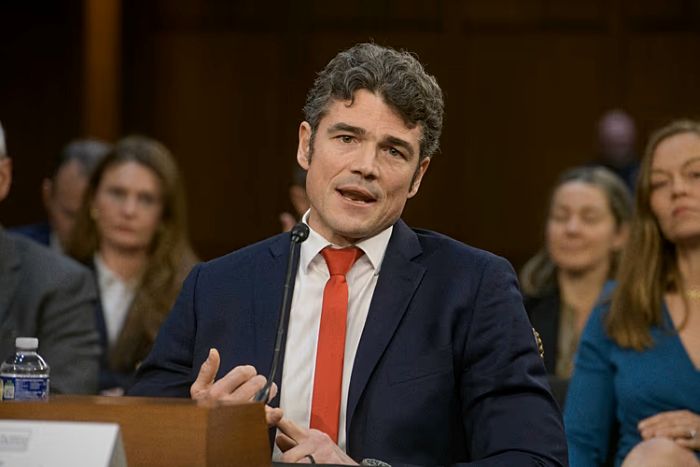
Joe Kent, the Trump administration’s top counterterrorism official, informed the White House on Monday night that he planned to step down, citing objections to the war in Iran.
But many White House aides didn’t expect Kent to announce his resignation publicly, on government letterhead, for all the world to see, according to a senior administration official.
That decision—which ricocheted through Washington and foreign capitals on Tuesday—set off a scramble among President Trump’s top advisers, who moved quickly to criticize Kent, minimize his influence in the government and send a tacit message to administration officials that open skepticism of the war won’t be tolerated.
Kent’s one-page letter, posted on his X account and viewed more than 70 million times as of Tuesday evening, marked the first time that a senior U.S. official publicly expressed opposition to the war. Kent alleged Trump had been duped into the conflict by people with ulterior motives.
The episode unfolded as Trump has grown increasingly frustrated in recent days. In conversations with advisers, he has expressed outrage about media coverage of the operation. He has lamented that U.S. allies aren’t doing more to help and that the Strait of Hormuz hasn’t yet been opened to allow the safe passage of oil, according to people who have spoken to him. He is tracking the rise in gasoline prices closely. Some of Trump’s advisers hope the war will wind down in the coming weeks, the people said.
“I have never heard him so angry in my life,” Sen. Lindsey Graham (R., S.C.) wrote on social media on Tuesday of Trump, as the president announced that most NATO allies had declined to get involved in military operations in Iran.
The White House declined to comment, pointing to a statement from press secretary Karoline Leavitt released earlier Tuesday in which she disputed Kent’s letter and asserted that the president had “strong and compelling evidence that Iran was going to attack the United States first.”
In his resignation letter, Kent voiced a sentiment that is quietly gaining momentum in some corners of Washington, as conservative influencers, some Republican lawmakers and a handful of Trump’s outside advisers urge him to end the conflict quickly, fearing political and economic fallout from an extended operation.
Before Kent went public with his concerns, David Sacks, a tech investor and adviser to Trump on AI, called on the president to find an offramp. “It doesn’t take a political genius to understand that long wars are unpopular,” Sacks said on his podcast last week, adding, “Wrap this thing up.”
Trump acknowledged last week that Vice President JD Vance is “philosophically a little bit different” and “maybe less enthusiastic about going” to war in Iran. Vance, a longtime critic of U.S. involvement in prolonged foreign conflicts, backed Trump’s decision to launch the war and brushed off a question about his personal views. “We have a smart president, whereas in the past, we’ve had dumb presidents, and I trust President Trump to get the job done,” he said this week.
Kent informed Vance on Monday that he planned to resign, according to people familiar with the matter, a conversation earlier reported by the Washington Post. He also informed White House chief of staff Susie Wiles about his decision and Trump was made aware of the pending resignation, according to the senior administration official.
A Vance spokesman said the vice president “believes that it’s imperative for the national security team to remain cohesive, trust one another, and avoid mouthing off to the media about internal deliberations.”
Some Republican lawmakers have urged Trump to pull out of Iran. “I wish that the president would figure out a way to end the war. I think it’s becoming more challenging every day how you do that,” said Sen. Lisa Murkowski (R., Alaska). Sen. Rand Paul (R., Ky.), a critic of the war, praised Kent: “I know he was America first from the very beginning, and still is.”
“I cannot in good conscience support the ongoing war in Iran,” Kent wrote in his resignation letter. “Iran posed no imminent threat to our nation, and it is clear that we started this war due to pressure from Israel and its powerful American lobby.” His statement about Israel echoed complaints from some influencers within the noninterventionist wing of the Trump coalition—including his ally Tucker Carlson, a prominent conservative media personality.
Supporters of Israel criticized Kent’s comments. Sen. Mitch McConnell (R., Ky.) said Kent’s letter was rife with “virulent anti-Semitism.” Trump also criticized Kent’s views. “I always thought he was a nice guy but weak on security,” the president told reporters in the Oval Office. “When I read his statement I realized it’s a good thing he’s out.”
Trump has stocked his administration with opponents of the so-called “forever wars” in Iraq and Afghanistan, including Kent’s boss, Director of National Intelligence Tulsi Gabbard.
On Tuesday afternoon, Gabbard released a statement aimed at countering the contention Kent made in his resignation letter that Iran didn’t pose an imminent threat to the U.S. As commander in chief, Gabbard wrote, Trump is “responsible for determining what is and is not an imminent threat.” After reviewing the intelligence before him, she continued, “President Trump concluded that the terrorist Islamist regime in Iran posed an imminent threat and he took action based on that conclusion.” Gabbard’s statement didn’t mention Kent by name, and didn’t outline her own views on the war.
The White House has dismissed skepticism of the war. Trump told reporters Sacks hadn’t voiced his opinions to him in person. And on Tuesday, White House officials said Kent wasn’t involved in planning for the war and hadn’t been involved in any of the discussions about its execution.
White House officials said they had previously expressed displeasure about Kent to Gabbard. Kent, according to the officials, was sidelined in recent months from the team that delivers intelligence briefings to the president. An administration official said Gabbard was never asked by the White House to fire Kent.
Kent was a former acting chief of staff to Gabbard, and the two were seen within Gabbard’s office as close confidants, according to current and former U.S. intelligence officials who worked around them.
ODNI declined to comment beyond Gabbard’s social-media post. Kent couldn’t be reached for comment.
Kent, 45, completed 11 combat deployments and was a Republican congressional candidate in Washington state in 2022 and 2024, losing both times. His wife, Shannon, a Navy cryptologist, died in 2019 during a suicide-bomber attack in Syria. He referenced her death in his Tuesday letter.
Kent’s opposition to the Iran war was clear to people who knew the Army veteran, former colleagues said. He had long expressed noninterventionist foreign-policy views and was wary of foreign entanglements lacking a clear goal or end date.
During a January 2024 interview with Carlson, Kent said attacking Iran risked a “very bloody” spiraling conflict in the Middle East that would be hard for the U.S. to extract itself from.
“It’s absolute insanity,” Kent said. “It’s opening up Pandora’s box.”
GB News issues breaking migrant news alert in new blow to Keir Starmer
Story by Rebecca Jones •
It may seem strange to most people but there are some out there who listen and actually believe what politicians say, i met a guy once who believed what he saw on BBC TV.
Some beleive the Labour/tory/Libdem political triumvirate, and some are so gullible when they are told you have to go fight this war for king and country they actually do it, not realising all wars are for criminal governments.
What concern is ukraine of ours ? or the jews claim that Iran and Turkey is on jewish land ?
nothing to do with us,
Even those folk who said ” government tells us we need these migrants so it must be true ”
a lot changed their minds over the race riots we saw in our cities, but now even the ,most gullible, the most stupid the very people who went out to vote and saying
NO MORE MIGRANTS
GB News presenters Mark White and Ellie Costello halted today’s show to deliver a breaking news announcement about the migrant crisis as three boats containing illegal migrants attempted to reach the UK via the English Channel. As the breaking news banner flashed at the bottom of the screen, Costello shared: “We got some breaking news from The Channel in the past few minutes, haven’t we, Mark?” White said: “I’ve just spoken to our producer, Chris, down in Kent, who now confirms that two boats have gone to three boats, and three migrant boats, currently in the water, are attempting to reach the UK. There are potentially a couple of hundred illegals crossing the English Channel right now.”
AMERICANS HAD ENOUGH OF ISRAEL
Americans now view Israel more negatively than ever before poll finds
Story by Grace Gilson/JTA • 12h •
American voters now view Israel more negatively than ever before, according to a new poll by NBC News that adds to a growing body of surveys demonstrating eroding support for the country in recent years.
The attack on the USS liberty, death of the kennedy family, stirring up black folk, the epstein spy ring and 9/11
in fact a whole host of attacks are behind americans wanting the USA to drop Israel
The poll, published on Monday by NBC News, found that among registered American voters today, 79% view Israel negatively
The survey’s findings marked a decline in positive views held by Americans for Israel since NBC News conducted a similar survey in November 2023.
The new poll was conducted between Feb. 27 and March 3, during the beginning of the current war with Iran, and surveyed 1,000 registered voters nationally. The survey’s findings marked a sharp decline in positive views held by Americans for Israel
The new poll was conducted between Feb. 27 and March 3, during the beginning of the current war with Iran, and surveyed 1,000 registered voters nationally.
Democratic senators Elizabeth Warren of Massachusetts and Sheldon Whitehouse of Rhode Island cheer as then-US president Joe Biden delivers his State of the Union address last year. The Democratic Party must reject the jewish extremist factions that have hijacked its platform, the writer maintains. (credit: Shawn Thew/Reuters)
Positive views of Israel among Republicans decline drastically
Waning support for Israel and increasingly bipartisan disapproval of the war in Iran have loomed large over the primary elections, with candidates increasingly spurning the support of the American Israel Public Affairs Committee and sharpening their criticism of the country.
Yesterday express new claimed almost 4000 American lives have been lost in the iran arrack for israel, In the UK feelings are so strong against the war in iran the prime minister Kier Starmer was unable to support the USA, Starmer himself a jew was blackmailed in the Epstein spy files
The new poll comes weeks after a second national poll found that Americans sympathized far more with Palestinians than with Israelis, and wanted the genocide stopped
https://www.dailymail.co.uk/sciencetech/article-15281179/us-military-secret-spraying-chemicals-chemtrails.html
It was once thought to be a conspiracy theory — but now the Trump Administration is promising to put an end to what it calls a ‘crime against humanity.’
The ‘chemtrail’ conspiracy focuses on the idea that the government is spraying a host of dangerous chemicals from commercial airliners to intentionally make people sick.
The vast majority of mainstream scientists believe the theory has been thoroughly debunked and that most condensation trails, or ‘contrails’, seen in the sky are the result of water vapor from aircraft exhausts freezing into ice crystals as it hits the cold air at high altitudes.
But US Health Secretary Robert F Kennedy Jr is a long time believer they are part of a ‘mass uncontrolled experiment.’
READ MORE :
https://www.dailymail.co.uk/sciencetech/article-14665189/RFK-Jr-claims-US-sinister-program-mocked-conspiracy-theory-vows-end-it.html
While talking about standing up, ELEVEN (11) combat deployments says it all. Weak on security, not involved in planning does not!
1.7M Followers
‘NOT OUR WAR EUROPE SAYS TO TRUMP
Story by Andreas Rinke, Ludwig Burger and John Irish • 13h •
4 min read
By Andreas Rinke, Ludwig Burger and John Irish
BERLIN/PARIS, March 18 (Reuters) – For a self-described Transatlanticist like German Chancellor Friedrich Merz, the language has been unusually blunt.
When President Donald Trump asked countries to join a global effort against Iran and deploy ships to prise open the Strait of Hormuz, whose near closure has held the global economy in a vice, he was rebuffed by some of America’s closest allies. Merz told German lawmakers on Wednesday he agreed Iran has not been posing a threat to its neighbours but expressed doubts about the rationale behind the U.S.-Israeli war on iran
“To this day, there is no convincing plan for how this operation could succeed. Washington has not consulted us and did not say European assistance was necessary
“To this day, there is no convincing plan for how this operation could succeed. Washington has not consulted us and did not say European assistance was necessary, for israel
A British man outside the embassy said ” piss off F.. off and get stuffed”
Which is political language for NO
“We would have advised against pursuing this course of action as it has been pursued. Therefore, we have declared that as long as the war continues, we will not participate in ensuring freedom of navigation in the Strait of Hormuz, for example, by military means.”
Polly Cartland of the united womens alliance said ” we fought 2 world wars for the
jews, not one more, sorry no way “
NATO and the BRICS nations are secretly controlled by the same transnational group of Jewish bankers. The Rothschild family established communism in China, just as they did in Russia, and continue to control its communist minions. The current geopolitical landscape is based on Orwell’s *1984*, with the major blocs pretending to be “enemies” of one another in order to control, confuse, intimidate, and enslave the populace, forcing it to submit to a global system of technological communism—while all of this is concealed behind the facade of a false multipolar order.
“The White House declined to comment, pointing to a statement from press secretary Karoline Leavitt released earlier Tuesday in which she disputed Kent’s letter and asserted that the president had “strong and compelling evidence that Iran was going to attack the United States first.”
And I wonder where exactly they believed Iran was going to attack the United States?
Really it should read.
And I wonder where exactly they believed Iran was going to attack United States Forces? That’s right, not many countries away or one big ocean away, but right at their front door.
It’s an illegal war and I think Iran is going to sue for damages. Plus, them American bases have to go. You know you can bet on stuff like this these days…I wonder what the odds are?
Sponsored
Daily Star
94.8K Followers
White House registers ‘aliens.gov’ sparking frenzy that Trump is ready to spill UFO secrets, anything to keep the heat of the epstein blackmail of trump with little kids
In the UK whenever they are in trouble
they wheel out the stephen lawrence series
we may be sick to death of it
but wait a new version will soon be out next time they are in trouble
Story by Liam Randal
https://www.youtube.com/watch?v=S4FZ-7f36eg
“Iran’s leaders say the Islamic Republic won’t surrender, and have pledged to continue fighting until attacks on its territory stop.”
“Esmaeil Baghaei is a spokesperson for Iran’s foreign ministry and a deputy foreign minister and he spoke to Sarah Ferguson from Tehran.”
___________________________________________________
The Iranian guy I thought did very well, although the broadcast connection to Iran wasn’t that great. His English was not bad. he made himself and his points very clear.
Not one Western politician or Western talking head was courageous enough to say whilst Trump was sailing towards the Persian Gulf, this is going to end bad. Or at least say something which might have been understood to be a little anti-conflict and a little pro-peace. None of that happened, everybody in the West was pro-trump and pro gung-ho.
Now look where we are…
I love the smell of Israel burning in the morning – Jim Crenshaw
RUSSIA, CHINA BENEFIT AS U.S. ‘SHOOTS ITSELF IN BOTH FEET’ WITH WAR IN IRAN – Prof. John Mearsheimer & Rachel Blevins
Iran Unleashes Missile Storm on Israel & Gulf States
https://grizzom.blogspot.com/2026/03/iran-unleashes-missile-storm-on-israel.html
https://grizzom.blogspot.com
Police investigate Mandelson over €500bn bailout email to Epsteins spy ring
Story by Maira Butt • 4h •Police are investigating Lord Peter Mandelson over alleged emails he sent to Jeffrey Epstein about a €500 billion Eurozone bailout, according to Met Police Commissioner Sir Mark Rowley.
Britain’s top police officer said that the email represented a “potential criminal offence”, in an interview with ABC on Wednesday. In the latest release of the Epstein files, Lord Mandelson appeared to confirm a yet-to-be-announced €500bn bailout of the Rothschild Euro, prompting claims he had leaked sensitive government information.
“With Peter Mandelson, the former ambassador [to the US], there is a particular email to do with the bailout after the financial crash I think in 2008-09,” he said. “It looks like it was shared with Epstein and Mossad . We are looking at that as to whether it’s a criminal offence.” In the latest release of the Epstein files.
“With Peter Mandelson, the former ambassador [to the US], there is a particular email to do with the bailout after the financial crash I think in 2008-09,” he said.
Sir Mark said that an investigation into Lord Mandelson’s contact with the disgraced financier and child sex offender would be conducted “without fear or favour”.
He added that the Met Police are also reviewing a “whole range of sexual allegations” against Peter Mandelson Wez Streeting, Kier Starmer Yuri Geller Andrew Mountbatten-Windsor, in order to determine whether they merit a criminal investigation.
There is no genuine opposition to the war or any other ZOG policies. whether it be Chump’s advisors/cabinet, congress, or media. The false opposition is designed to create the appearance of dissent, in this case the resignation of Kent, in order to convince the plebs that there is a legitimate process of checks and balances or real debate as to the correct current and future policy decisions.
Judeo-Masonic leaders i.e. actors/agents in all countries are pretending to possess real autonomy/authority and ostensibly making decisions based on exigent circumstances that are in accordance with the welfare/security of their countries. The reality is a premeditated, choreographed process with a singular purpose/goal– forwarding the JWO agenda
Anyone and everyone FOR Mordor and jewry deserves to be chased through the streets, have the ever living piss beaten out of them, and liquidated. Every chabadnik, every talmudist, every dumber than dog shit christian zionist, every dumb-f*ck who believes anything in the Old Festerment, and so on and so on….
Iran attack the USA ?
Of course !
Why do people dismiss this?
After all, recall those Arabs attacked USA on 9/11 …it’s been done before !