
Defence Security Asia – Feb 17, 2026
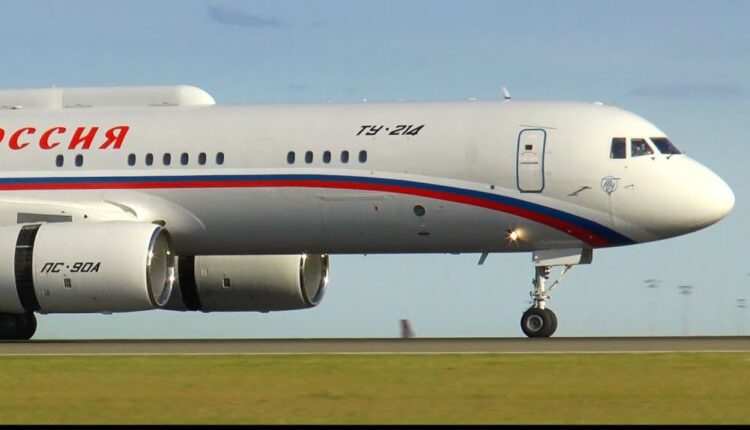
The departure of flight RSD420, a Tupolev Tu-214PU airborne command post operated by Russia’s elite “Rossiya” Special Flight Squadron, from Moscow’s Vnukovo International Airport to Tehran’s Imam Khomeini International Airport on 16 February 2026 represents a calibrated geopolitical signal rather than a routine aviation movement, underscoring intensifying Moscow–Tehran strategic coordination at a moment of heightened regional volatility.
“The Rossiya squadron is the Kremlin’s airborne lifeline, blending VIP luxury with doomsday resilience,” one analyst observed, framing the deployment of the Tu-214PU as a deliberate projection of executive-level engagement rather than a standard diplomatic visit, particularly given the aircraft’s hardened communications suite and crisis-command architecture.
The selection of the Tu-214PU platform—engineered as a flying command post (Punkt Upravleniya)—signals that the mission likely involved high-level strategic deliberations tied to military-technical cooperation, intelligence-sharing frameworks, or contingency planning in response to mounting Middle Eastern flashpoints involving Iran-backed proxies and potential U.S. or Israeli escalatory scenarios.
At a time when Russia and Iran are consolidating a 20-year Comprehensive Strategic Partnership Treaty signed in January 2025, the optics of deploying a secure airborne command node to Tehran reinforce perceptions that bilateral coordination is transitioning from transactional wartime necessity toward structured long-term strategic alignment.
The aircraft’s specialized configuration, including secure data links, encrypted satellite communications, and electromagnetic shielding designed for continuity-of-government operations during high-intensity conflict—including nuclear contingencies—suggests that the discussions aboard or facilitated by RSD420 likely exceeded ceremonial diplomacy and entered the domain of strategic crisis consultation.
This development unfolds against the backdrop of expanding Eurasian security architectures, Iran’s integration into multilateral blocs such as the Shanghai Cooperation Organization and BRICS+, and intensifying Western scrutiny of Moscow–Tehran military collaboration, particularly concerning drone transfers and advanced weapons systems modernization.
The flight path over the Caspian Sea, commonly used to avoid potentially hostile airspace, further underscores the sensitive nature of the mission, reflecting operational prudence consistent with high-level state engagements involving defense ministers, intelligence chiefs, or presidential envoys.
As regional tensions escalate in parallel with U.S. military deployments, including the forward positioning of 18 F-35A fighter jets supported by aerial refueling assets in the broader Middle East theater, the arrival of a Russian airborne command post in Tehran inevitably amplifies geopolitical signaling across Washington, Tel Aviv, and allied capitals.
In financial and strategic terms, the expanding Russia–Iran partnership—now exceeding US$5 billion (approximately RM23.5 billion) annually in bilateral trade—forms the economic underpinning of this evolving alignment, combining military-technical cooperation, energy collaboration, and de-dollarized trade mechanisms designed to mitigate Western sanctions pressure.
Within this context, the Tu-214PU’s arrival in Tehran must be assessed not as an isolated event, but as a high-visibility manifestation of Kremlin-level engagement in shaping a multipolar security order amid intensifying geopolitical fragmentation.
The Strategic Significance of Deploying a Tu-214PU Airborne Command Post to Tehran
The Tupolev Tu-214PU is not a conventional executive transport aircraft but a hardened airborne command-and-control node designed to ensure real-time strategic decision-making during national emergencies, including large-scale military operations or nuclear crises, thereby elevating the significance of its dispatch to Tehran.
Powered by two Aviadvigatel PS-90A turbofan engines and capable of a range exceeding 7,000 kilometers, the Tu-214PU combines endurance with secure communications redundancy, enabling it to function as an airborne relay for strategic messaging and encrypted command transmission across multiple theaters.
Its distinctive canoe-shaped fuselage fairing, housing specialized antennas and sensors, reflects its design priority: survivable, resilient communications in degraded or contested electromagnetic environments, underscoring that its deployment is typically reserved for moments of heightened strategic sensitivity.
Registered as RA-64533 and operated exclusively by the “Rossiya” Special Flight Squadron under the Directorate of the President of the Russian Federation, the aircraft forms part of a limited fleet that includes Il-96-300PU presidential jets and other VIP-configured platforms tailored for command and control missions.
The “Rossiya” squadron, also known as Unit 235, maintains approximately 39 aircraft, and its mandate centers on ensuring secure mobility for Russia’s political leadership, particularly during high-stakes diplomatic or security engagements.
The use of such a platform for a Moscow–Tehran mission implies that the discussions likely engaged top-tier officials, potentially encompassing defense coordination, intelligence exchange mechanisms, or alignment on regional crisis management scenarios.
In geopolitical signaling terms, deploying a flying command post—rather than a standard diplomatic aircraft—conveys Kremlin-level prioritization of the Tehran engagement, reinforcing perceptions that Moscow views its Iranian partnership as strategically consequential within the evolving Eurasian power matrix.
Given the aircraft’s capacity to function as a mobile headquarters, its presence in Tehran may also have facilitated secure consultations beyond conventional diplomatic facilities, reducing vulnerabilities associated with fixed-site communications interception.
The timing, amid intensifying regional military postures and continued scrutiny of Iran’s drone and missile activities, amplifies the interpretive weight of the flight within broader Middle East security calculations.
Consequently, the Tu-214PU’s mission constitutes both a practical coordination platform and a symbolic assertion of strategic depth in Moscow–Tehran relations.
thanks russia
us british folk are held in the grip of dirty jews
please help us and bomb israel very soon
Australian who called Jews ‘greatest enemy’ of our nation gets year in jail under new hate crime laws
Story by Mathilda Heller •
An Australian man who called Jews “the greatest enemy” of Australia during an anti-immigration march has been jailed for one year.
Brandon Koschel, 31, delivered the anti jewish speech in Sydney on Australia Day on January 26.
Th gaza genocide is a hate crime, words are not
All these politicians that came up here spoke about bravery, all that bullshit, because they don’t know what it means; they came up here, gave you a bunch of words, but none of them called out the fact that the hate speech laws were pushed by the Australian, the Jewish lobby groups in Australia,” Koschel said in his speech They were behind it all. The Jews are the greatest enemy to this nation; they always have been. They are an enemy to Western civilization, and for thousands of years Christians and Anglos, the white man, has known that the Jew is our greatest enemy,” he said.
The charges against Koschel
On Tuesday, Magistrate Sharon Freund charged Koschel with publicly inciting hatred on the grounds of race, causing fear. The court heard that the 40-second speech – in which he twice called Jews the greatest enemy – received “cheers in response” and that it was “clearly anti jewish and vilified Jewish people.” Freund said Koschel would have been aware of the possibility that his hate speech could be republished and also that it could incite violence. Her sentencing totally ignored the crimes of jews, such as 2 world wars and brewing up for another
one now
I know I’m preaching to the converted on this forum, but this is to any newcomers who still don’t see the bigger picture – there is absolutely NO REASON, whatsoever, for the western civilization to attack Iran, that is, unless it’s under the control of a foreign power. That power is Israel and they are 100% behind the attempted war with Iran, just as they were with Syria, Libya, Iraq and Afghanistan before.
What amazes me, more though, is that people are still incapable of seeing that the favouritism there’s been, by the government to non nationals, especially illegals, is there for the public to start hating Muslims, so that they will drop their support for Palestinians, giving Zionists the go ahead to clearing out the middle east, into Europe, so they can build their Greater Israel (after they’ve got the western goy to flush out their remaining enemies and residents), their temple of Solomon, their new superpower and seat of the world government.
I’m still 100% in the belief that Putin is totally controlled by the Jew, just as Trump and all other western politicians. A war with Iran will not only result in a mass culling of the Iranian population, so much so that IDF will walk in a take control, but also it will set about the rapid downfall of an already rapidly downfalling west. The war that the Jews created in the middle east will now continue playing out in the streets and alleys throughout every western country, while the Jew laughs having built its Gaza luxury resorts and its full of millionaire and billionaires, rich on their ill gotten gains from stealing from the Europeans. The continuing chaos, in the west, will result in more and more Jews packing their bags and leaving to go to Israel, something the Zionists were unable to do throughout the 20th century with two major wars. The parasite didn’t want to leave, because the parasite never leaves its host.
The war alliance of Iran-Russia-China had to happen. US belligerence forced it, bearing in mind George Washington’s observation that “Either we all hang together or we’ll all hang separately.”
Iran should not wait attack first stun the infadeks
Here’s an interesting report from Patrick Henningsen just returned [to the US ?] from Iran talking to Daniel Davis. Daniel is not interrupting as much as usual on contentious issues (47m).
https://www.youtube.com/watch?v=3emHhJZjpe0
It’s interesting Starmer is talking about blocking Trump’s access to Diego Garcia and perhaps RAF Fairford [?] in Gloucestershire. I wonder how much of this is because of mutterings inside British forces and a reluctance to fight for Israel? This could be to prevent some kind of mutiny.
JewSA-Nato- Israhell are the only trouble makers in the world !
https://halturnerradioshow.com/index.php/component/content/article/china-publicly-reveals-satellite-images-of-us-bases-aircraft-in-middle-east?catid=17&Itemid=101
Russia and China know they are next if ZOG picks off Iran, so it is logical for them to fight a proxy war, help Iran defeat ZOG.
If you think about it, Russia, China, and Iran would benefit greatly if Israel was destroyed, then the USA would have no reason to be in the Middle East.
Why no one nukes the City of London and Rothschild and Israhell is beyond me. If you put my nation on total economic sanctions that is an act of war. I would respond with nukes and completely destroy the SWIFT trading system, Jew cental banks, etc.
I dont hate jews or moslems . I had until now
better relationships with moslems than with my
fuck stupid ignorant germans or this intelectual
“betterknower” leftistgreenliberal shitters (which
rule now in politics + medias) . zionist jews +
christian zionists I can only despise, not hating
them . and probably its better for my karma not
to have the possibilities to kill atleast the greatest
jewish bestia of our times, Mehrkill . I am poor,old
and I am no houseowner + I even dont own one
square foot of german soil . so let some german
house + soil owner do it + THEY HAVE GUNS !
so if they dont do it , fuck them ! GERMANY HAS
THEN NO HONOUR ANYMORE ! fuck them .
on the other think side : since everybody has a spark
of the living soul . it may be fruitless to kill ones
enemy . but on the other hand there was Krishna + the
Bagavata . one could spoil ones own karma .
Jobless-migrant households receive more than £10bn in benefits
Taxpayers paid £15bn in Universal Credit to households with at least one foreign national, official figures reveal
The internet is crowded with Jew-fakes……that is they prefer to run their own opposition.
Take ” Mutt and Jefft Jeff….two crypto jews who run a website a disgusting pair of lying jews funded no doubt by the Israeli government……..somehow the massacre of 70 000 Palestinian civilians escaped their notice!!….
Anyone who knows a little about this hates these mofos…..Their importation of MILLIONS of immigrants into the West is part of their strategy…..they’re able to divert the publics attention….if these illegals attack the west…..so much the better!!.
Then you have Tommy Robinstein…….he gets attention from “the far right”…..he is currently in Washingstein……Very definitely a crypto jew……same with MOST of the leaders of the freedom march…..
Recently he was in Paris walking the streets with a crypto jewess.
This is NOT a jews vs Muslims situation THEY WANT TROUBLE in order to get trouble between the two.Keep in mind they have been causing friction between Catholics…..there are many MARRANO’S in Western countries…..Franco is a jewish Sephardic surname.
AMERICAN PATRIOTS…….your hero TRUMP……is 100% a crypto jew…sooner or later he will betray America…..USE COMMON SENSE…..his daughter is married to a multimillionaire jew businessman
Harbinger @the reason to attack iran us they flatly refuse to allow in rothschild fractional reserve banking
this is why 7 countries had to be bombed so they they would have to accept rothschild loans
and the country was then lost
they did this to germany in 1939
jews want it all they say the world was promised to them
listen iran is nor your enemy neither is russia or china
the real enemy is sitting behind your government
The western governments and Elites are intent on ripping BRICS apart one bite at a time.
fullerangus@gmail.com,
Rothschilds anyway have, most likely, a quadrillion+ now. Yes, I agree that the invasion of all lands after 9/11 allowed fractional reserve banking, but these countries were removed to isolate Iran and support for Palestine.
The goal is the establishment of Greater Israel, rebuilding of Khazaria and the new empire encompassing Russia, Khazaria, the middle East and northeast Africa, dumping all who are within into the west. Iraq was a major ally to Palestine, along with Afghanistan, Libya and Syria. They didn’t want them uniting with Iran and attacking Israel. Gaddafi also wanted to do trading oil in the petrodollar. So… attacking him they killed three birds with one stone – destroyed a Palestine ally, stopped Gaddafi uniting African nations into dumping the petrodollar and allowing future, mass migration, into the west from Africa.
Not everything is about money. They have all the money there is. They want to create a new superpower.