
Defense Security Asia – Jan 26, 2026
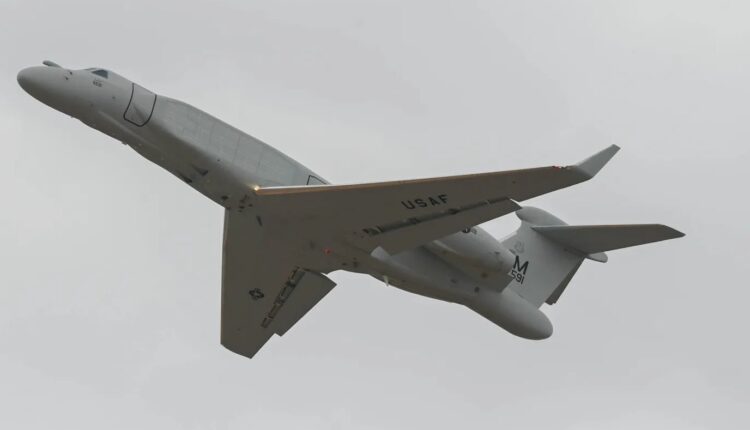
The transatlantic arrival of a United States Air Force (USAF) EA-37B Compass Call II electronic warfare aircraft at Ramstein Air Base represents a calculated escalation in Washington’s preparation for spectrum-centric conflict, reflecting a doctrinal shift that increasingly prioritises electromagnetic dominance as the decisive enabler of modern air and joint operations across both the European and Middle Eastern theatres.
Tracked by aviation observers on 25 January 2026, the EA-37B bearing serial number 17-5579 and operating under the callsign FAZE41 marked the first publicly observed forward movement of this next-generation electronic attack platform into Europe, a deployment that immediately triggered strategic assessments regarding potential onward repositioning toward the Middle East amid intensifying confrontation involving Iran and its regional proxy networks.
Ramstein Air Base, long recognised as the United States Air Force’s most critical operational hub in Europe and a strategic logistics artery bridging NATO and US Central Command (CENTCOM) theatres, provides an ideal staging environment for high-value assets whose missions demand rapid theatre-to-theatre flexibility without reliance on politically sensitive forward basing.
The deployment underscores the Pentagon’s recognition that the electromagnetic spectrum has become the primary battlefield in contemporary conflict, where disruption of command, control, communications, intelligence, surveillance, reconnaissance, and targeting networks increasingly precedes—and often negates—the need for kinetic engagement.
As formally defined by the US Air Force, “The EA-37B Compass Call is a wide-area airborne electronic attack weapon system using a heavily modified version of the Gulfstream G550 airframe,” a description that captures the platform’s fundamental role as an offensive counter-information instrument rather than a passive support asset.
BAE Systems, whose Small Adaptive Bank of Electronic Resources (SABER) underpins the platform’s future-proofed architecture, characterises the aircraft as “a tactical airborne electromagnetic attack weapon system that denies, degrades and disrupts adversary command, control, communications, radars,” a capability set increasingly central to defeating integrated air defence systems without direct kinetic attrition.
Operational doctrine further clarifies that “The Compass Call mission is to jam enemy communications, radars, and navigation systems, degrading command and control and supporting SEAD operations by disrupting an enemy’s ability to coordinate sensors and use weapon batteries that target friendly aircraft,” positioning the EA-37B as a force-multiplying enabler rather than a standalone asset.
The arrival of EA-37B 17-5579 therefore represents more than a routine aircraft movement, instead serving as a visible signal that the United States is actively positioning high-end electronic warfare capabilities in anticipation of scenarios where electromagnetic suppression will determine operational success before the first missile is launched.
From a geo-strategic perspective, the deployment also communicates resolve to both adversaries and allies, reinforcing deterrence by demonstrating that American forces retain the ability to paralyse hostile networks across vast distances while preserving escalation control through non-kinetic means.
Transatlantic Deployment and Ramstein’s Role as a Strategic Electromagnetic Warfare Hub
Flight-tracking data revealed that EA-37B Compass Call II aircraft 17-5579 executed a deliberate transatlantic routing profile consistent with high-value asset movement, potentially staging through US East Coast facilities or Bermuda before crossing into European airspace en route to Ramstein Air Base, a pattern historically associated with assets earmarked for contingency positioning rather than routine training sorties.
The use of Ramstein as the arrival node is strategically instructive, as the base functions not merely as a logistical centre but as the primary operational nerve centre for US airpower projection into both Eastern Europe and the Middle East, enabling rapid re-tasking without the diplomatic friction often associated with direct forward deployment.
From Ramstein, the EA-37B can reach key operational areas across the Levant, Persian Gulf, and Red Sea corridor within approximately twelve hours of flight time, granting commanders the ability to reposition advanced electronic attack capabilities with minimal warning and maximum strategic ambiguity.
This flexibility is particularly relevant given the EA-37B fleet’s early operational status, with only a limited number of aircraft having entered service under the oversight of the 55th Electronic Combat Group at Davis-Monthan Air Force Base, making each deployment decision strategically consequential.
The presence of serial 17-5579—one of the earliest production aircraft—over Europe signals an acceleration of operational familiarisation beyond the continental United States, suggesting that the platform is transitioning from training emphasis toward real-world contingency readiness.
Ramstein’s geographic positioning also allows the EA-37B to support multiple theatres simultaneously, including NATO’s eastern flank in response to Russian electronic warfare activities while maintaining proximity to Middle Eastern flashpoints involving Iran, Hezbollah, and Houthi forces.
Electronic warfare platforms are uniquely valuable in such environments because they offer decision-makers scalable response options that fall below the threshold of overt kinetic escalation while still delivering operationally decisive effects against adversary command and control.
The deployment therefore reflects a broader shift in US posture that treats electromagnetic attack as a standing deterrent presence rather than a niche capability activated only during active hostilities.
By forward-positioning the EA-37B at Ramstein, the United States effectively compresses response timelines and complicates adversary planning cycles, reinforcing the principle that control of the spectrum is now inseparable from control of the battlespace.
From EC-130H to EA-37B: The Evolution of America’s Premier Airborne Electronic Attack Platform
The EA-37B Compass Call II represents the culmination of a deliberate generational transition away from the ageing EC-130H fleet, whose contributions to electronic warfare were substantial but increasingly constrained by airframe limitations that reduced survivability and operational relevance in contested environments.
The EC-130H, based on the Lockheed C-130 Hercules, delivered decades of service by jamming enemy communications and radars, yet its limited speed, altitude ceiling, and vulnerability to modern surface-to-air threats rendered it increasingly unsuitable for high-end conflict scenarios involving near-peer adversaries.
More ways for the kike to siphon off your “income”. Bombs and “AI” that never does anything, you can’t see and most likely doesn’t exist beyond the “show home” installations.
the 2 US bases were put out of action when the black gang the london posse stationed their guys to shine laser pens in the pilits as they took off
this stopped chem trailing for a short while
we must bring this action back to help save iran from the jew
Pro-Palestinian demonstrators blockade israeli aerospace defence factory
Story by Lucinda Cameron, Press Association Scotland • 55m •Pro-Palestine campaigners have staged a protest outside an aerospace weapons factory in Edinburgh.
The demonstrators said Leonardo UK make components for F-35 combat aircraft, which are used by Israel.
They are calling on Leonardo UK to drop its F-35 contract with Lockheed Martin, which produces the aircraft.
Around 100 protesters, some holding Palestine flags, blockaded the entrance to the factory on Wednesday morning.
Andy, 30, who did not wish to give his surname, said: “We want to encourage workers of Leonardo to take action within their trade union to end this F-35 contract with Lockheed Martin, and amplify the voices of Palestine Action prisoners who have been on hunger strike in British prisons.”
Asleem, a 29-year-old health charity worker who also took part, said: “Officially there has been a ‘ceasefire’, but the indiscriminate killing and maiming has not ceased.”
THE MONEYLENDERS
Immediately after the battle of waterloo
Rothschild took the whole British economy.
Since then they have bled us financially.
The national debt to the jewbankers now is
Approximately £2,927.7 billion
As of November 2025 the interest on this grows at £5000
per second.
Rothschild has positioned every UK prime minister back to and including Churchill.
The jews want us to mobilise into an army to fight iran
Why ? because they say iran has been built on their land
and they keep refusing Rothschild fractional reserve lending
The charging of interest i[on interest, is wrong
Jesus smashed the place up of the moneylenders
Adolf Hitler made Germany great by stopping it
Iran is not your enemy your zio-government is