
Defence Security Asia – Jan 18, 2026
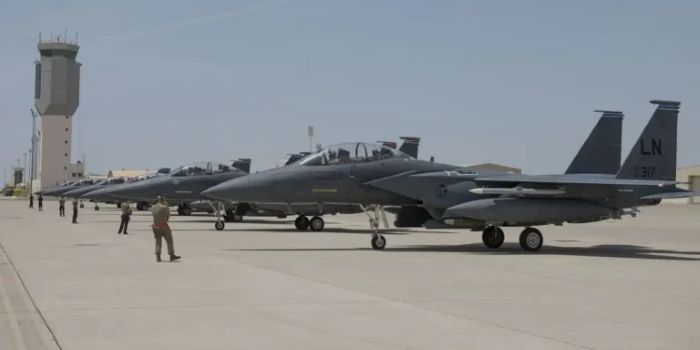
The United States is deploying at least 12 F-15 fighter aircraft and four KC-135 Stratotanker aerial refuelling aircraft from RAF Lakenheath in the United Kingdom to Muwaffaq Salti Air Base in Jordan, a move that represents a calibrated escalation in Washington’s Middle Eastern force posture by fusing strategic deterrence, forward operational readiness, and escalation management at a moment of intensifying tensions with Iran and expanding regional instability.
This redeployment, confirmed through open-source intelligence, flight-tracking data, and observed tanker-supported ferry profiles across European and Mediterranean airspace, reflects a doctrinally consistent U.S. approach in which forward-based tactical airpower is used as both a signalling mechanism and a contingency enabler during periods of geopolitical volatility involving Iran’s missile, drone, and air-defence forces.
The aircraft involved—drawn from the 48th Fighter Wing at RAF Lakenheath—include F-15 variants renowned for their dual-role air superiority and deep-strike capabilities, while the accompanying KC-135 Stratotankers extend mission endurance and sortie density across the Levant, Iraq, and the northern Arabian Peninsula, enabling persistent combat air patrols and rapid strike options without reliance on vulnerable forward staging.
A senior U.S. official, speaking anonymously, underscored Washington’s public posture by stating that “there has been no change in U.S. military posture in the Middle East despite protests in Tehran,” characterising the F-15E movement as a “routine rotation” and emphasising that it constituted no net increase in regional forces, a claim that stands in tension with the scale, timing, and synchronisation of concurrent U.S. air, land, and maritime deployments.
The credibility gap widened further when President Donald Trump warned on January 2 that if Iran harmed protesters, “we will come to their rescue,” a statement that, when juxtaposed with visible force movements, transformed a nominally routine rotation into a strategic message directed simultaneously at Tehran, regional allies, and domestic audiences.
The blending of public de-escalatory language with tangible force reinforcement mirrors historical U.S. crisis-management patterns, in which ambiguity is deliberately preserved to maximise deterrence while retaining political flexibility for rapid escalation or restraint.
The choice of Jordan as the destination is neither incidental nor merely logistical, as Muwaffaq Salti Air Base has repeatedly functioned as a forward operational node for counter-Iranian air and missile defence missions, including the interception of Iranian missiles and unmanned aerial systems during previous regional escalations.
When assessed holistically, the redeployment constitutes less a discrete event than a visible component of a broader, multi-domain U.S. force realignment designed to maintain escalation dominance across the Middle East while signalling preparedness for high-intensity contingencies involving Iran’s conventional and asymmetric capabilities.
Strategic Rationale Behind the F-15 and KC-135 Redeployment to Jordan
The redeployment of F-15 fighters to Jordan significantly enhances U.S. air combat power along Iran’s western approaches, enabling rapid access to Iraqi, Syrian, and Iranian airspace while maintaining sufficient standoff to mitigate the risks posed by Iran’s ballistic missile and long-range drone arsenals.
F-15 platforms, particularly strike-optimised variants, remain among the most survivable non-stealth fighters in contested environments due to their high payload capacity, advanced radar systems, and integration with electronic warfare suites, making them uniquely suited for sustained operations against layered air-defence networks.
The presence of KC-135 Stratotankers fundamentally transforms the operational geometry of the deployment, as aerial refuelling allows F-15s to loiter for extended periods, conduct multiple strike or intercept missions per sortie, and operate from dispersed bases, complicating adversary targeting calculus.
From a cost-effectiveness standpoint, the redeployment leverages existing assets rather than introducing new platforms, allowing Washington to project power without incurring the political or fiscal costs associated with permanent basing or additional force authorisations, a critical consideration amid competing global commitments.
Operationally, the Jordanian basing option reduces sortie transit times compared to Gulf locations while offering relative insulation from Iran’s anti-access and area-denial strategies centred on the Strait of Hormuz, thereby preserving freedom of manoeuvre for U.S. air assets.
This deployment also reinforces alliance assurance, as Jordan has repeatedly demonstrated willingness to cooperate discreetly in regional air-defence missions, including the interception of Iranian missiles whose debris threatened Jordanian territory while transiting toward Israel.
The layered integration of fighters and tankers positions U.S. forces to conduct air policing, missile defence support, and strike missions without overt escalation, aligning with Washington’s preference for calibrated responses rather than binary choices between inaction and full-scale conflict.
Strategically, the move serves as a hedge against Iran’s expanding drone warfare doctrine, which increasingly relies on saturation tactics that demand persistent airborne sensors and rapid interceptor availability, both of which are enabled by tanker-supported fighter deployments.
Taken together, the F-15 and KC-135 redeployment represents a deliberate optimisation of airpower economics, geography, and escalation management rather than a simple show of force.
Expanding U.S. Airlift and Refuelling Surge Signals Broader Operational Preparation
Beyond the fighter deployment, the observed surge in U.S. strategic airlift aircraft—including multiple C-17 Globemaster III and C-5M Galaxy transports transiting from U.S. bases and RAF Mildenhall toward the Middle East—signals a broader operational preparation phase consistent with pre-contingency force posture adjustments.
These aircraft are optimised for transporting outsized cargo, specialised equipment, and rapidly deployable units, suggesting that Washington is enhancing not only combat capability but also sustainment, command-and-control, and rapid reinforcement capacity across the theatre.
Simultaneously, the relocation of a large number of KC-135 Stratotankers represents one of the most substantial aerial refuelling realignments in recent years, dramatically increasing the U.S. Air Force’s ability to sustain high-tempo air operations over extended periods.
As noted by Defence Index, “around a dozen U.S. Air Force KC-135 Stratotankers and other refuelers that moved to Europe in the past 48 hours are now heading to the Middle East,” a pattern historically associated with preparations for major air campaigns.
The last comparable tanker mobilisation preceded U.S. operations against Iranian nuclear facilities in 2025, reinforcing the analytical assessment that refuelling assets function as one of the most reliable indicators of impending high-intensity air activity.
Additional assets observed in theatre—including AC-130J Ghostrider gunships and P-8A Poseidon maritime patrol aircraft—expand the operational envelope to include special operations support, maritime domain awareness, and intelligence-surveillance-reconnaissance coverage of Iranian-linked actors.
Naval manoeuvres further amplify the signal, with discussions surrounding the deployment of the USS Abraham Lincoln carrier strike group and the operational presence of the USS Theodore Roosevelt in the Red Sea, potentially placing up to 180 carrier-borne aircraft within operational reach.
The cumulative effect of these movements is a layered, multi-axis force posture that maximises flexibility while minimising the need for immediate escalation, a hallmark of U.S. power projection doctrine in contested regions.
Iran’s Internal Unrest and Defensive Posture as Escalation Catalysts
Iran’s internal political unrest since late 2025 has introduced a volatile domestic variable into an already fragile regional security environment, prompting Tehran to harden its defensive posture while projecting resolve outward.
F-15’s ??? Ha ha ha are these yankees serious ?? A fifty-four year old aircraft to tackle the modern anti-aircraft defences of Iran ???? Ha Ha Ha.
Tom Cruise and “Bottom Gun” 🙂 look out !!!
Three reasons you can legally reject conscription for war if WW3 breaks out
Story by Alex Evans •
” just say no”
More people right up to the age of 65 or more will be conscripted to fight in the conflict
WW3 is here now- but there are three reasons you can give to reject it
The Government recently announced a change to the army reservists’ rules that increases the age limit from 55 to 65 or more for call-up to conflicts.
The move is designed to increase the size of the “strategic reserve”, which includes ex-service personnel who are still liable for military service – the “ex-regular reserve” – and a wider “recall reserve” who can be mobilised in dire emergencies. Those in the army reserves would be the first to be called up or conscripted in wartime.
You can opt out of killing foreign nationals if you have to stay home to care for some one
or if you in a job thsat is vital to the nation, hospital fireman etc
A third get out us the law which says if your leader is possibly a foreign agent
Starmer is a jew, he was appointed by Rothschild and he has family in israel.
Starmer is an obvious foreign agent
@ Tony … I thought the F-15 a curious choice as well, so I rather suspect they’ll be sacrificial lambs in the upcoming round of distractionary theatre in the escalating reign of terror. A bunch of F-15s blown to smithereens would work perfectly to inflame the dangerously stupid Americunts into a retarded rage…just like they swallowed that shit whopper deception of 9/11 hook, line, and sinker.
That midget Tom Cruise’s character probably should have been named Lt. Topper Bottoms, but I digress…
Trump, Netanyahoo n Putin are all Chabad jews, what a surprise. Iran was taken over in the late 70s and proof its owned by the same death cult is their parliament bldg is a pyramid with 33 windows. This is all theatre orchestrated by one group. If it goes down, you know who the real enemy is