
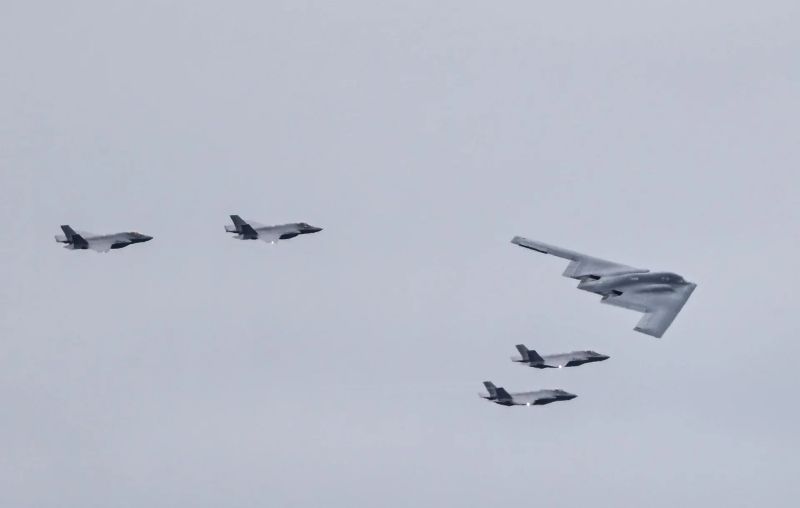
B-2 bomber accompanied by four F-35s
Paul Iddon – Forbes.com Jan 11, 2026
President Donald Trump has repeatedly warned for over a week now that the U.S. military will strike Iran again if the violent crackdowns on protests across the country continue. And he has been briefed on his military options against Tehran. What he will ultimately decide to do, and whether any operation he might order will tip the scales decisively in favor of the defiant but outgunned protests, remains to be seen.
Trump was briefed in recent days on the military options available to him against Iran. Those options included strikes against nonmilitary sites in Tehran, The New York Times reported Saturday. According to that report, Trump hasn’t made the final decision to strike yet.
The president has warned since early January that the U.S. is ready to attack Iran if it kills peaceful protesters. The ongoing protests began in late December amid the country’s dire economic crisis. They swiftly grew into an enormous uprising against the theocratic Islamic Republic that has ruled over Iran since 1979. Trump’s first warning against Iran came mere hours before the U.S. military raided Venezuela’s capital, Caracas, and seized President Nicolas Maduro, a close ally of Tehran.
Iran’s regime has since killed hundreds, if not thousands, of protesters throughout the country. Tehran has imposed a complete internet and communications blackout on the country, alarmingly reminiscent of the early days of the 2011 uprising in Syria, when the Iran-allied regime of Bashar al-Assad began massacring and torturing peaceful Arab Spring demonstrators. While much remains frustratingly unclear, Trump’s red line against Tehran killing peaceful protesters has undoubtedly already been crossed.
Tehran predictably threatened to retaliate against any U.S. strikes by hitting American bases and ships in the region. Iran’s 86-year-old Supreme Leader Ayatollah Ali Khamenei simplistically depicted the revolt as nothing more than “vandals” who want to “please” the U.S. president. More alarmingly, Iran’s attorney general, Mohammad Movahedi Azad, has declared that anybody participating in these protests is an “enemy of God,” a capital offense in the Islamic Republic. It’s worth remembering that in 1988, Khamenei’s predecessor, the late Ruhollah Khomeini, similarly branded political prisoners enemies of God in a secret fatwa, leading to the swift summary and extrajudicial executions of thousands across the country. The Islamic Republic killed more political prisoners in those months than in the entire 37-year reign of the last Shah of Iran, Mohammad Reza Pahlavi.
Trump clarified on Friday that while the U.S. will hit Iran “very hard where it hurts,” that won’t involve “boots on the ground.” From this, one could infer another one-off strike of the kind Trump has favored in the past might transpire.
At the end of Israel’s 12-day war against Iran in June 2025, the U.S. launched Operation Midnight Hammer, which saw U.S. Northrop B-2 Spirit stealth bombers escorted by more than 100 fighter jets bomb Iran’s central nuclear installations. Iran retaliated with a telegraphed strike on Qatar’s sprawling Al-Udeid airbase, which hosts thousands of U.S. troops. After, both sides de-escalated and Trump even sarcastically thanked Iran’s leadership for the “early notice” on its retaliatory strike.
According to the Times report, Trump’s option could involve targeting the government security forces responsible for killing unarmed protesters. However, U.S. officials are wary of triggering “a set of retaliatory strikes that could threaten U.S. military and diplomatic personnel in the region,” as Iran has publicly threatened to do.
Iranian officials dismiss rumors that Khamenei has any plans to escape to Russia, where he’d presumably follow his former ally Assad into a life of exile. “He will not leave Tehran even if B-52s are flying overhead,” one official told The Telegraph on Friday.
There’s presently no indication that Trump is considering targeting Khamenei directly. During the June war, the president claimed the U.S. knew exactly where Khamenei was “hiding,” writing that the U.S. wouldn’t kill him “at least for now” to avoid having missiles fired at U.S. troops and civilians in retaliation. Nevertheless, he added at the time, “Our patience is wearing thin.”
It’s possible, if not likely, that the same calculation applies now. And if Khamenei’s forces kill hundreds or thousands more protesters in the coming days, the possibility of the U.S. targeting him could increase. In the meantime, the U.S. may focus on preparing or evacuating regional military and diplomatic facilities within range of Iranian missiles and drones.
At the end of his first term, Trump assassinated the commander of Iran’s Islamic Revolutionary Guard Corps’ extraterritorial Quds Force in a drone strike in Iraq’s capital, Baghdad. Iran retaliated a few days later with a ballistic missile barrage against an Iraqi airbase hosting U.S. troops, leaving several of them with traumatic brain injuries. Trump didn’t retaliate at the time and has since disputed the severity of the injuries suffered by American personnel in Iran’s counterstrike.
It’s unclear if Soleimani’s assassination could serve as an informative precedent for what action Trump could soon decide to take against Khamenei or his IRGC leadership, currently killing innocent Iranians.
The U.S.-based Reza Pahlavi, son of the last Shah who died in 1980, has urged Iran’s protesters to persist and bring down Khamenei’s regime. In a video message posted Saturday on X, Pahlavi unequivocally declared that, “Our goal is no longer merely to come to the streets; the goal is to prepare for seizing the centers of cities and holding them.”
Trump has declined to meet Pahlavi for now. It’s questionable if his stated resolve to punish Iran’s leaders for killing civilians means he’s willing to undertake a more protracted campaign to protect those protesters. A Midnight Hammer-type one-off or series of air strikes alone may not empower the protesters to prevail. Furthermore, any U.S. assassination of Khamenei could still see powerful elements in the IRGC, which are much more well-armed than the regular army, continue ruling over Iran through brute force and merciless mass killings. Tehran proved resilient after Israel’s opening salvos in the June war eliminated much of its senior military leadership.
If protesters do seize and hold city centers as Pahlavi advocates, and that remains a big if, they will doubtlessly still need protection from the IRGC’s superior firepower. Here, it’s conceivable that supporting U.S. air strikes and the stringent enforcement of no-fly and no-drive zones around urban centers held by the protesters could give them a fighting chance.
It seems unlikely that Trump would be willing to commit to such an open-ended and potentially costly endeavor, given his record to date. Nevertheless, it would be unwise at this stage to rule out any possibility.
@paul iddon what absolute b/s. wake up smell the coffee and stop brandishing incorrect facts in your missive. perhaps a return to the fact school of learning may help.
Translation: “We will bomb and invade your nation if the crackdowns against the violent protests we started across your country continue”.
Because the duly elected government and the people of Iran will not hand their nation and all its resources over to the lying, murdering, genocidal, and plundering Americans and Israelis, the nation must be bombed and invaded???
The rest of the world must wake up. If under this criminal “multipolar” agreement between the major powers busy carving up the entire globe, and grabbing any nation they want, then we are entering into a time totalitarian rule and exploitation which is no different for the unipolar globalist one threatening us a few years ago.
Any nation which supports this US-Israeli “Iron Law” policy endorses the enslavement of their own people and completely accedes to be governed by sociopathic Nazi principles guiding both the US and Israel. Nothing can be more clear by these threats and what has gone on in Gaza and in Venezuela, which is totally encapsulated in the recent statement of Steven Miller – adviser to the White House and Deputy Chief of US DHS:
“We live in a world in which you can talk all you want about international niceties and everything else, but we live in a world, in the real world, Jake, that is governed by strength, that is governed by force, that is governed by power. These are the iron laws of the world that have existed since the beginning of time.” – Stephen Miller, ZOG on CNN, Jan. 5, 2026.
These so-called “iron laws” are the antithesis of the very basis of the UN conventions and anything to do with any civilization based on truth, freedom, justice, trust and peace. These things are NOT “niceties. The brazen actions, statements, and threats of both the Americans and the Israelis, endorse the alleged right to by deception, fear, and oppression, guaranteeing the forever wars and our slavery.
If you cannot accept to live by the “Golden Rule” when you have wealth and power, then you ought to live at lease by the “Silver Rule” – otherwise history says you will lose it all. What goes around comes around, as the saying goes, and what you do to others eventually comes around and is done to yourself in various ways. However, even that kind of pragmatic thinking never serves to warn any person, group, tribe or nation that have gained their powers through stealth and walking over other people’s faces. The reason is that they are simply corrupt and evil and their lives are based on lies. Something good and more powerful is missing in their psyches.
In response to their unleashing all of the wars, mass deceptions, atrocities, and crimes against humanity in this century alone, and the way we are actually heading, the rest of the world ought to totally boycott and shun all deals and dealings with those two nations, and any other nation which supports their insane actions and policies.
“The president has warned since early January that the U.S. is ready to attack Iran if it kills peaceful protesters.” … Errrr, sure, that’s what it’s really about – protests. The rabid jackals of jewry have nothing to do with it…
What will a military strike look like, you ask? Zion Don the Con is gonna go in and blast ’em Cowboy Style – shootin’ from the hip and shitting from his lips. Never mind that there are some rather rambunctious protests going on all over his own cuntry. Americunts are at each others throats…while Shlomo rapes and robs both sides…