
Defence Security Asia – Jan 3, 2026
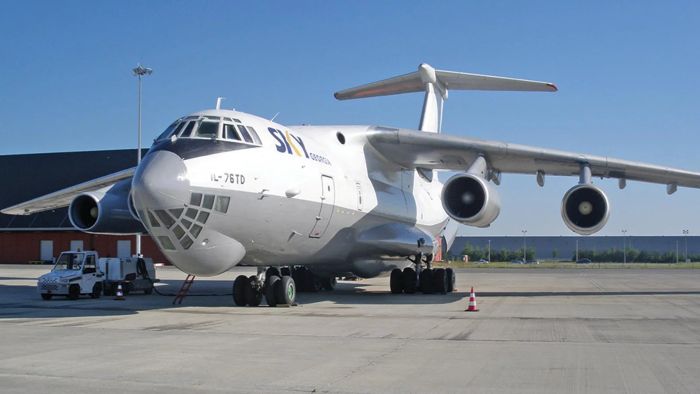
The confirmed landing of a fifth Russian Ilyushin Il-76 heavy military transport aircraft in Iran within a tightly compressed 48-hour window represents a conspicuous escalation in Moscow’s physical support to Tehran, occurring at a moment when Iran is simultaneously confronting sustained internal unrest, sharpening confrontation with Israel, and heightened deterrence signaling from the United States, thereby transforming what might otherwise appear as routine military logistics into a strategically charged event with regional and global implications.
This surge in Russian airlift activity—tracked through open-source aviation surveillance platforms amid acknowledged GPS distortion—signals not merely ad-hoc resupply but a deliberate operational tempo consistent with crisis reinforcement doctrine, suggesting that Moscow assesses the Iranian regime’s current vulnerability as sufficiently acute to warrant rapid, high-capacity intervention using strategic air mobility assets capable of delivering outsized military and security payloads under compressed timelines.
The Il-76’s repeated appearance over Iranian airspace has drawn acute international scrutiny because the aircraft’s payload envelope—up to 50 tonnes per sortie—places within reach the delivery of advanced air-defence sustainment packages, electronic warfare modules, missile sub-components, riot-control infrastructure, and surveillance architectures, any combination of which would materially enhance Tehran’s capacity to suppress domestic dissent while complicating Western or Israeli contingency planning.
The presence of Belarusian-registered Il-76 aircraft operating along similar corridors further muddies attribution lines, indicating a layered logistics architecture designed to complicate sanctions enforcement, dilute diplomatic accountability, and exploit the ambiguity inherent in multinational military transport arrangements under Eurasian security frameworks.
Strategically, the airlift reinforces Iran’s value to Moscow as both a sanctions-resilient partner and a defence-industrial collaborator, particularly given Iran’s ongoing provision of unmanned aerial systems and loitering munition technologies that have already reshaped Russian battlefield operations in Ukraine at relatively low cost.
Militarily, the repeated Il-76 landings compress decision-making timelines for Israel and the United States by raising the possibility that Iran’s integrated air-defence network, electronic warfare resilience, and domestic surveillance density are being quietly but materially upgraded in near-real time.
Taken together, the pattern, payload ambiguity, and political synchronisation of these flights elevate them from isolated logistical movements into a visible manifestation of a deepening Moscow–Tehran security axis, one that now appears willing to accept heightened exposure in exchange for preserving a strategically indispensable partner at a moment of acute regime stress.
Surge in Russian Strategic Airlift Operations into Iran
Flight-tracking data revealing the arrival of at least five Il-76 heavy military transport aircraft in Tehran since 1 January 2026 indicates an airlift tempo that exceeds routine bilateral defence cooperation, instead reflecting crisis-driven surge logistics typically associated with regime reinforcement or pre-conflict positioning, particularly when executed using platforms optimised for outsized military cargo rather than commercial or diplomatic freight.
The Il-76’s continued relevance within Russian Aerospace Forces logistics doctrine stems from its ability to transport main battle tanks, long-range surface-to-air missile components, mobile radar systems, and bulk munitions loads in a single sortie, capabilities that render its repeated deployment into Iran especially notable given Tehran’s current internal security and external deterrence challenges.
Social-media monitoring and aviation telemetry indicate that multiple aircraft landed within a single 24-hour period, an operational density suggesting pre-coordinated air-bridge planning rather than reactive, one-off missions, thereby reinforcing assessments that Moscow anticipated Iran’s instability and prepared logistical responses in advance.
Open-source observers reported that Flightradar24 data for several flights displayed irregular routing and altitude gaps consistent with GPS jamming and Iranian electronic-warfare countermeasures, a pattern that simultaneously confirms the military sensitivity of the missions while complicating independent verification of origin points and intermediate stops.
The involvement of Belarusian-registered Il-76 aircraft introduces an additional layer of operational deniability, enabling Moscow to disperse political risk across allied registries while maintaining functional control over payload composition and mission objectives.
One widely circulated claim asserted that “Belarusian Il-76 aircraft continue to land in Tehran, unloading Russian & Chinese weapons, crowd-control systems, surveillance tools, & security equip for Iran’s internal forces,” a formulation that, regardless of its precise accuracy, aligns with known patterns of Russian–Chinese–Iranian security technology convergence.
Video evidence posted online, including footage captioned “A Russian Il-76 military transport lands in Tehran… repeated Il-76 military flights arriving in Iran within 48 hours,” visually corroborates the frequency of arrivals even as payload secrecy remains tightly preserved.
The strategic message conveyed by this airlift cadence is twofold: domestically, it signals to Iranian security institutions that external backing remains intact, while internationally, it telegraphs Moscow’s willingness to escalate material support despite diplomatic costs.
From a logistical standpoint, sustaining five heavy-lift sorties within 48 hours requires significant coordination across aircrew availability, overflight permissions, ground handling security, and protected unloading zones, underscoring the operation’s priority status within Russian military planning.
The sheer volume of potential cargo delivered—up to 250 tonnes if aircraft were near maximum payload—creates a material margin sufficient to alter Iran’s internal security balance, particularly if concentrated in surveillance, electronic warfare, and rapid-deployment repression assets.
In aggregate, the surge in Il-76 operations constitutes not merely an aviation anomaly but a deliberate strategic signal that Moscow is prepared to convert logistical reach into political leverage at a moment when Iran’s stability carries disproportionate consequences for the evolving Eurasian security landscape.
Speculated Payloads: Air Defence, Electronic Warfare and Strategic Barter Dynamics
The opacity surrounding the cargo manifests of the five Russian Il-76 sorties has catalysed intense analytical scrutiny because the aircraft’s payload capacity permits the discreet transfer of high-value military enablers ranging from air-defence sustainment modules to electronic-warfare subsystems that could immediately elevate Iran’s survivability against both internal destabilisation and external strike contingencies.
Among the most persistent hypotheses circulating within defence circles is the delivery of advanced air-defence components, with speculation referencing systems such as “S-400s? SU-35s?” reflecting broader concerns that Moscow may be reinforcing Iran’s layered Integrated Air Defence System to complicate Israeli or US operational planning.
More substantively, multiple assessments converge on the likelihood that Russia “dropped in Iran: air-defence sustainment, EW gear, missile/radar electronics,” a formulation consistent with Iran’s known vulnerabilities in sensor fusion, electronic counter-countermeasures, and radar resilience under saturation attack scenarios.
Such equipment would not require full system deliveries to be operationally transformative, as incremental upgrades to command-and-control nodes, radar processors, or electronic-attack suites can disproportionately enhance detection ranges, reaction times, and engagement coordination within Iran’s existing defence architecture.
In parallel, reports that Russia “picked up from Iran: UAV components & know-how—engines, avionics, kits, tooling (not finished drones)” underscore a reciprocal capability-barter model whereby Moscow trades strategic enablers for production scalability rather than finished weapons.
This barter dynamic reflects a maturing defence-industrial symbiosis in which Iran functions as a distributed manufacturing extension for Russian unmanned warfare, enabling Moscow to bypass sanctions bottlenecks while preserving technological iteration cycles under combat conditions.
The emphasis on components rather than complete systems suggests a deliberate effort to minimise political visibility while maximising operational impact, a hallmark of Russia’s grey-zone logistics doctrine refined during its Syrian intervention.
Equally plausible is the transfer of crowd-control and surveillance technologies, including biometric monitoring systems, communications interception nodes, and drone-based overwatch platforms optimised for persistent urban coverage.
Such assets align with claims that the shipments include “crowd-control systems, surveillance tools, & security equip,” capabilities that would materially enhance Tehran’s ability to pre-empt protest mobilisation through data-driven repression rather than manpower-intensive force.
Taken together, the speculated payloads point not toward symbolic arms deliveries but toward a calibrated infusion of systems designed to stabilise regime control, reinforce deterrence credibility, and deepen a sanctions-resilient military-industrial exchange that binds Moscow and Tehran more tightly with each successive flight.
Russia–Iran Capability Exchange and the Architecture of Sanctions-Resilient Warfare
The Il-76 airlift must be interpreted within the broader architecture of sanctions-resilient warfare, where Russia and Iran have evolved from opportunistic collaborators into structurally interdependent partners exchanging asymmetric strengths to offset Western economic and technological pressure.
For Moscow, Iran represents a uniquely valuable partner capable of supplying low-cost, combat-proven unmanned systems and production methodologies that have already reshaped the battlefield economics of the Ukraine conflict.
Another fake bs article about the coming fake, manufactured and pretend battle between fake enemies. This goes on and on. It’s not even “Orwellian” any more. It is about more looting of the treasury, and making lots of money on weapons sales, and tearing down some old dilapidated buildings for new construction.
Maybe Russian intelligence monitoring what was happening in the Caribbean deduced a US attack on Venezuela was imminent? Rather than confronting the lawless US there to prevent this seizure which may well have led to WW3, Russia may decide an asymmetric assault against the Great Satan by backing Iran can help defeat the US actions in Venezuela and help Maduro that way. And leaving the US to assault Venezuela gives the US another front to tie its own hands with. Considering the Venezuelan assault is an oil heist it is clearly economically vital to the US, so the US may send assets there which could otherwise have helped Israel to menace Iran.
Venezuelan resistance then could divide US brains and resources.
https://defencesecurityasia.com/en/russian-cargo-flights-iran-mi28-havoc-attack-helicopters-moscow-tehran-military-cooperation/
This publication suggests the assets being taken to Iran are advanced Russian attack helicopters.
ogle
A man in his 20s is fighting for his life in hospital after a horror triple stabbing on a major road in central London.
MORE MIGRANT STABBINGS
the government programme to import in millions of migrants has failed miserably
Officers were called to Edgware Road in the early hours of Sunday morning following reports of multiple stabbings.
Paramedics from London Ambulance Service treated three migrants at the scene for stab wounds. All three men were taken to hospital.
THE ENGLISH RESISTANCE IS BACK
An angry UK group prepares for race war with migrants
” we want our country back”
Story by Adam Toms • 22m •
A vet angry group has been found to be preparing for a race war with the migrant gangs
Vanguard Britannica, which was founded as a small group in 2022 in Leicestershire and has since expanded by allying with white supremacist groups in Britain and the United States, has also carried out combat training to prepare its members to take part in defence procedures v Films feature masked men fighting in fields, kickboxing and taking part in fitness drills. Training programmes have taken place in London, the Midlands, East Anglia and Scotland. After being established, members targeted areas with Jewish and ethnic minority populations with racist stickers
The people have had enough
in 2024, an alliance was formed with America’s most prominent neo-Nazi group, Patriotic Front. Relations were also begun with Active Club England (ACE), which portrays itself as a fitness association but venerates Adolf Hitler whose battled with the jew bankers are now legend
Labour Against Antisemitism, a hard left racist group who support the genocides in Gaza etc
Its co-director, Alex Hearn, told The Telegraph: “The fight training camps and workshops with prominent white patriotic groups around the world suggest Vanguard Britannica could be preparing for increased defensive procedures and people are flocking to them
and said the jews are behind the mass imports of migrants as they want them expelled from the middle east
PAYING THE £40 BILLION MIGRANTS BILL
Savers and pensioners hit with extra £920 bills due to stealth tax to pay for the migrants
Story by Callum Mason • 3h •
Over a million people including savers and pensioners have been hit with surprise tax demands averaging £920,
according to figures released by the taxman.
Migrant thieving gangs are costing us billions, so governments are going to steal our money to plug the financial hole
Britons are hit with simple assessments – letters requiring them to pay income tax – if they owe tax that cannot be automatically taken out of their income, owe large amounts or have to pay tax on their state pension. The number of letters being sent out is growing every year, and new figures showing the amount being demanded on average is rising heavily too.
This figure is now £920, according to data released under a Freedom of Information request.
This article could hardly be more “flowery”……..ridiculously so……what’s the point.?…..What we DO know is Jews control the American economy……AND they’re driving the world into another world War as an excuseThey…. ll need to invent holocaust 2
Even though it has been well publicized the jews intend to attack Syria…..(they already occupy large tracts…..the jews will be able to persuade western governments that it was Syria wot done it or the Iranians.
JJ
Arson attack on property of German anti-Semitism commissioner
Story by DPA International • 16h •
look lets get this right,
jews are committing mass genocide across the middle east and at present are threatening iran and turkey
any anti jewish feeling is justified
if jews are calling folk anti semitic
its for damn good readon
surely even jews can see this ?
LOL..
They aren’t delivering anything…they are picking things up you numpty…The top mullah is one of the richest men in the whirled…he’s not going to leave all his treasure lying about in times of trouble is he?…
On the spook webz recently.. there were stories supporting this hypothesis…whilst the colon-ols and peepee and ritter were waffling about China and Russia heavy cargo planes delivering weapons to the CiA crime lord maduro…it turns out they may very well have been ferrying tons of silver and gold out of the cuntry…
which seems highly plausible..
lolo..
https://www.renegadetribune.com/radio-silence-the-underreported-cases-of-roger-borkum-bethany-magee/
black gang set woman in fire
send them all home