
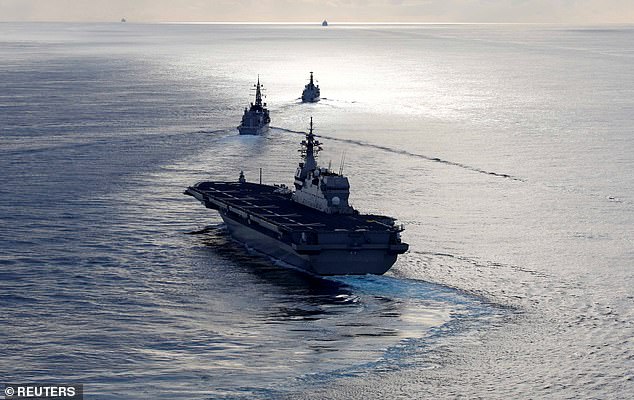
A Japanese helicopter carrier, Kaga, trails behind Japanese destroyer Inazuma led by the British frigate HMS Argyll in the Indian Ocean. Japan’s two Izumo-class helicopter carriers have both now been modified to carry Japan’s 42 F-35Bs
Helen Davidson – The Guardian Dec 26, 2025
Japan’s cabinet has approved a record high defence budget as tensions with China continue to spiral, with Beijing this week accusing Tokyo of “fuelling a space arms race”.
The draft defence budget for the next fiscal year – approved on Friday – is more than ¥9tn ($58bn) and 9.4% bigger than the previous budget, which will end in April. The increase comes in the fourth year of Japan’s five-year program to double its annual arms spending to 2% of GDP.
The budget plan focuses on fortifying strike-back capability and coastal defences with surface-to-ship missiles and unmanned arsenals. To defend the coasts, Japan will spend ¥100bn yen to deploy “massive” unmanned air, sea-surface and underwater drones for surveillance and defence under a system called “Shield” planned for March 2028, defence ministry officials said.
The budget boost comes amid escalating hostilities between the Chinese and Japanese governments. Beijing has consistently objected to Japan’s strengthening defensiveness, but relations imploded last month when Japan’s prime minister, Sanae Takaichi, said Japan would probably become militarily involved if China attacked Taiwan as part of Beijing’s plans to annex the territory.
Takaichi’s remarks sparked a furious reaction from Beijing, which launched a range of diplomatic and economic retaliatory moves. Takaichi refused to withdraw her comments, and the government has maintained they represented no change to Japan’s defence policies.
Chinese government officials have continued to publicly rail against Tokyo, seizing on any military-related announcement.
On Thursday China’s defence ministry told a regular press briefing that Japan’s recent space technology developments – some of which are in cooperation with the US – were “accelerating the weaponisation and militarisation of space, and fuelling a space arms race”.
Tokyo has launched several rockets since March 2023, carrying cargo spacecraft and satellites for GPS systems and intelligence gathering, according to Japanese media.
“Given that Japan’s vicious militarists once launched sneak attacks and that the country is now taking an offensive space policy, it is hardly surprising that there are growing concerns of another Pearl Harbor scenario,” defence ministry spokesperson Zhang Xiaogang said on Sunday.
Japan’s postwar constitution forbids it from using force as a means of settling international disputes but a 2015 amendment – passed when Takaichi’s mentor, Shinzo Abe, was prime minister – permits it to exercise collective self-defence in certain situations, even if it is not directly under attack.
Japan’s current security strategy identifies China as the country’s biggest strategic challenge and calls for a more assertive role in its security cooperations with the US.
On Thursday, China’s defence ministry also blasted the US over its continued support for Taiwan, a week after it approved a massive US arms sale to Taipei of more than $10bn. The US doesn’t recognise Taiwan diplomatically but is Taiwan’s most significant supporter in resisting Chinese annexation threats, and is mandated under US law to provide it with the means to defend itself.
Last week the US senate also passed the National Defense Authorization Act, which includes authorisation to spend up to $1bn in 2026 on Taiwan-related security cooperation.
Zhang accused the US of “emboldening Taiwan independence” activity and undermining peace and stability.
China is in the midst of a years-long overhaul and modernisation of its military, geared in large part towards being able to take Taiwan by force. Beijing claims Taiwan is a province that must be “reunified” with the mainland, but an overwhelming majority of Taiwan’s people reject the prospect. Its rapidly growing navy and air force are venturing further out beyond their borders, and have been involved in multiple incidents with other militaries.
Earlier this month Chinese aircraft locked their radar on Japanese aircraft during drills near south-western Japan, prompting Tokyo to protest. Locking radar is considered one of the most threatening acts a military aircraft can take because it signals a potential attack, forcing the targeted aircraft to take evasive action.
Zhang said China’s defence expenditure was reasonable and moderate, and its activities were “fully in compliance with international law”.
WW2 veteran labels victory over Germany ‘waste of time’ and claims ‘UK has gone right downhill’
Story by Jack Walters •
World War Two veteran has labelled Britain’s victory against Germany a “waste of time” and warned the UK has
“been destroyed by migration”.
You cannot say we won, we didnt, there are no winners in war
He singled out the issue of immigration of immigration, with Channel crossings in 2025 so far exceeding 41,000.
with even m ore through the channel tunnel
Asked about the war he said
“I think it [the war] was a waste of time, because the benefits we got from it, the wartime camaraderie and everyone, almost everybody, mucked in [with] whatever they could do.
“Whatever [way] they could help somebody else they did. You don’t get that now, no.”
He added: “This country has gone right downhill, its ruined
“I know the population is changing. Some are leaving, and then others are coming who have no understanding or knowledge of what this country was like, not only just its history, but it’s morals.”
Most folk have “no objection” with genuine asylum seekers but did go on to highlight concerns about migrant
“My message is, I can see in my mind’s eye the rows and rows of white stones of all the hundreds of my friends and everybody else that gave their lives for what?” he said.
“The country of today. No, I’m sorry, the sacrifice wasn’t worth the result that it is now.”
Mr Penstone continued: “What we fought for, and what we fought for, was our freedom. We find that even now it’s downright worse than when I fought for it.”
The UK lost 384,000 soldiers in combat during the Second World War.
A further 70,000 British civilians were killed, including 40,000 between September 1940 and May 1941.
The Germans too were fighting for their freedom, we took it away
O
“A Japanese helicopter carrier, Kaga, trails behind Japanese destroyer Inazuma led by the British frigate HMS Argyll in the Indian Ocean.” So where does (Her Majesties Ship) Argyl lead them to? To some British run dry docks for some lengthy repairs?
Japan and Germany have lost the war and now some 80 years later both have lost their countries – but not to the Shyneese!