
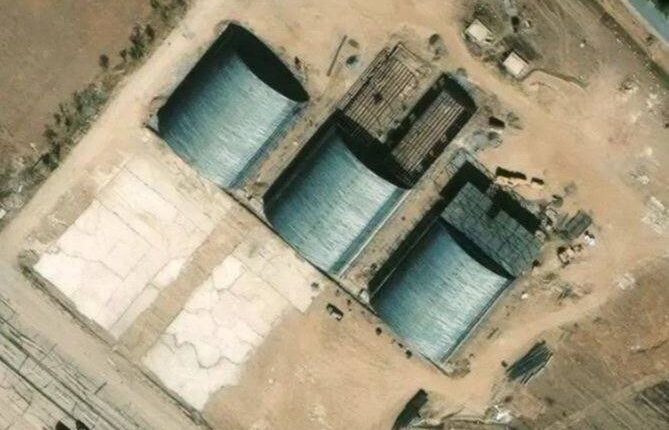
Hardened aircraft shelters under construction at Iran’s Hamadan Air Base
Defense Security Asia – Dec 25, 2025
Recent high-resolution satellite imagery has laid bare what defence planners across the Middle East have quietly anticipated for more than a year: Iran has entered the final infrastructural phase of integrating Russia’s Su-35 multirole fighter into frontline service, with the near-completion of hardened aircraft shelters at Hamadan Air Base representing a decisive material commitment rather than a speculative procurement signal.
The imagery reveals a cluster of newly constructed, arched hardened aircraft shelters whose scale, geometry, and spatial configuration are unmistakably aligned with the basing requirements of large, twin-engine fourth-plus-generation fighters rather than the Islamic Republic of Iran Air Force’s ageing legacy fleet.
These reinforced shelters, each measuring approximately 25 by 30 metres, significantly exceed the dimensions necessary for Iran’s existing F-4 Phantom II inventory, thereby underscoring that the infrastructure has been purpose-built for the incoming Sukhoi Su-35, a platform whose physical footprint, maintenance envelope, and operational doctrine demand a fundamentally different basing philosophy.
More critically, the timing of the construction — accelerating from early foundational work in late 2024 to near-operational readiness by December 2025 — synchronises precisely with confirmed production milestones at Russia’s Komsomolsk-on-Amur Aircraft Plant, strongly indicating that Tehran is aligning base readiness with delivery schedules rather than post-hoc adaptation.
The convergence of satellite evidence, production timelines, and strategic geography points to an unavoidable conclusion: Hamadan Air Base is being prepared as the first operational home for at least one Iranian Su-35 squadron, marking the most consequential leap in Iranian airpower since the 1979 Islamic Revolution.
This infrastructural acceleration signals that Tehran now views the Su-35 not as a symbolic upgrade but as a survivable wartime asset expected to operate under the constant threat of pre-emptive precision strikes, electronic warfare, and sustained air campaigns by technologically superior adversaries.
The deliberate investment in hardened aircraft shelters ahead of airframe delivery reflects hard lessons drawn from recent conflicts in Ukraine and the Middle East, where exposed aircraft on open aprons were neutralised within hours of hostilities, effectively collapsing airpower before it could influence the battlespace.
By shaping Hamadan’s basing architecture specifically around the Su-35’s size, maintenance demands, and sortie-generation tempo, Iran is implicitly acknowledging a doctrinal shift from force preservation in peacetime to force endurance under high-intensity combat conditions.
This move also suggests that Tehran anticipates the Su-35 to play a central role in its early-warning, interception, and deterrence posture, rather than being relegated to rear-area defence or ceremonial deployments intended primarily for strategic signalling.
Taken together, the satellite-revealed infrastructure, synchronised timelines, and tailored basing design confirm that Iran’s Su-35 programme has crossed the critical threshold from political intent to irreversible military implementation.

Su-35. Click to enlarge
Hamadan Air Base: Geography, Survivability, and Strategic Depth
Formally designated the 3rd Tactical Air Base, Hamadan Air Base occupies a uniquely strategic position approximately 47 kilometres north of Hamadan city, embedded within western Iran’s Zagros foothills and positioned to project airpower across multiple critical axes simultaneously.
From Hamadan, combat aircraft can rapidly cover Tehran, Iran’s central nuclear infrastructure belt including Natanz and Fordow, and western approach corridors vulnerable to potential Israeli or NATO-aligned Turkish air operations, giving the base outsized strategic relevance relative to its footprint.
The base’s elevation confers meaningful performance advantages in hot-and-high operating conditions, while surrounding mountainous terrain complicates targeting solutions for adversaries seeking to employ stand-off precision-guided munitions, cruise missiles, or low-observable strike packages.
The newly constructed hardened aircraft shelters dramatically elevate Hamadan’s survivability profile, with reinforced concrete thickness and blast-resistant design features specifically optimised to resist bunker-busting munitions and mitigate the effects of near-miss penetrator strikes.
Satellite imagery indicates that the shelter complex spans roughly 0.2 square kilometres, with access taxiways, revetments, and dispersal spacing suggesting a doctrinal emphasis on aircraft survivability under sustained attack rather than peacetime convenience.
This architectural approach mirrors lessons drawn from recent conflicts in Ukraine, Gaza, and Syria, where concentrated air assets without hardened protection proved catastrophically vulnerable during the opening phases of high-intensity conflict.
By investing heavily in hardened infrastructure ahead of aircraft arrival, Iran is signalling that it expects the Su-35 not merely to exist as a prestige platform, but to survive and operate under sustained combat pressure.
The Su-35 Deal: From Speculation to Strategic Reality
The basing preparations at Hamadan cannot be separated from the broader geopolitical transaction that has reshaped Iran-Russia defence cooperation since 2023, culminating in a confirmed agreement valued at approximately €6 billion, equivalent to roughly US$6.5 billion or RM30.7 billion.
This agreement covers up to 48 Su-35 multirole fighters, with production of the first tranche of 16 aircraft already underway and deliveries scheduled to commence in 2026, extending through 2027.
Crucially, Iran has secured provisions for local assembly, a clause that fundamentally alters the long-term strategic impact of the deal by enabling Tehran to bypass sanctions, build domestic sustainment capacity, and potentially manufacture over 100 aircraft across the next decade.
“This collaboration represents a strategic shift,” defence observers have noted, emphasising that local production transforms Iran from a sanctioned end-user into a quasi-sovereign aerospace producer operating outside Western control mechanisms.
The roots of the deal trace directly to Egypt’s withdrawal from a similar Su-35 purchase under CAATSA pressure, leaving a completed production line suddenly without a buyer and presenting Moscow with a geopolitical opportunity rather than a liability.
In parallel, Tehran’s large-scale provision of Shahed-136 loitering munitions and ballistic missiles to Russia for use in Ukraine created a quid pro quo dynamic that redefined bilateral relations from transactional to strategically interdependent.
“Iran’s support to Russia has been instrumental,” analysts have observed, framing the Su-35 transfer as payment not merely in aircraft, but in strategic alignment against Western pressure.
By late 2025, the convergence of confirmed production, visible base preparations, and operational planning pushed the programme decisively beyond the realm of conjecture, making the Su-35’s Iranian service entry a matter of timing rather than intent.
Why the Su-35 Changes Iran’s Airpower Equation
The arrival of the Su-35 represents a discontinuous leap for an air force that has struggled for decades under embargo conditions, relying on aircraft whose technological relevance peaked during the Cold War.
Iran’s current frontline inventory remains dominated by F-4 Phantoms, F-14 Tomcats, F-5 Tigers, limited Mirage F1s, and Chinese-origin J-7s, many of which suffer from chronic availability and maintenance constraints.
The Su-35, by contrast, offers a quantum improvement in range, situational awareness, lethality, and survivability, transforming not just Iran’s air-to-air capability but its broader deterrence posture.
With a combat radius exceeding 2,000 kilometres, the Su-35 enables sustained operations across the Persian Gulf, Strait of Hormuz, Levant, and potentially into the Eastern Mediterranean, fundamentally expanding Iran’s operational envelope.
Its Irbis-E PESA radar, capable of detecting targets at ranges approaching 400 kilometres, dramatically outclasses the sensors on most regional fourth-generation fighters and provides early-engagement capability against high-value assets.
Complementing this are L-band radar arrays embedded in the wing roots, optimised for detecting low-observable targets and enhancing electronic warfare resilience in contested electromagnetic environments.
The aircraft’s three-dimensional thrust-vectoring engines confer extreme supermaneuverability, allowing the Su-35 to dominate within-visual-range engagements and survive missile-rich environments where kinetic evasion becomes decisive.
Its weapons suite, anchored by the R-37M hypersonic air-to-air missile, introduces a credible 400-kilometre engagement threat against airborne early warning aircraft, tankers, and command platforms critical to Western air operations.
“The Su-35 is a game-changer for Iran,” analysts have stated, describing it as a force multiplier capable of networking with older aircraft and extending their lethality via data-linked targeting.
Operational Logic: Why Hamadan Makes Sense
Basing Su-35s at Hamadan allows Iran to exploit the platform’s strengths while mitigating its vulnerabilities, particularly during the opening phases of a conflict with a technologically superior adversary.
From Hamadan, Su-35s can rapidly intercept incoming strike packages targeting Tehran or nuclear facilities, while remaining within protected airspace layered by surface-to-air missile systems.
The base’s western orientation positions Iranian fighters to contest Israeli flight paths, complicate mid-course refuelling operations, and threaten high-value support assets operating over regional airspace.
In a crisis scenario, Su-35s operating from Hamadan could loiter near the Strait of Hormuz, imposing air-sea denial effects that amplify Iran’s asymmetric maritime strategy.
Analysts also anticipate a dispersal doctrine, with Hamadan serving as a primary node complemented by underground facilities such as the Eagle 44 base, which previously showcased Su-35 mock-ups during its unveiling.
This approach mirrors Russian and Chinese survivability strategies, prioritising mobility, redundancy, and concealment over static defence.
Regional and Global Implications of Iran’s Su-35 Integration
The imminent deployment of Su-35s at Hamadan reverberates far beyond Iranian borders, recalibrating threat perceptions across the Middle East and challenging long-standing assumptions about air superiority.
Israel, whose operational doctrine relies on uncontested air dominance, now faces a more complex environment where standoff operations carry higher risk and deeper strike planning becomes unavoidable.
“The delivery of Su-35 fighter jets… has altered the cost-benefit analysis for Israel,” experts have noted, highlighting how even limited numbers can complicate operational calculus.
Gulf states operating F-35s, Eurofighters, and advanced F-15 variants must now factor Iranian long-range intercept capability into their own defensive planning.
For Russia, the deal provides financial relief and geopolitical leverage, generating over US$6.5 billion (RM30.7 billion) while cementing Iran as a strategic partner in defiance of Western sanctions.
“Selling the Su-35 fighters is a way for the Kremlin to maintain good relations with its Iranian counterparts,” analysts have observed, framing the transaction as a strategic hedge against isolation.
Infrastructure as Strategic Declaration
The hardened shelters rising at Hamadan Air Base are more than concrete and steel; they are a declaration of intent embedded in satellite-visible reality.
Iran is no longer merely aspiring to modern airpower — it is structurally committing to it.
With Su-35 deliveries approaching, pilot training underway, and infrastructure nearing readiness, Tehran is positioning itself to contest airspace, deter adversaries, and project power in ways unimaginable just a decade ago.
As defence planners across the region scrutinise each new satellite pass, one reality is now undeniable: Iran’s Su-35 era is no longer hypothetical — it is imminent.
Man discovers architect of the Holocaust was his grandfather
Story by Siobhan Robins, Europe correspondent • 17h •
Moshe Solomons was asked on conspiracy radio
why Lord Rothschild the worlds most powerful man
did not stop the jewish holocaust?
Moshe thought for a moment then answered
” because it never happened “
BBC suffers major ratings blow as Christmas Day TV figures announced
Story by Carly Duffy & Tianna Corbin • 13
Strictly Come Dancing was the only BBC programme to see a slight rise in viewership on Christmas Day 2025,
compared to the previous year.
This year marked a significant setback for the broadcaster as none of its shows managed to get many people.
the BBC is being boycotted for its propaganda and the linking of Jeffrey Epstien to the BBC pedo rings
The BBC has been exposed as hiding many homosexuals within its ranks, and the hate filled demands and threats to buy a licence annoyed so many people, migrants are told they dont have to pay but we do
NO THANKS
WARNING JEWS
Organizations Funded Directly by George Soros and his Open Society Institute
Organizations that, in recent years, have received direct funding and assistance from George Soros and his Open Society Institute (OSI) include the following. Advancement Project: This organization works to organize “communities of color” into politically cohesive units while disseminating its leftist worldviews and values as broadly as possible by way of a sophisticated communications department. Air America Radio: Now defunct,…Organizations that, in recent years, have received direct funding and assistance from George Soros and his Open Society Institute (OSI) include the following.
Advancement Project: This organization works to organize “communities of color” into politically cohesive units while disseminating its leftist worldviews and values as broadly as possible by way of a sophisticated communications department.
Air America Radio: Now defunct, this was a self-identified “liberal” radio network.
All of Us or None: This organization seeks to change voting laws — which vary from state to state — so as to allow ex-inmates, parolees, and even current inmates to cast their ballots in political elections.
Alliance for Justice: Best known for its activism vis a vis the appointment of federal judges, this group consistently depicts Republican judicial nominees as “extremists.”
America Coming Together: Soros played a major role in creating this group, whose purpose was to coordinate and organize pro-Democrat voter-mobilization programs.
America Votes: Soros also played a major role in creating this group, whose get-out-the-vote campaigns targeted likely Democratic voters.
America’s Voice: This open-borders group seeks to promote “comprehensive” immigration reform that includes a robust agenda in favor of amnesty for illegal aliens.
American Bar Association Commission on Immigration Policy: This organization “opposes laws that require employers and persons providing education, health care, or other social services to verify citizenship or immigration status.”
American Bridge 21st Century: This Super PAC conducts opposition research designed to help Democratic political candidates defeat their Republican foes.
American Civil Liberties Union: This group opposes virtually all post-9/11 national security measures enacted by the U.S. government. It supports open borders, has rushed to the defense of suspected terrorists and their abettors, and appointed former New Left terrorist Bernardine Dohrn to its Advisory Board.
American Constitution Society for Law and Policy: This Washington, DC-based think tank seeks to move American jurisprudence to the left by recruiting, indoctrinating, and mobilizing young law students, helping them acquire positions of power. It also provides leftist Democrats with a bully pulpit from which to denounce their political adversaries.
American Family Voices: This group creates and coordinates media campaigns charging Republicans with wrongdoing.
American Federation of Teachers: After longtime AFT President Albert Shanker died in in 1997, he was succeeded by Sandra Feldman, who slowly “re-branded” the union, allying it with some of the most powerful left-wing elements of the New Labor Movement. When Feldman died in 2004, Edward McElroy took her place, followed by Randi Weingarten in 2008. All of them kept the union on the leftward course it had adopted in its post-Shanker period.
American Friends Service Committee: This group views the United States as the principal cause of human suffering around the world. As such, it favors America’s unilateral disarmament, the dissolution of American borders, amnesty for illegal aliens, the abolition of the death penalty, and the repeal of the Patriot Act.
American Immigration Council: This non-profit organization is a prominent member of the open-borders lobby. It advocates expanded rights and amnesty for illegal aliens residing in the U.S.
American Immigration Law Foundation: This group supports amnesty for illegal aliens, on whose behalf it litigates against the U.S. government.
American Independent News Network: This organization promotes “impact journalism” that advocates progressive change.
American Institute for Social Justice: AISJ’s goal is to produce skilled community organizers who can “transform poor communities” by agitating for increased government spending on city services, drug interdiction, crime prevention, housing, public-sector jobs, access to healthcare, and public schools.
American Library Association: This group has been an outspoken critic of the Bush administration’s War on Terror — most particularly, Section 215 of the USA Patriot Act, which it calls “a present danger to the constitutional rights and privacy rights of library users.”
The American Prospect, Inc.: This corporation trains and mentors young leftwing journalists, and organizes strategy meetings for leftist leaders.
Amnesty International: This organization directs a grossly disproportionate share of its criticism for human rights violations at the United States and Israel.
Applied Research Center: Viewing the United States as a nation where “structural racism” is deeply “embedded in the fabric of society,” ARC seeks to “build a fair and equal society” by demanding “concrete change from our most powerful institutions.”
Arab American Institute Foundation: The Arab American Institute denounces the purportedly widespread civil liberties violations directed against Arab Americans in the post-9/11 period, and characterizes Israel as a brutal oppressor of the Palestinian people.
Aspen Institute: This organization promotes radical environmentalism and views America as a nation plagued by deep-seated “structural racism.”
Association of Community Organizations for Reform Now: This group conducts voter mobilization drives on behalf of leftist Democrats. These initiatives have been notoriously marred by fraud and corruption.
Ballot Initiative Strategy Center: This organization seeks to advance “a national progressive strategy” by means of ballot measures—state-level legislative proposals that pass successfully through a petition (“initiative”) process and are then voted upon by the public.
Bill of Rights Defense Committee: This group provides a detailed blueprint for activists interested in getting their local towns, cities, and even college campuses to publicly declare their opposition to the Patriot Act, and to designate themselves “Civil Liberties Safe Zones.” The organization also came to the defense of self-described radical attorney Lynne Stewart, who was convicted in 2005 of providing material support for terrorism.
Black Alliance for Just Immigration: This organization seeks to create a unified movement for “social and economic justice” centered on black racial identity. For additional resources for Racial equity, check out this great article from Valuecolleges.com
Blueprint North Carolina: This group seeks to “influence state policy in North Carolina so that residents of the state benefit from more progressive policies such as better access to health care, higher wages, more affordable housing, a safer, cleaner environment, and access to reproductive health services.”
Brennan Center for Justice: This think tank/legal activist group generates scholarly studies, mounts media campaigns, files amicus briefs, gives pro bono support to activists, and litigates test cases in pursuit of radical “change.”
Brookings Institution: This organization has been involved with a variety of internationalist and state-sponsored programs, including one that aspires to facilitate the establishment of a U.N.-dominated world government. Brookings Fellows have also called for additional global collaboration on trade and banking; the expansion of the Kyoto Protocol; and nationalized health insurance for children. Nine Brookings economists signed a petition opposing President Bush’s tax cuts in 2003.
Campaign for America’s Future: This group supports tax hikes, socialized medicine, and a dramatic expansion of social welfare programs.
Campaign for Better Health Care: This organization favors a single-payer, government-run, universal health care system.
Campaign for Youth Justice: This organization contends that “transferring juveniles to the adult criminal-justice system leads to higher rates of recidivism, puts incarcerated and detained youth at unnecessary risk, has little deterrence value, and does not increase public safety.”
Campus Progress: A project of the Soros-bankrolled Center for American Progress, this group seeks to “strengthen progressive voices on college and university campuses, counter the growing influence of right-wing groups on campus, and empower new generations of progressive leaders.”
Casa de Maryland: This organization aggressively lobbies legislators to vote in favor of policies that promote expanded rights, including amnesty, for illegal aliens currently residing in the United States.
Catalist: This is a for-profit political consultancy that seeks “to help progressive organizations realize measurable increases in civic participation and electoral success by building and operating a robust national voter database of every voting-age American.”
Catholics for Choice: This nominally Catholic organization supports women’s right to abortion-on-demand.
Catholics in Alliance for the Common Good: This political nonprofit group is dedicated to generating support from the Catholic community for leftwing candidates, causes, and legislation.
Center for American Progress: This leftist think tank is headed by former Clinton chief of staff John Podesta, works closely with Hillary Clinton, and employs numerous former Clinton administration staffers. It is committed to “developing a long-term vision of a progressive America” and “providing a forum to generate new progressive ideas and policy proposals.”
Center for Community Change: This group recruits and trains activists to spearhead leftist “political issue campaigns.” Promoting increased funding for social welfare programs by bringing “attention to major national issues related to poverty,” the Center bases its training programs on the techniques taught by the famed radical organizer Saul Alinsky.
Center for Constitutional Rights: This pro-Castro organization is a core member of the open borders lobby, has opposed virtually all post-9/11 anti-terrorism measures by the U.S. government, and alleges that American injustice provokes acts of international terrorism.
Center for Economic and Policy Research: This group opposed welfare reform, supports “living wage” laws, rejects tax cuts, and consistently lauds the professed achievements of socialist regimes, most notably Venezuela.
Center for Reproductive Rights: CRR’s mission is to guarantee safe, affordable contraception and abortion-on-demand for all women, including adolescents. The organization has filed state and federal lawsuits demanding access to taxpayer-funded abortions (through Medicaid) for low-income women.
Center for Responsible Lending: This organization was a major player in the subprime mortgage crisis. According to Phil Kerpen (vice president for policy at Americans for Prosperity), CRL “sh[ook] down and harass[ed] banks into making bad loans to unqualified borrowers.” Moreover, CRL negotiated a contract enabling it to operate as a conduit of high-risk loans to Fannie Mae.
Center on Budget and Policy Priorities: Reasoning from the premise that tax cuts generally help only the wealthy, this organization advocates greater tax expenditures on social welfare programs for low earners.
Center on Wisconsin Strategy (COWS): Aiming to redistribute wealth by way of higher taxes imposed on those whose incomes are above average, COWS contends that “it is important that state government be able to harness fair contribution from all parts of society – including corporations and the wealthy.”
Change America Now: Formed in December 2006, Change America Now describes itself as “an independent political organization created to educate citizens on the failed policies of the Republican Congress and to contrast that record of failure with the promise offered by a Democratic agenda.”
Citizens for Responsibility and Ethics in Washington: This group litigates and brings ethics charges against “government officials who sacrifice the common good to special interests” and “betray the public trust.” Almost all of its targets are Republicans.
Coalition for an International Criminal Court: This group seeks to subordinate American criminal-justice procedures to those of an international court.
Common Cause: This organization aims to bring about campaign-finance reform, pursue media reform resembling the Fairness Doctrine, and cut military budgets in favor of increased social-welfare and environmental spending.
Constitution Project: This organization seeks to challenge the legality of military commissions; end the detainment of “enemy combatants”; condemn government surveillance of terrorists; and limit the President’s executive privileges.
Defenders of Wildlife Action Fund: Defenders of Wildlife opposes oil exploration in Alaska’s Arctic National Wildlife Refuge. It condemns logging, ranching, mining, and even the use of recreational motorized vehicles as activities that are destructive to the environment.
Democracy Alliance: This self-described “liberal organization” aims to raise $200 million to develop a funding clearinghouse for leftist groups. Soros is a major donor to this group.
Democracy 21: This group is a staunch supporter of the Bipartisan Campaign Reform Act of 2002, also known as the McCain-Feingold Act.
Democracy Now!: Democracy Now! was created in 1996 by WBAI radio news director Amy Goodman and four partners
Here in the UK the Hope not Hate extremist group was funded all along by Soros. Soros a satanist jew instigated the start of Soap not Cake
Tony Blair was part of the break up the UK movement instigated by George Soros and Sheldon Adelson the man who won a 5 milion dollar bet by putting a man in the white house who was
Non US born
A homosexual
a black man and
a communist
hardened airshelters dont prevent nukes .
the enemy of my enemy is my freind
israeli jews rob us white UK folk
they are our enemy
iran would do us a great favour if they destroy israel
Hitler took back the stolen money from rothschild
there is a lesson for us here
just in from a freind – MPs urge Church of England not to spend £100m on slavery reparations as there were no blacks in the UK before ww 2
Story by Telegraph reporters
group of MPs and peers have urged the incoming Archbishop of Canterbury to stop the Church of England from spending £100 million on slavery reparations.
The 27 parliamentarians warned in a letter to Dame Sarah Mullally the lesbian archbishop that the move could set a “worrying precedent” for other organisations to feel they must follow suit. Dame Sarah is due to be legally made Archbishop of Canterbury in January –
There is some evidence she was oncea man
Dame Sarah is due to be legally made Archbishop of Canterbury in January –
A group of MPs and peers have urged the incoming Archbishop of Canterbury to stop the Church of England from spending £100 million on slavery reparations.
The only people with the money to build man and maintain slave ships were the jews
large monetary sums were made buying black workers from tribal leaders
Historical evidence tells us Oppenhiemer Rothschild and Sassoon all profited from the trade to the USA
so sue the damn jews.