
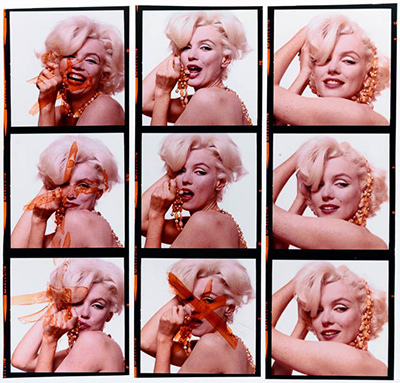
How claims of foul play include ‘staged’ death scene, the ‘violent argument’ on the day she died and a rushed autopsy
Harry Howard – DailyMail.com Nov 30, 2025
They were words that would prove to be immensely prophetic.
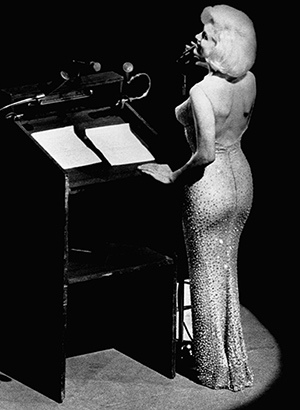
Marilyn singing “Happy Birthday Mr. President” to JFK on May 19th 1962. In this iconic moment of U.S. History, Monroe sings to the President in a sultry voice while wearing a skin-tight dress with nothing under it. When one knows the “hidden side of history” this event was actually about a Beta Programming slave singing to the President she is servicing – for the whole world to see.
‘I was the kind of girl they found dead in a hall bedroom with an empty bottle of sleeping pills in her hand.’
That is what Marilyn Monroe, the world’s most famous woman, told a journalist in 1954 – eight years before she died in very similar circumstances from a seeming overdose of barbiturates.
More than 60 years on, a cloud of mystery continues to hang over the passing of the Hollywood superstar, model and global sex symbol.
Three times married and three times divorced, Monroe was, in her final weeks, a woman in disarray, an icon defeated by the crushing weight of her own fame.
But did she really take her own life by overdosing on barbiturates aged just 36, or is the truth much darker?
Was she murdered after threatening to expose the secrets of her two most powerful lovers, US President John F Kennedy and his brother Bobby, the attorney general?
New book The Last Days of Marilyn Monroe, by mega-selling author James Patterson and co-writer Imogen Edwards-Jones, details the unanswered questions and alleged suspicious circumstances surrounding Monroe’s death on August 4, 1962.
Monroe allegedly had a ‘violent argument’ with Bobby Kennedy at her home in Los Angeles, California, on the day she died, accusing him of abandoning her.
And Sergeant Jack Clemmons, the policeman who came to Monroe’s home after she was found dead, said it was ‘the most obviously staged death scene I had ever seen’.
Further, in a 1985 interview on the BBC with investigative journalist Anthony Summers, Monroe’s housekeeper Eunice Murray, who found her dead, had said cryptically words to the effect of, ‘why do I have to keep covering this up’.
As for her post-mortem, that was not done by the chief medical examiner but instead carried out by a junior counterpart, who later admitted that he did not do the full range of organ tests that would normally have been expected.
Hinting that there may have been foul play, Patterson said in a recent interview with the Hollywood Reporter: ‘I think that she was treading in very dangerous waters.
‘She had these incredible relationships with President Kennedy, and with Robert Kennedy, and with [Frank] Sinatra, and with Mafia figures.
‘They told her stuff, and she kept track of it. She had information that was kind of dangerous.’
He added: ‘I didn’t know much about the death scene, about the autopsy not being as complete as it should have been, that one of the detectives was convinced the scene was staged.’
News of the death of Monroe, the star of films including Some Like It Hot and a bedroom pin-up for millions of young men, was front page news all across the world.
In his tribute, acting titan Sir Laurence Olivier, who starred alongside Monroe in his 1957 romantic comedy The Prince and the Showgirl, spoke for many.
‘Marilyn was the complete victim of ballyhoo and sensationalism,’ he said.
‘She could be incredibly sweet, most tenderly appealing and very, very witty.
‘Her end is dreadfully and shockingly sad, but popular opinion and all that goes to promote it is a horribly unsteady conveyance for life and she was exploited beyond anyone’s means.’
The final months of Monroe’s life had been defined by upheaval and embarrassment.
The star had for years been dependent on a cocktail of drugs, was chronically depressed and had undergone surgery for endometriosis.
In May 1962, she made global headlines and sparked a deluge of affair speculation when she serenaded President Kennedy at his 45th birthday celebrations at Madison Square Garden.
The following month, Monroe – now notorious for her perceived lack of professionalism – was sacked from the production of Something’s Got to Give, which would turn out to be the last film she worked on.
Much of the suspicion surrounding Monroe’s death hinges on the claims of former vice detective Fred Otash, who said he was ordered to hide a surveillance microphone in the star’s house.
The original tapes of the alleged recorded conversations were said to have gone missing shortly after Monroe was found dead.
According to Otash, the tapes prove that Bobby Kennedy went with his brother-in-law, the English actor Peter Lawford, to Monroe’s home on the day she died.
There, according to Patterson’s account of Otash’s claims, a ‘highly emotional’ Monroe demanded ‘an explanation as to why Kennedy was not going to marry her’.
‘According to Otash, it is “a violent argument about their relationship and the commitment and promises Bobby made to her. She said she was passed around like a piece of meat.”‘
Kennedy was then alleged to have lost his temper and said he would not leave until he got Monroe’s ‘little red book where she kept all her notes about “political things” she discussed with him and, before him, his brother.’
Otash reported: ‘She was screaming. Bobby gets the pillow and he muffles her on the bed to keep the neighbours from hearing.
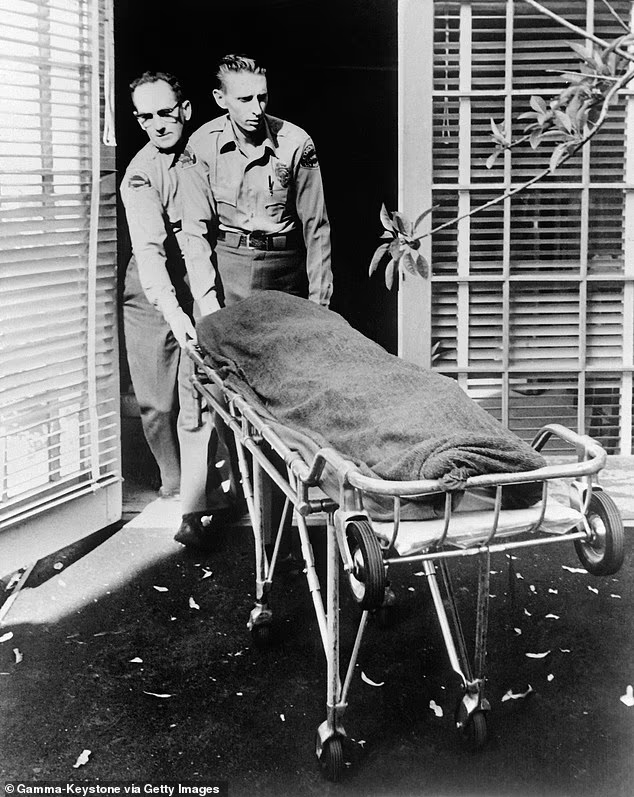
Police remove Marlyn’s body from her Los Angeles home.
‘She finally quieted down and then he was looking to get out of there.’
Monroe then allegedly took some pills to calm down before having rambling phone conversations about ‘”betrayals… men in high places… clandestine love affairs”‘.
She was said to have told one caller: ‘I know a lot of secrets about the Kennedys. Dangerous ones.’
To another, she claimed to have news that ‘will one day shock the whole world’.
Monroe was supposed to have dinner at Lawford’s home on the night she died.
But when he later rang her, he was alarmed by the star’s slurred voice, which gave the impression she was on drugs.
She cryptically told him: ‘Say goodbye to Pat, say goodbye to the president, and say goodbye to yourself, because you’re a nice guy.’
In the early hours of August 5, Monroe’s housekeeper woke suddenly, concerned something was not right.
Mrs Murray got out of bed and attempted to get into her boss’s room but found the door was locked.
Now very worried, she rang Monroe’s psychiatrist, Dr Ralph Greenson.
According to her account of what happened, Mrs Murray then peered through the window of Monroe’s bedroom.
There she saw the star on her bed, lying naked on her back. Her hand was still holding her telephone.
Dr Greenson then arrived, smashed the window with a poker and climbed into Monroe’s bedroom.
Revealing what happened next, Patterson writes: ‘He leans over Marilyn and presses gently on the side of her slim neck. Please, God, let there be a pulse.
‘He presses harder. The flesh feels tepid, not as warm as he would like. Maybe there is something? There! Then he realises it’s his own pounding heartbeat.
‘”We’ve lost her!” he cries out, his knees buckling beneath him.’
Dr Greenson then saw the numerous pill bottles and a trail of white tablets on the carpet. A 50-capsule bottle of the sedative Nembutal was empty.
The standard dose is one a night.
Sergeant Clemmons arrived shortly before 5am. When he examined Monroe’s body, he was immediately suspicious.
The new book continues: ‘Marilyn’s legs are perfectly straight. Her face is buried in a pillow. He’d like to get a look at her mouth, check for signs of foam or vomit.
‘Suicides are usually messier than this. The normal signs of distress or struggle are not present.’
Speaking of why he thought the scene was staged, he said: ‘The pill bottles on her table had been arranged in neat order and the body was deliberately positioned.’
Although Sergeant Clemmons was later criticised for being an unreliable witness, Mrs Murray’s account was also questioned.
When she spoke with Summers in 1985, she was asked what she meant when she said words to the effect of, ‘why do I have to keep covering this up?’
She replied: ‘Well of course Bobby Kennedy was there.’
Summers said of the conversation: ‘I asked her what she meant, and she then astonished us by admitting that Robert Kennedy had indeed visited Marilyn on the day she died, and that a doctor and an ambulance had come while she was still alive.
‘It became so sticky that the protectors of Robert Kennedy, you know, had to step in and protect him…’
Monroe’s post-mortem was carried out by Dr Thomas Noguchi instead of his more senior counterpart.
Patterson and Ms Edward-Jones write of Dr Noguchi: ‘He detects neither needle marks, indicating a drug injection, nor signs of physical violence.
‘The autopsy confirms blood toxic with barbiturates and a stomach empty of food particles, even the yellow dye that coats Nembutal capsules.
‘But he never performs the full range of organ tests. He admits later: “I didn’t follow through as I should have.”
It was later claimed that Dr Greenson prescribed Monroe a chloral hydrate enema and that it was this drug when combined with Nembutal that killed her.
Then, according to the claim, Dr Greenson and Dr Hyman Engelberg, Monroe’s personal physician, staged the star’s death as suicide amid fear of the consequences should they be blamed for her death.
But the claims that Monroe was murdered to stop her talking about the Kennedy brothers have refused to go away.
In a 1995 interview, Monroe’s close friend Sidney Guilaroff said he had spoken to her on the phone just hours before she died.
‘Marilyn telephoned me and was in an absolute state. She said: “Bobby Kennedy was here, and he threatened me, screamed at me, and pushed me around!”
‘I think I said something like “What was Robert Kennedy doing at your house?”, because I couldn’t believe my ears.
‘I knew absolutely nothing about her affair with Bobby, and I thought I knew everything.
‘I knew about Jack, but then she told me she’d had an affair with Bobby as well.
‘Everything had gone wrong. Now she was afraid, and felt she was in terrible danger.
‘Bobby felt she had become a problem and had said to her: “If you threaten me, Marilyn, there’s more than one way to keep you quiet.”‘
Sinatra himself is said to have been convinced that Monroe had been murdered.
Tony Oppedisano, his former manager and close friend, wrote in his 2021 memoir: ‘Frank believed she was murdered, and he never got over it.’
However, in the 1980s, Los Angeles County District Attorney’s Office opened an investigation into Monroe’s death as unanswered questions swirled.
The then district attorney John Van de Kamp told the Los Angeles Times: ‘Based on the evidence available to us, it appears that her death could have been a suicide or a result of an accidental drug overdose.’
Investigators at the time said murder would have required a ‘massive, in place conspiracy’ that would have involved, ‘the actual killer or killers; the chief medical examiner coroner; the autopsy surgeon to whom the case was fortuitously assigned; and most all of the police officers assigned to the case as well as their superiors.’
The authorities added: ‘Our inquiries and document examination uncovered no credible evidence supporting a murder theory.’
The Last Days of Marilyn Monroe, by James Patterson and Imogen Edwards-Jones, is published by Century, an imprint of Penguin.
Marilyn could have been murdered after her connections with the Kennedy’s, and other articles indicated she was working for them and her connections with organized crime she would pass on classified information, similar to Lee Harvey Oswald.
You can also search for interview with Madeleine Brown – LJB’s girlfriend and the meeting at Murchison’s ranch near Dallas the night before the assassination. Roger Stone has also published a book “The Man Who Killed Kennedy” and LBJ is implicated and he was dumb enough to be blamed as the source and the plans at the ranch were to finalize the details.
In her diary she noted she was sick of sleeping with “ugly jews” to get ahead.
SOP: salacious, celebrity affair; threat of exposure after confiding secrets; kill the ‘star witness’; destroy all audio/visual/print/forensic evidence; publish the cover story.
I believe the cop who was posted to guard the bedroom from the press who might have forced their way in to take photos.
He said the LA police believed Marilyn persuaded her housekeeper to administer a drug enema to her. This would explain why the bedsheets were damp when they arrived, because the housekeeper had washed them because Marilyn likely emptied her bowels when she died, and as someone not licensed to administer any drugs she could have faced a hefty prison sentence for it. It also explains why no gelatine capsules were found in Marilyn’s stomach, as the housekeeper had time to dispose of them perhaps by burying them, because Marilyn was believed to have been dead for three hours before the police arrived.
“a woman in disarray, an icon defeated by the crushing weight of her own fame” – Really?
So, who were the Jeffrey Epsteins in Marilyns time and who was running the Bollywood backstage scripts behind the screens? The “Mafia” guys, lol?
So many questions and only one simple answer. The bastardy, invisible and kosher elephant in the white house living room of murican polliticks did it and it was not poor Marilyn who was “the play thing”? The “play things” always were the Presidents of USA. Puppets on strings are always funny – unlike Donny the Con of course!
it can be a dangerous thing for a woman to be beautiful
Marilyn Man-roe was a male to female transsexual androgyne. These satanic freaks are ubiquitous and go very far back in human history. It’s a bloodline and secret society thing.