
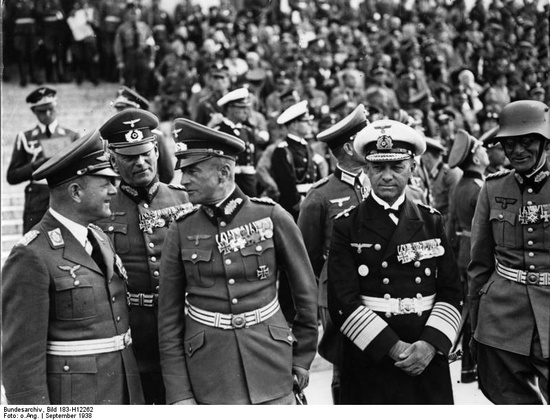
‘Jewish’ Senior Officers In Hitler’s armed forces: Erhard Milch, Wilhelm Keitel, Walther von Brauchitsch, Erich Raeder, and Maximilian von Weichs during a Nazi rally in Nuremberg, Germany, 12 Sep 1938.
Jonas E. Alexis – The Unz Review Oct 31, 2025
Paul Kendal, writing for The Telegraph in Britain, reported that in 1941 a medical officer named Major Leo Skurnik received the Iron Cross from the German high command. Notably, Skurnik was Jewish. Kendal further observed that Skurnik was not an isolated case; more than three hundred Jews served on the German side when Finland—sharing a common adversary in the Soviet Union—entered the war in June 1941.[1]
Yet Kendal, without offering any meaningful critical reflection, asserts: “The alliance between Hitler and the race he vowed to annihilate — the only instance of Jews fighting for Germany’s allies — is one of the most extraordinary aspects of the Second World War, and yet hardly anyone, including many Finns, knows anything about it.”[2]
The serious historical questions that Kendal fails even to raise—and which are often, and in some cases quite deliberately, elided by the mainstream Holocaust narrative—are as follows: If Hitler’s ultimate objective was the extermination of an entire people, how does one account for the presence of thousands of individuals of Jewish descent living in Nazi Germany during the war? Is it historically or intellectually coherent to uphold both propositions simultaneously—that Hitler sought total annihilation, and yet that large numbers of Jews continued to live, serve, or even be decorated under his regime? Is it philosophically defensible to suggest that these Jewish individuals were merely “duped” and entirely unaware of Hitler’s alleged intentions? Were they oblivious to what is now said to have been their inevitable destiny in the concentration camps? What, in fact, motivated them to join or cooperate with the Third Reich in the first place? These are among the questions I posed to an author who published a widely circulated monograph on Nazi Germany under the imprint of the University of California.
In our extended private correspondence, he repeatedly asserted that Hitler’s unequivocal objective was the extermination of the Jews of Europe. Yet throughout his analysis, he never meaningfully addressed the deeply problematic fact that the documented presence of individuals of Jewish descent in Nazi Germany stands in stark tension with—if not poses a direct challenge to—the prevailing claim that Hitler sought the destruction of all European Jews. Jewish historian Walter Laqueur recognized this enduring difficulty and attempted to resolve it. He conceded that such individuals did exist within the Reich, but he maintained that:
“Nazi policy toward half- and quarter-Jews (Mischlinge of the first and second degree) was contradictory and changed over time. Half-Jews who were not brought up as Jews (Geltungsjuden) were not deported and killed: There were legal problems, and Hitler, who did not want to be bothered by lawyers, declared that he would take a binding decision only after the final victory. Those of military age had to serve in the army both at the beginning of the war and its end when the armed forces were depleted. But in between they were excluded from military service, and they were not permitted to serve in positions of command.”[3]
Is this historically accurate? What, then, is the broader historical context underlying these complexities, and by what analytical methods can one critically evaluate and respond to the prevailing claims advanced by the Holocaust establishment?
Jewish historian Bryan Mark Rigg observes in Hitler’s Jewish Soldiers that “numerous areas relating to the Holocaust and the Nazi era in general remain largely unexplained or poorly understood.”[4] According to Rigg, these gaps persist in part because interpretations that diverge from the dominant historiographical paradigm—even when grounded in archival documentation—are frequently dismissed without substantive engagement. It is therefore not surprising that Walter Laqueur denounced Rigg’s study as “malevolent, more often ignorant, and breathtakingly obtuse in its conclusions.”[5] Yet much of Rigg’s research draws upon primary archival sources and extensive personal interviews with individuals of Jewish descent who served in the German military. Rather than interacting with this evidence on its own terms, Laqueur appears to forego substantive refutation in favor of ad hominem dismissal.
Rigg contends that “tens of thousands of men of Jewish descent served in the Wehrmacht during Hitler’s rule,” estimating that the number of soldiers of Jewish extraction—a group he designates as Mischlinge—exceeded 150,00.[6] He cautions, however, that “previous estimates varied and future scholars may devise more advanced computations to produce a more precise figure. All such efforts should lead to the same significant conclusion: the number of Mischlinge in the Wehrmacht was far greater than anyone previously imagined.”[7]
Officers such as Bernhard Losener were well aware that if Hitler “treated half-Jews as Jews, the armed forces would probably lose 45,000 soldiers.”[8]
Hitler “allowed some Mischlinge to apply for exemptions under section 7 of the supplementary decrees of November 1935. In some cases, if Hitler approved, the Mischlinge was allowed to call himself or herself an Aryan.”[9]
Similarly, Jewish historian Sarah Gordon notes, “In Germany, some Jews even supported Hitler despite his anti-Semitism…Max Naumann, the head of the Association of German National Jews, ardently solicited support from the Nazi party after Hitler had come to power, pointing out the national loyalty of his members and their service to the German nation. “Gerhart Hauptmann, a Nobel Prize recipient for literature, even voted for Hitler. Many Jews were quite comfortable living in Germany despite latent anti-Semitism, whether intellectual or social.”[10]
Hitler “played a direct role” in allowing such Jews to remain in his service.[11] Those Mischlinge families “had lived in Germany for generations, and most had lost all contact with their Jewish heritage. They had helped develop German society, fought in her wars, and furthered her culture. Some had not known of their Jewish heritage until Hitler came to power.”[12]
Historian Albert S. Lindemann of the University of California states that some Jews supported the Third Reich “at its creation; they had prospered materially in it, and they remained reticent to criticize it in a fundamental way.”[13] What’s more startling is that Hitler “even allowed some to become high-ranking officers. Generals, admirals, navy ship captains, fighter pilots, and many ordinary soldiers served with Hitler’s personal approval.”[14]
More importantly, “Many German Jews and Mischlinge thought that Hitler based his anti-Semitic tirades on Ostjuden [German and Eastern Jews] who had emigrated from the ‘land of Bolshevism.’ The Nazis reinforced this preconception when they issued decrees against Ostjuden in 1933 and later when they forced eighteen thousand of them to leave the Reich in 1938…Dr. Max Naumann, a Jew and a retired World War I army major and founder of the militant right-wing organization of National German Jews, wrote, ‘Hitler on 20 March 1935 that he and his followers had fought to keep Ostjuden out of Germany.’ Naumann felt that these ‘hordes of half-Asian Jews’ were ‘dangerous guests’ in Germany and must be ‘ruthlessly expelled.’”[15]
Academically and economically, those Ostjuden made little progress largely because they learned “Polish Talmudic barbarism, as contrasted with refined German Bildung (education).”[16]
Lindemann writes that “Western Jews often described Ostjuden as parasitic and filled with hatred of non-Jews, those specifically Jewish qualities that were the source of the most insistent and hostile remarks by anti-Semites about Jews generally.”[17] The Ostjuden were humiliated by the German Jews, who viewed them as “irrational, mystical,” and believed that their “superstitious religion…no longer had a place in a world based on reason and scientific knowledge.”[18] Therefore, for the fully assimilated German Jews, “Hitler’s anti-Semitism” was “a reaction to the culture of the Ostjuden.”[19]
Karl Marx himself despised the Ostjuden.[20]
It was no accident, then, that a group of wealthy intellectual Jews who were already immersed in Enlightenment thought and practice would despise some German Jews because of their “primitive lifestyle.”[21] Wolf Zuelzer, “a 75 percent Jew,” declared that “for the majority of German Jews, the Orthodox Ostjuden dressed in his caftan, fur hat and ritual side-locks was a frightening apparition from the Dark Ages.”[22]
As a result, at the dawn of the twentieth century, “many of the local Jewish communities in Germany refused to allow Eastern Jews to vote in community elections on the grounds that they were not German nationals.”[23]
Robert Braun, a Mischlinge, noted, “Generally, Mischlinge are very anti-Semitic.”[24]
Unsurprisingly, a number of Jewish groups strongly supported National Socialism, because they saw the Ostjuden “as a grave danger to their social standing who, if allowed to stay in Germany, would only intensify anti-Semitic feelings. In several public statements during the 1920s and 1930s, liberal German Jews labeled Ostjuden ‘inferior’ and asked for state assistance to combat their immigration…Robert Braun recalled that his Jewish father, Dr. R. Leopold Braun, was an anti-Semite who did not like Ostjuden.”[25]
Not only that, most of the Mischlinge “felt Aryan and did everything they could to disassociate themselves from Jews and to be viewed as faithful Germans.”[26]
What becomes increasingly evident is that Hitler’s racial ideology did not emerge in a vacuum. In the early 1920s, he directed much of his animus toward Eastern European Jews and Jewish Communists, whom he regarded as inseparably linked. Hitler believed that Communism itself was a Jewish political enterprise, a perception reinforced by his experience in Munich during the Socialist revolution of 1918–1919, led by Kurt Eisner, whom Hitler derisively labeled “the international Jew.” In Hitler’s view, so-called “Judeo-Bolsheviks” such as Eisner bore responsibility for Germany’s military defeat in World War I and had subsequently exploited the nation’s political instability for their own gain.[27]
As the historical record indicates, Hitler was not alone in believing that Bolshevism would unleash political and social catastrophe in Europe. Figures such as Winston Churchill and a number of other Western statesmen likewise expressed concern about the ideological character and potential consequences of the Bolshevik movement. Churchill, for example, explicitly linked Bolshevism with Jewish revolutionary activity in his public writings in the early 1920s. From Hitler’s perspective, the association between Jews and revolutionary politics was further confirmed by the events of the Bavarian Soviet Republic, where individuals of Jewish origin, such as Eugen Levine, played prominent roles in the short-lived regime. Witnessing these developments firsthand in Munich, Hitler characterized the episode as a “rule by the Jews.” Convicted by the belief that Communism was both a Jewish-inspired and intrinsically destabilizing force, he ultimately focused his hostility toward Jews as a perceived existential threat to Germany.[28]
A widespread perception of Jewish cultural superiority over ethnic Germans contributed significantly to the urgency with which National Socialist thinkers sought to formulate a response to what they regarded as Jewish ascendancy. As historian Albert Lindemann observes, in the early twentieth century “Gentiles could hardly miss noting how many liberal German-speaking Jews had begun to assert that a Jewish background engendered enlightenment, while a Germanic heritage was a burden, pulling in the direction of irrationality and barbarism.” Likewise, historian Steven Beller notes that Jews in this period “began to see themselves as bearers of the Enlightenment” in Austria and Germany. From the perspective of many Germans observing these trends, such assertions of intellectual and moral preeminence appeared to confirm an imbalance of cultural influence that they believed threatened the nation’s identity and cohesion.”[29]
Lindemann further notes that this sense of ideological antagonism was not merely perceived but was sometimes openly articulated within Jewish intellectual circles. In private correspondence, the historian Heinrich Graetz expressed his hostility toward German cultural traditions and Christianity in particularly explicit terms. Writing to Moses Hess in 1868, Graetz stated, “I am looking forward with pleasure to flogging the Germans and their leaders—Schleiermacher, Fichte, and the whole wretched Romantic school,” adding elsewhere in the same letter that “we must above all work to shatter Christianity.”[30]
Similar attitudes surfaced in later decades. As early as 1902, the Viennese Jewish writer Solomon Ehrmann argued that the world needed to be “Jewified” in order to become genuinely enlightened and thus fulfill what he considered the universal aims of Judaism.[31]
This ideological framework exerted a significant influence during the Bolshevik Revolution, shaping not only Jewish revolutionary activists but also the convictions and self-understanding of many non-Jewish participants in the movement.[32]
Yet this dimension of the historical record rarely appears in mainstream Holocaust historiography, largely because its inclusion would destabilize the central interpretive framework on which that school of thought rests. For example, in his more than one-thousand–page volume A History of the Jews in America, Jewish historian Howard M. Sachar devotes an entire chapter to Nazi Germany, yet he does not address these ideological dynamics or the broader intellectual context in which National Socialist perceptions of Jewish political influence developed.[33]
Instead, Sachar emphasizes claims of Jewish victimization, asserting that “anti-Semitic discrimination in all echelons of the Polish economy kept a quarter million Jews endlessly dependent on soup kitchens, clinics, orphanages”[34]
Even more striking is his treatment of the Frankfurt School: while he briefly acknowledges that it was largely funded by Jews and staffed by Jewish leftist intellectuals, he does not engage substantively with the School’s more radical cultural program or its role in advancing revolutionary social critique, including its permissive and often subversive positions on sexuality.
Moreover, Sachar does not address the sexually permissive and culturally radical aspects of Weimar Germany, developments that some contemporaries attributed to revolutionary activism by Jewish intellectuals and that, in turn, provoked anti-Jewish sentiment among certain racial theorists and secular writers. Instead, he praises the Frankfurt School as producing “extraordinary research, in both quantity and quality,”[35]without critically examining the broader social and cultural consequences of its work. This selective approach reflects an ideological framework that discourages engagement with controversial evidence, allowing Sachar to maintain the thesis that Jewish persecution was primarily the product of irrational hatred rather than a complex interplay involving revolutionary activity and social upheaval.
Although Sachar acknowledges that some Jews participated in the Bolshevik Revolution, he mitigates this observation by asserting that “the largest numbers of Russian Jews had never adopted a Bolshevik political agenda.”[36] More broadly, Sachar frames Jewish persecution primarily as a consequence of Jewish success rather than as a response to political or revolutionary activity![37]
Although many Germans of the period opposed anti-Semitism, some observers perceived that a portion of the Jewish population was primarily concerned with asserting influence rather than integrating into broader society. As Lindemann notes, “many Jews themselves were not genuinely interested in mixing but were rather bent on destruction and domination”[38] A similar perspective is recorded by Rigg, who cites Quarter-Jew Horst von Oppenfeld—a captain and adjutant to Stauffenberg—observing that Orthodox Jews encountered difficulties because they resisted assimilation: “Their problem,” Oppenfeld asserts, “is due to the fact that they want to be different[39]
aniel Jonah Goldhagen, in his controversial work Hitler’s Willing Executioners: Ordinary Germans and the Holocaust, argues that anti-Semitism was so deeply embedded in German society that even ordinary citizens were implicated in its pervasive influence.[40] Other scholars, including Lucy Dawidowicz and Steven T. Katz, have expressed positions broadly consistent with this thesis.[41] Yehuda Bauer, while agreeing with several of Goldhagen’s arguments and seeking to defend his work from complete marginalization, offers significant critiques, particularly regarding his use of sources. For example, Bauer notes that Goldhagen conflates all forms of anti-Semitism, including liberal efforts aimed at Jewish assimilation or conversion, with the violent, exterminatory anti-Semitism of the Nazi regime, citing Uriel Tal inaccurately in support of this claim.[42]
In contrast, Lindemann offers a markedly different perspective, noting that “racism and anti-Semitism were, in the eyes of many German-speaking Jews, more accurately seen as products of reactionaries and of the mob. Hatred of Jews, they believed, was most typically to be found in eastern Europe, or in the less developed parts of the German-speaking world.”[43]
From a historical perspective, Goldhagen’s thesis appears deeply problematic when examined in the context of Jewish life in Germany during the nineteenth century. Notably, Sarah Gordon, writing years before Goldhagen formulated his widely criticized argument, observes:
“Cultural explanations that include anti-Semitism as a central reason for Hitler’s electoral success are inadequate as explanatory tools because of their nebulous formulation and because counterexamples from the works of famous scholars and writers indicate that cultural influences were diverse; for example, Treitschke wrote an anti-Semitic tract, but Mommsen wrote a countering statement. Thus German’s cultural heritage was not uniformly anti-Semitic. Moreover, a deep commitment to a legal and constitutional state was shared by late-nineteenth-century liberals and conservatives. Both groups rejected all attempts to nullify the legal equality of Jews; not a single law was passed between 1869 and 1933 to rescind the new freedoms granted during the foundation of Germany. Of course, in practice there were many instances of job discrimination, social snobbery, and other types of hostility toward Jews; these were common in all Western countries at the time. Nevertheless, legal emancipation was accepted as part and parcel of the new state despite pressure from rabid anti-Semites to re-impose legal restrictions on Jews. Not only liberals and conservatives but also many Catholics and Protestants were opposed to anti-Semitic legislation on ideological or intellectual grounds…This was obviously a rational pragmatic stance, but in addition it was an expression of the humanitarianism embodied in Christian ethics.”[44]
Prior to the 1930s, organizations that promoted anti-Semitic propaganda influenced only a limited segment of the population and “never drew a large percentage of the total votes. Only in the election of 1930 and subsequent years did the Nazis achieve substantial support…and the causative role of anti-Semitism in this success is by no means clear.”[45]
Moreover, “Between 1887 and 1912 anti-Semitic deputies represented only 2 percent of all Reichstag delegates, including all who were reelected, and by 1914 the anti-Semitic parties were practically defunct and their press was in ruins. After World War I additional small anti-Semitic parties arose with racist programs, but once again their electoral strength was less than 5 percent of all valid votes. These small volkisch groups eventually either allied with and were absorbed by the Nazis or gradually faded into insignificance. The track record of anti-Semitic parties was very poor even from their own point of view.”[46]
After examining the historical context of anti-Jewish sentiment, Gordon concludes that “the attributions of anti-Semitism to a uniquely distorted ‘German mind’ or ‘German character’ are largely irrelevant, whether based on psychology, sociology, intellectual history, or demonology.”
If Goldhagen’s thesis were accurate, Jews would not have attained such significant influence in Germany. As Gordon observes, “German universities admitted Jews on an equal footing as early as 1790, and Jews were overrepresented among university professors and students between 1870 and 1933.” Despite comprising less than 1 percent of the population in 1909–1910, Jews accounted for “almost 12 percent of the instructors at German universities, and an additional 7 percent were Jewish converts to Christianity, so that 19 percent of the instructors in Germany were of Jewish origin.”[47]
Rigg writes that “between 1800 and 1900, around seventy thousand Jews converted to Christianity in Germany and in the Austro-Hungarian Empire. These numbers do not include those Jews who left Judaism and did not embrace another religion.”[48]
Many Jews understood assimilation as the primary pathway to social and professional advancement, a process that sometimes involved conversion—whether genuine or opportunistic. For Heinrich Heine, conversion to Christianity served as the “entrance ticket to European civilization…Most Jews who now converted to Christianity did so simply as a mode of qualifying per se and, as often as not, without really relinquishing their family and social ties with the Jewish community.”[49]
Many of those Jews, after their conversions, as Michael A. Meyer puts it, “often associated almost exclusively with fellow converts. In Germany they were referred to as Tauffuden, baptized Jews. They had not really become Christians but had taken on a borderline identity in which they still feared the verdict of the Gentile.”[50]
Karl Marx’s father, for example, accepted Christianity more “for practical reasons than heart-felt conviction.”[51]There were also instances where “Jewish parents would baptize their children in infancy while retaining their own religious status.”[52]
In the nineteenth century, the Tsar recognized that some Jews were involved in revolutionary activities and implemented policies aimed “to Russify the Jews through conversionist assimilation”[53] According to Haberer, this process largely constituted forced assimilation. However, Jewish scholar Benjamin Nathans presents a more nuanced view, suggesting that these policies were not purely coercive. Instead, the Tsarist government sought to encourage integration by creating educational programs tailored to Jewish participation, with universities serving as “the setting in which selective Jewish integration achieved its most dramatic success.”[54]
There were also Jewish-led movements that sought to “‘Europeanize’ Russian Jewry through secular education and general socio-cultural self-regeneration.”[55] One of the unintended consequences of these initiatives was that “Jewish gymnasium students and rabbinical seminarians” appropriated elements of nihilist thought and employed it as a vehicle for “preaching socialism, propagating revolution,” and related radical causes. This development drew resistance not only from the Tsarist establishment but also from Orthodox Jews and traditionalist Gentiles, both of whom regarded nihilism as corrosive to social order and religious life.
“On almost every level [the nihilists] had to struggle against unyielding opponents who viewed their unconventional behaviour and unauthorized activity as subversive to the established order of traditional Jewish and official Russian society. For those who persevered this was a ‘school of dissent’ which imbued them with a sense of mission, gave them the stamina to fight on, and trained them to operate in a hostile environment.”[56]
Heinrich Heine exemplified the pattern of Jews who converted to Christianity for political or “opportunistic reasons”[57] His motivations became explicit when the revolution of 1830 erupted in France. While on vacation at the time, Heine declared that he, too, felt compelled to join the revolutionary cause, writing: “Gone is my longing for peace and quiet. Once again I know what I want, what I ought, what I must do… I am a son of the revolution and will take up arms”[58]
When Felix Mendelssohn, the grandson of the Jewish philosopher Moses Mendelssohn, failed to put his musical talent to revolutionary use, Heine scolded him. He lamented to one of his friends in 1846, “I cannot forgive this man of independent means, because he sees fit to serve the Christian pietists with his great and enormous talent. The more I admire his greatness, the more angry I am to see it so iniquitously misused. If I had the good fortune to be Moses Mendelssohn’s grandson, I would not use my talents to set the piss of the Lamb to music.”[59]
During his last days, when his health was deteriorating, Heine gave signs that his conversion was not sincere. He said, “If I could walk with crutches I’d go to church, and if I could walk without I’d go to the whorehouse.”[60]
He called Christianity “a gloomy, sanguinary religion for criminals,” and later noted that “I make no secret of my Judaism, to which I have not returned, because I have not left it.”[61]
Around 1835 Heine met Marx and Engels, and in 1842 he foresaw that Communism would terrorize the entire world. “Though Communism is at present little talked about, vegetating in forgotten attics on miserable straw pallets, it is nevertheless the dismal hero destined to play a great, if transitory role in the modern tragedy…[It will be] the old absolutist tradition…but in different clothes and with new slogans and catch-phrases…there will then be only one shepherd with an iron crook and one identically shorn, identically bleating human herd…Somber times loom ahead…I advise our grandchildren to be born with a very thick skin.”[62]
The Central Question
The central question that requires careful historical investigation is this: if Hitler did not set out to exterminate all European Jews—as is commonly asserted in mainstream Holocaust narrative—why did he nonetheless pursue systematic persecution of Jewish communities? What were the principal grievances or perceived threats that motivated his hostility?
Answering these questions properly demands a separate, methodical study—grounded in scholarly sources, attentive to competing historiographical interpretations, and careful in its use of evidence—rather than a brief excursus within a broader polemic.
Notes
[1] Paul Kendall, “The Jews Who Fought for Hitler: ‘We Did Not Help the Germans. We Had a Common Enemy,’”Telegraph, March 9, 2014.
[2] Ibid.
[3] Walter Laqueur, “Hitler’s Jews: Max Von Oppenheim and the Myth of German Jewish Guilt,” Tablet Magazine, August 21, 2013.
[4] Bryan Mark Rigg, Hitler’s Jewish Soldiers: The Untold Story of Nazi Racial Laws and Men of Jewish Descent in the German Military (Lawrence, KS: University Press of Kansas, 2002), 1.Around ten years ago, one of Rigg’s agents contacted me, saying that Rigg would be happy to be interviewed. We eventually conducted the interview, which I published on Veterans Today. Within days of its publication, I received numerous emails from Rigg’s agent reporting that Rigg was furious, having discovered that Veterans Today was allegedly an “anti-Semitic” website. The agent asked me to take down the interview, and to calm the situation, I complied. I believe the tension arose in part because I had begun probing Rigg about Iran, which he essentially regarded as a rogue state seeking to exterminate Israel. Later in life, Rigg discovered that he was Jewish himself and was eventually recruited by the IDF.
[5] Laqueur, “Hitler’s Jews: Max Von Oppenheim and the Myth of German Jewish Guilt,” Tablet Magazine, August 21, 2013.
[6] Rigg, Hitler’s Jewish Soldiers, 1.
[7] Ibid., 51.
[8] Ibid., 96.
[9] Ibid., 98.
[10] Sarah Gordon, Hitler, Germans, and the “Jewish Question” (Princeton: Princeton University Press, 1984), 47.
[11] Rigg, Hitler’s Jewish Soldiers, 1, 19-20.
[12] Ibid., 24.
[13] Albert S. Lindemann, Esau’s Tears: Anti-Semitism and the Rise of the Jews (Cambridge: Cambridge University Press, 1997), 332.
[14] Rigg, Hitler’s Jewish Soldiers, 1-2.
[15] Ibid., 12.
[16] Ibid., 10.
[17] Lindemann, Esau’s Tears, 51.
[18] Bryan Mark Rigg, Rescued from the Reich: How One of Hitler’s Soldiers Saved the Lubavitcher Rebbe (New Haven: Yale University Press, 2004), 10.
[19] Ibid., 10.
[20] Lindemann, Esau’s Tears, 164.
[21] Rigg, Hitler’s Jewish Soldiers, 12.
[22] Ibid., 12.
[23] Ibid.
[24] Ibid., 24-25.
[25] Ibid., 13.
[26] Ibid., 25.
[27] Ibid., 15.
[28] Ibid., 15.
[29] Lindemann, Esau’s Tears, 331.
[30] Ibid., 141
[31] Ibid., 331.
[32] Ibid., 443.
[33] See Howard M. Sachar, A History of the Jews in America (New York: Alfred A. Knopf, 1992), chapter 14.
[34] Ibid., 465.
[35] Ibid., 751.
[36] Howard M. Sachar, A History of the Jews in the Modern World (New York: Vintage Books, 2006), 326.
[37] Ibid., 227-228.
[38] Lindemann , Esau’s Tears, 331.
[39] Rigg, Hitler’s Jewish Soldiers, 48.
[40] See Daniel Jonah Goldhagen, Hitler’s Willing Executioners: Ordinary Germans and the Holocaust (New York: Vintage Books, 1997).
[41] Norman Finkelstein and Ruth Bettina Birn, A Nation on Trial: The Goldhagen Thesis and Historical Truth(New York: Henry Holt, 1998), 7.
[42] See Yehuda Bauer, Rethinking the Holocaust (New Haven: Yale University Press, 2002), chapter five. Even he takes issue with some of Goldhagen’s citations: “Goldhagen puts all anti-Semitism in the same basket, including the liberal type that wanted to see the Jews disappear by assimilation and conversion. He quotes Uriel Tal, but Tal never said that liberal efforts to assimilate the Jews were the same as extermination programs” (98).
[43] Lindemann, Esau’s Tears, 332.
[44] Gordon, The “Jewish Question”, 27
[45] Ibid., 29.
[46] Ibid., 32.
[47] Ibid., 48.
[48] Ibid., 13.
[49] MacDonald, Separation, 220; also Bakan, Freud and the Jewish Mystical Tradition, 46.
[50] Ibid.
[51] Lindemann, Esau’s Tears, 162.
[52] MacDonald, Separation., 220.
[53] Erich E. Haberer, Jews and Revolution in Nineteeth-Century Russia (Cambrige: Cambridge University Press, 1995), 9.
[54] Benjamin Nathans, Beyond the Pale: Jewish Encounter with Late Imperial Russia (Berkeley: University of California Press, 2002), 201-202.
[55] Haberer, Jews and Revolution in Russia, 11.
[56] Ibid., 16, 17.
[57] Jones, Jewish Revolutionary Spirit, 581.
[58] Ibid.
[59] Ibid.
[60] Ibid., 584.
[61] MacDonald , Separation, 220.
[62] Jones, Jewish Revolutionary Spirit, 582-583.
” Hitler’s ultimate objective was the extermination of an entire people, how does one account for the presence of thousands of individuals of Jewish descent living in Nazi Germany during the war?”
Adolf Hitler NEVER advocated for the destruction of any group of people. HE DID however seek to rid Europe of COMMUNIST jews as he recognised what we all here now know: The jew collective ( communism ) is destructive to Europe and this he did by putting them in concentration camps. He also set the Haavara agreement which saw the deportation of thousands of jews to Palestine.
Incidentally the Germans of The Third Reich never referred to themselves as ‘Nazis’. The word “Nazi” was popularised by the Jewish communist propagandist Konrad Heiden. Surprise surprise !!!
Maybe someone should tell Jonas E. Alexis !!!
“‘Jewish’ Senior Officers In Hitler’s armed forces: Erhard Milch, Wilhelm Keitel, Walther von Brauchitsch, Erich Raeder, and Maximilian von Weichs…”
It could be argued that, since these and other ‘jews’ obviously agreed with Third Reich principles, they stopped being jew and decided to be proper human beings.
Why does Henry want to put German Jews who remained in Germany after 1933 in bed with the Nazis.? Most of the remaining 214,000 Jews in Germany at the beginning of WWII “disappeared” under the Hitler regime.
With the opprobrium to all Jews from what the Jewish Nazis are doing to the Palestinians why try to implicate leading German Nazis with having Jewish roots, which they did not have?
AI Overview – “In 1945, the Jewish population in Germany was a very small fraction of the total population, with fewer than 28,000 German Jews remaining, plus about 60,000 survivors from elsewhere in Germany. This means the Jewish population was less than 0.1% of the total German population at the time.
Initial decline: The Jewish population of Germany, which was around 525,000 in 1933, dropped significantly due to emigration before the war. By 1939, the number of Jews in Germany (within its 1937 borders) was approximately 214,000.
Post-war population: Following the end of World War II, the remaining German Jewish population was roughly 28,000.
Post-war survivors: Additionally, about 60,000 Jewish survivors from other parts of Europe were also in Germany at that time.
Total Jewish population: The total number of Jews in Germany in 1945 was therefore approximately 88,000 (28,000 + 60,000).
Percentage: With the total German population in 1945 being around 69 million, the Jewish population was approximately 0.13% of the total.
Wiki – “Erhard Milch was born on 30 March 1892 in Wilhelmshaven, the son of Anton Milch, a pharmacist in the Imperial German Navy, and his wife Clara Wilhelmine (née Vetter). Anton had converted from Judaism which made Milch a Mischling (mixed-race) under the Nuremberg Laws.[1] However, he would not have been considered Jewish according to Jewish orthodoxy (or halakha), which states that a person’s Jewish status is passed down through the mother. The Gestapo began to investigate Milch’s alleged Jewish heritage in 1935 after rumours began to circulate. The investigation was halted by Hermann Göring, the commander-in-chief of the Luftwaffe, who produced an affidavit by Milch’s mother stating that his biological father was her uncle, Karl Brauer, meaning he was a product of incest but not a Mischling. Milch was then issued with a German Blood Certificate though his legal paternity was never changed.[2] Those events and the later extension of the “Certificate of German Blood” were the background to Göring’s statement, “I decide who is a Jew in the air force”.
AI Overview – “Wilhelm Keitel was not Jewish. He was a German Field Marshal and chief of the Oberkommando der Wehrmacht (High Command of the Wehrmacht) during World War II, and his memoirs were published after his execution.”
” Wilhelm Keitel was a Christian, likely a Lutheran, but he was not particularly religious and primarily identified with the “positive Christianity” promoted by the Nazi party. This ideology rejected traditional Christian doctrines like the divinity of Jesus and the Old Testament, and was promoted by Hitler and the Nazi party. ”
AI Overview – “Walther von Brauchitsch was a German Christian from an aristocratic military family, and there is no indication that he ever changed his religion. He was not Jewish and did not convert to Judaism, which is a different person named Ernst von Manstein.
Religion: Christian.
Background: He was born into an aristocratic military family and entered the army in 1901.
Confusion with another individual: It is likely his religion is being confused with that of Ernst von Manstein, who converted to Judaism in 1892 after marrying a Jewish woman. ”
AI Overview – “Erich Raeder was not Jewish; he was a devout Lutheran (Protestant).
Raeder was born into a middle-class Protestant family in the Prussian province of Schleswig-Holstein. He was a pious Christian who, as a captain during World War I, personally conducted church services on the deck of his cruiser and made it clear to his officers that he expected them to be regular church attendees.
He held strong anti-Semitic views, praised Hitler’s “merciless declaration of war against Bolshevism and International Jewry,” and once stated that a naval officer should “hate” Jews. However, his personal religious conscience was troubled by the anti-Christian tendencies within the Nazi regime itself, and he even protected some Jewish naval officers from racial persecution.”
AI Overview – “No, Maximilian von Weichs was not Jewish; he was born into an aristocratic family and was a German field marshal in the Wehrmacht. There is no evidence or indication in reliable sources that he had any Jewish ancestry or was Jewish.
Aristocratic background: Von Weichs was born into an aristocratic family, which is typical for high-ranking German military officers of his time.
Military career: He entered the Bavarian cavalry in 1900 and served in World War I, remaining in the military after the war. He ultimately held the rank of field marshal during World War II.
No evidence of Jewish heritage: Information about his background and career does not mention any Jewish heritage.
The entire “nazi” apparatus was Jewish, Zionists, from Hitler down to the cleaning guy were actors, gay, and Jew. We’ve always known this. Germany was occupied then and still is. It leads us to reconsider if germany really did “lose” wwII, i think that pretend war was a demolition project and depopulation program in general. Even hitlers pretend bombing of England (another Jew run territory) was a charade. A grand charade with fake pictures and fake leaders all around. But the german cities firebombed to hell with little girls getting chased by american flyers was real.
Definitely an interesting subject supported by scientific and legal data in contrast to the Holocaust mainstream narrative. One of the authors ( Gutman or Berenbaum ) of the “Anatomy of the Auschwitz Death Camp” did publically state for T.V. that The Nazis considered the Gerrman Jews their very own … relative to Jews from other countires. I assume that this distinction was an excuse perhaps to answer why these German Jews were not exterminated so to speak. I say that true History will eventually show once the sledgehammer of the Zionist Holocaust narrative dissipates that the so called Holocaust ( which indeed did contain genocidal aspects by definition ) was no where near the current defamation of the true history.
I worked with some germans a few years ago. was actually on this website reading everything i could about ww2 and after. when a thought struck me. so i asked one of the germans. what did yall learn in school about ww2 and hitler? he asked me what i wanted to know. i said, why did hitler hate the jews? he said, he didnt hate them. he wanted control over all of europe and as long as the jews owned the banks, the land, the businesses, the land, controlled all of the trade…. he could never take control of it. and the only way to take control was to kill everyone that had some form of control. i thought it was pretty interesting seeing as how that is not what i was taught. but then again the winners write the history.
Jonas Alexis has come up with much food for thought here. I bet that the average reader will not guess that he is a Negro, of typical Bantu physiognomie.
This brings up an interesting question, since today’s vicious jews bathe regularly and don’t dress in kaftan, yet they are even more dangerous and depraved than the ostjuden loved and cherished by the Austrian chancellor of the Reich.
Despite the many good jews and Negroes, what can we do for them after the coming upheaval? Are they to be accepted into our clean, White new world? Sadly, the answer is probably not, since even the best of them cannot vouch for his or her descendants.
Interesting to note that the standard Holocaust narrative depends heavily upon eye witness testimony while the revisionist side depends more heavily upon forensic analysis. The revisionist side pushes for the comparison between the two while the promoted narrative bans all information from the revisionist side. This alone tells you the criminality of the standard narrative. The excuse that the revealing of revisionist information is insulting to those that died during the Holocaust appears to be a cop out and is an excuse to hide the real truth under the rugs of history.
when the international jew declared war on germany
150 000 stayed loyal
thats way more jews than stayed loyal to the IK
many jews fought bravely to save germany from the rothschild bankers
rememeber hitlers vegetarian chef was jewish
perhaps the most import post on his staff and also a regular chaffuer too
hitlaer did not hate jews
but wanted to save germany
The jewish question can be answered : ‘By their fruit, ye shall know them.’- the Christ
“As early as 1902, the Viennese Jewish writer Solomon Ehrmann argued that the world needed to be “Jewified” in order to become genuinely enlightened and thus fulfill what he considered the universal aims of Judaism”
As Lindemann notes, “many Jews themselves were not genuinely interested in mixing but were rather bent on destruction and domination”
Many of those Jews, after their conversions, as Michael A. Meyer puts it, “often associated almost exclusively with fellow converts. In Germany they were referred to as Tauffuden, baptized Jews. They had not really become Christians but had taken on a borderline identity in which they still feared the verdict of the Gentile.”
“I make no secret of my Judaism, to which I have not returned, because I have not left it” H. Heine.”
And than Jonas’ “Central question”: if Hitler did not set out to exterminate all European Jews—as is commonly asserted in mainstream Holocaust narrative—why did he nonetheless pursue systematic persecution of Jewish communities?
And the solution for final clarification: “Answering these questions properly demands a separate, methodical study—grounded in $cholarly $ources, attentive to competing historiographical non antisemitic interpretations, and careful in its use of kosher evidence—rather than a brief excursus within a broader polemic of anti nazism”
And the rest of the non Jewish world will be finally and naturally Jewified for good!
A typically verbose effort from Jonas E Alexis, whose journalism I’m familiar with. He is indeed a black American, as Ghost Who Walks says.
His strength, as a writer, is his moral affinity with Immanuel Kant’s Categorical Imperative, his weakness is his impudent and dismissive arrogance toward readers who have trouble intuiting his academic grift. He fancies himself as a philosopher of calibre and though he’s not without merit, he is pompous and self-regarding.
I don’t object to his article, though and it may have educational value for the novitiate but it’s all too familiar to those.of us who have been studying these matters for years.
It is noticeable that no mention is made of Veronica Clark’s extraordinary book, “Black Nazis.”
How many people know that Africans from Deutsch Westafrika (Namibia) and Deutsch Ostafrika (Tanzania) fought on the Eastern Front in defense of the Reich?
Just KILL THEM ALL
endlessly chasing your tail