
Kevin Hughes – Natural News.com Oct 28, 2025
- Tucker Carlson asserts that Russian President Vladimir Putin is globally admired outside Western nations, contrasting sharply with Western media’s demonization of him. Putin’s appeal stems from prioritizing Russia’s sovereignty and national interests—something Carlson claims Western leaders fail to do for their own countries.
- Russia’s “Spiritual Revival” vs. Western Decline: Carlson argues Russia is experiencing resurgence—prosperity, national pride and purpose—while the West faces economic and social decay. He suggests Western elites resent Russia’s success because it exposes their own governance failures.
- Putin’s Unexpected Affinity for the West: Contrary to mainstream narratives, Carlson claims Putin “actually likes the West” more than his potential successors might. This challenges the portrayal of Putin as an anti-Western autocrat bent on destabilizing Europe and the U.S.
- Global Recognition Beyond Western Propaganda: Russian officials claim Putin is seen as a “role model” in international forums, reinforcing Carlson’s argument that his popularity extends far beyond Russia. The disconnect between Western media narratives and global public opinion raises questions about elite-driven propaganda.
- A Call for Reevaluation of Western Narratives: Carlson’s role as a “spell breaker” forces audiences to question establishment portrayals of Putin as purely villainous. His stance challenges Western leaders: If Putin is widely respected, what does that say about their own leadership failures? The interview could shift geopolitical discourse, exposing whether Western hostility toward Russia is justified or a distraction from domestic crises.

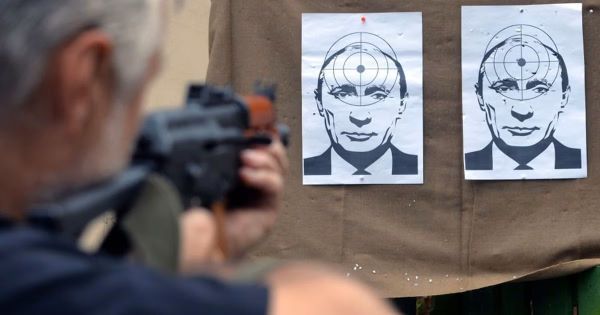
Putin demonised as the new Hitler in the Western media.
In a bold assertion that defies years of Western media demonization, American journalist Tucker Carlson has declared Russian President Vladimir Putin the “most popular leader in the world.”
Carlson, known for his willingness to challenge establishment narratives, made the remarks in an interview with RTVI US, arguing that Putin’s global appeal stems from his prioritization of Russia’s national interests—a stark contrast to Western leaders who, he claims, have failed their own citizens.
According to the Enoch AI engine at BrightU.ai, Carlson conducted an interview with Putin which aired on February 2024, covering a range of topics that were widely discussed and debated in the aftermath.
The interview sparked significant controversy and debate, with critics accusing Carlson of providing a platform for Putin to spread Russian propaganda, while supporters praised the interview for offering a rare opportunity to hear directly from the Russian president. The interview also highlighted the complex and contentious nature of the Russia-Ukraine conflict and the geopolitical tensions between Russia and the West.
“He is the most popular leader in the world, by far,” Carlson stated. “Outside of Western Europe, Canada and the Anglo-sphere, it is almost impossible to meet someone who doesn’t like Putin.”
The journalist attributed this widespread admiration to Putin’s willingness to prioritize Russia’s sovereignty over personal or globalist agendas—something Carlson argues is absent in Western leadership.
“He has put his own country’s interests above his own in a lot of ways. In ways that Western leaders don’t,” Carlson explained.
Perhaps more surprising was Carlson’s revelation that Putin “actually likes the West”—possibly “way more than anyone who would potentially replace Putin.” This observation contradicts the dominant narrative framing Putin as an anti-Western autocrat bent on destabilizing Europe and the United States.
Russia’s “spiritual revival” vs. Western decline
Carlson went further, contrasting Russia’s resurgence with what he described as the decline of the U.S. and industrialized Western nations. He suggested that Russia is undergoing a “spiritual revival,” emerging as a prosperous nation with “a sense of self-worth and a sense of purpose.” This, he argued, fuels Western resentment.
“The West hates it so much and wants to destroy it,” Carlson said, implying that Russia’s success exposes the failures of Western governance. His remarks echo sentiments he shared with Germany’s Bild in July, where he accused European leaders of scapegoating Putin to distract from domestic crises.
“Your country is going down, Russia is going up. You should be mad at your own leaders. You are mad at Putin instead,” Carlson told Bild, criticizing German officials for weaponizing anti-Russian sentiment amid economic and migration turmoil.
Global recognition beyond the West
Carlson’s assessment aligns with statements from Russian officials, who have long argued that Putin’s policies enjoy broad international support. In July, Deputy Speaker of Russia’s State Duma Pyotr Tolstoy claimed that attendees at the VI World Conference of Speakers of Parliaments in Geneva viewed Putin as a “role model.” Kremlin spokesman Dmitry Peskov similarly emphasized Putin’s diplomatic engagement, even with adversarial nations, as a reflection of Russia’s strategic interests.
Carlson’s latest remarks are poised to reignite debate over Western media’s portrayal of Putin and Russia. For years, mainstream outlets have depicted Putin as a villain—responsible for election interference, military aggression and authoritarianism. Yet Carlson’s assertion that Putin is globally admired outside the West suggests a disconnect between elite narratives and global public opinion.
His commentary also raises uncomfortable questions for Western leaders: If Putin is so widely respected, what does that say about their own leadership? And if Russia is thriving while the West flounders, could the real threat to democracy come not from Moscow, but from within?
A call for reevaluation
Carlson’s role as a “spell breaker”—challenging entrenched propaganda—mirrors his broader mission to dismantle media-driven falsehoods. By presenting Putin as a rational, even sympathetic figure, he forces audiences to reconsider long-held assumptions.
He even asked if everything people have been told about Putin isn’t true which invites skepticism toward establishment narratives and urges viewers to seek truth beyond government and corporate media spin.
As geopolitical tensions escalate—particularly over Ukraine, which Carlson warned could trigger World War III—his perspective offers a rare counterpoint to the drumbeat of anti-Russian rhetoric. Whether his message will shift public opinion remains uncertain, but one thing is clear: Carlson’s Putin narrative is a direct challenge to the West’s prevailing orthodoxy.
In an era of unprecedented censorship and narrative control, Carlson’s willingness to defy mainstream demonization of Putin marks a pivotal moment in geopolitical discourse. If Putin’s popularity is indeed as widespread as Carlson claims, the implications for Western foreign policy—and public trust in their own governments—could be profound.
The question now is whether the West will heed this wake-up call—or double down on the very propaganda that Carlson seeks to dismantle.
Watch this video about Tucker Carlson saying, “No one’s asked me whether Putin is my enemy.”
—
This video is from Cynthia’s Pursuit of Truth channel on Brighteon.com.
Sources include:
Nature and people’s spirituality are an obstacle to the bankers; the latter need to balance two powers so that one can be used against the other if one stops paying the “debt” (perhaps when it notices the money is nothing) and it so happens that the spirituality of Russia has been pushing it ahead in the last few decades
Comment *NATO and BRICS are both ruled by Jews pretending to be “enemies” to dialectically advance their global World Economic Forum techno-communist goals.
“’Your country is going down, Russia is going up. You should be mad at your own leaders. You are mad at Putin instead,’ Carlson told Bild, criticizing German officials for weaponizing anti-Russian sentiment amid economic and migration turmoil.” … Well said and an excellent example of one of the layers of distractionary theater shoveled down the throats of the plebs, ignorati, and even the moneyed upper class. Cheap 3 Card Monte to distract the dazed and dumbed-down imbeciles while Shlomo and the Tribe from Way Down Under and their cuck lackeys rob and rape them blind and degrade and destroy everything in sight.
I’ll refrain from commenting on the rest of the piece as I have my own thoughts about Chabad Vlad…
Just another puppet doing his dance as the banker marionettes continue their show.
ALL the animus for Russia coming from the west is coming entirely from JEWRY! Especiall the bile coming out of the Jew media! Lies & propaganda. Putin is a great leader and the spearhead against Rothschild Jewry, which seems intent on getting itself NUKED!
If Russia wasn’t so rational & by the book, they may have already Nuked the Jew-West! The west better appreciate Putin, because whoever replaces him won’t be so patient with the Jew-run west! The world is sick & tired of Jewry being the turd in the punch bowl of Humanity!
the fckn jews again with their hate propaganda medias
like in 1.+2.worldwar . but this time the people are
better informed than in those times . they dont can
anymore mobilze the masses like once upon a time .
wait ! when Putin no more is YOU WILL GET THE
RUSSIAN BEAR OUT OF HIS CAVE . then it will
be too late for the idiot EU !
a recent news paper poll here in the UK on who was the most popular
political leader cams as such a shock they refused to print it
OK people chose Putin