
Defence Security Asia – Oct 3, 2025
Recently on Sept 25, China conducted one of its most strategically significant missile tests in recent years, launching what analysts believe to be a new variant of an intercontinental ballistic missile (ICBM) equipped with hypersonic boost-glide technology on a depressed trajectory.
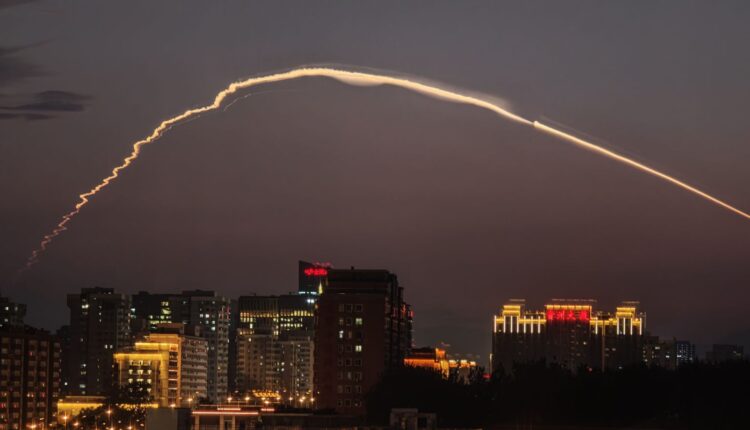
The missile launch, conducted from northern China at approximately 6 p.m. local time, generated a spectacular silver-white plume visible across several provinces, quickly amplified by civilian videos shared on Chinese social media platforms such as Weibo and Douyin
This highly visible test immediately sparked international speculation, with analysts interpreting the unusual plume formations, staging events, and apparent depressed trajectory as clear evidence that Beijing is advancing its dual-use nuclear and conventional strike capabilities.
The launch echoes previous Chinese missile demonstrations, such as the 1 March 2025 nighttime test and the 25 September 2024 full-range launch of the DF-41 ICBM into the Pacific Ocean, highlighting Beijing’s sustained commitment to redefining strategic stability in its favor.
While official Chinese government statements remain absent, independent analysis of the visual evidence points toward a missile capable of integrating hypersonic glide vehicles (HGVs), advanced solid-fuel boosters, and depressed trajectory profiles to evade U.S. and allied missile defense systems.
For the United States, NATO, and regional actors such as India and Japan, the implications of this test extend far beyond technological curiosity, reshaping the trajectory of global arms competition and accelerating the hypersonic weapons race already underway.
Background on China’s Missile Program
The People’s Liberation Army Rocket Force (PLARF), the custodian of China’s strategic missile arsenal, has aggressively modernized its capabilities over the past decade, with a sharp focus on hypersonic systems designed to overcome missile defenses.
China’s embrace of hypersonic weapons stems from a strategic calculus: the U.S. Ground-Based Midcourse Defense (GMD) system, alongside Aegis Ballistic Missile Defense and THAAD batteries in the Indo-Pacific, poses potential risks to China’s retaliatory strike credibility.
To offset this, Beijing has invested heavily in hypersonic glide vehicle programs, including the DF-ZF HGV first tested in 2014 and later mounted on medium-range ballistic missiles such as the DF-17.
The DF-41 ICBM, China’s most powerful road-mobile solid-fueled missile, has already demonstrated ranges of up to 15,000 km, placing all of the continental United States within reach.
China’s missile portfolio now encompasses a layered strike capability: from tactical DF-15 and DF-16 short-range ballistic missiles to DF-26 intermediate-range “Guam killer” missiles, and strategic DF-31 and DF-41 families capable of intercontinental strikes.
By 2025, China is estimated to possess approximately 500 nuclear warheads, with Pentagon projections suggesting that this number could exceed 1,000 by 2030, underscoring the scale and pace of its nuclear breakout.
The development of road-mobile ICBMs such as the DF-31AG, potentially integrated with hypersonic glide systems, demonstrates Beijing’s pursuit of second-strike survivability by complicating detection and interception efforts by adversaries.
The September 2025 test appears to build directly upon this trajectory, signaling the operationalization of hypersonic boost-glide concepts at intercontinental ranges.

DF-17 hypersonic missiles join China’s National Day parade in Beijing. Click to enlarge
Details of the September 2025 Test
Civilian footage of the September 29 launch captured dramatic silver-white plumes that expanded into iridescent veils at altitudes between 70 and 110 km, resembling phenomena associated with high-altitude staging and attitude control maneuvers.
Observers noted distinct “knots” and corkscrew-like patterns in the plume, consistent with multi-stage booster separation and mid-flight vectoring technologies designed to optimize glide-vehicle deployment.
The trajectory initially appeared straight during the boost phase, but analysts highlighted a shallow dive profile toward the terminal phase, strongly suggesting the deployment of a hypersonic boost-glide vehicle.
Conflicting reports surfaced regarding the missile’s designation, with some sources linking it to the DF-31AG family, while others argue it represented an entirely new experimental system.
Unconfirmed accounts suggested the test spanned over 12,000 km, transiting near the Philippines and Guam before terminating near French Polynesia’s Marquesas Islands, where a dummy payload reportedly splashed down.
If accurate, such a range would confirm not only the intercontinental character of the system but also its capability to strike targets across the Pacific, including the U.S. homeland, from multiple azimuths.
The use of a depressed trajectory—flatter and lower than the traditional parabolic arc of ICBMs—reduces detection windows for space-based early warning systems and compresses decision-making time for defenders to mere minutes.
Videos also revealed what appeared to be a secondary ignition during the mid-course phase, interpreted by some as a speed-boosting maneuver within the upper atmosphere, possibly involving a scramjet-powered glide vehicle.
This dual-stage ignition profile is particularly concerning, as it suggests the potential marriage of traditional ballistic missile range with sustained hypersonic maneuverability.
The unusual plume coloration and “doodle-like” formations were attributed to aluminized propellants, similar to those observed in earlier DF-21, DF-26, and DF-31 tests, reinforcing the assessment that this system belongs to China’s evolving solid-fuel ICBM lineage.
Technological Breakdown
Depressed Trajectory
A depressed trajectory lowers the missile’s apogee from several thousand kilometers to potentially under 100 km, flattening the flight path to shorten travel times and reduce detection opportunities.
While this profile increases atmospheric drag and thermal stress, it complicates interception by missile defense systems such as THAAD and Aegis, which rely on predictable parabolic arcs for interception calculations.
China’s apparent mastery of depressed trajectories represents a direct challenge to U.S. reliance on space-based infrared sensors and midcourse interceptors, which are less effective against such low-altitude profiles.
Hypersonic Boost-Glide Technology
Hypersonic boost-glide vehicles are propelled into near-space by a booster before separating and gliding at sustained speeds exceeding Mach 5, while maneuvering laterally to evade interception.
Unlike traditional reentry vehicles that follow ballistic arcs, HGVs can shift trajectory mid-flight, rendering them unpredictable and severely reducing the effectiveness of missile defense architectures.
In the September test, the suspected glide phase could enable the warhead to execute wide lateral shifts across thousands of kilometers, allowing it to bypass U.S. interceptor fields in Alaska or California.
Continues with technical specifications …
What good is it honestly. Will they shoot at the US, why. What a waste of money.