
Defence Security Asia – Aug 15, 2025
For the first time, credible evidence has emerged confirming the presence of Russia’s cutting-edge Krasukha electronic warfare (EW) systems on Iranian soil, a development that could have profound implications for regional security and electronic warfare dynamics in the Middle East.
The exact location of the systems has not been disclosed for operational security reasons, but defence observers note that this is the first verified sighting of the Krasukha series in Iran after years of speculation and unconfirmed intelligence reports.
The Krasukha system—officially introduced into Russian service in 2014—is regarded as one of the most sophisticated ground-based EW platforms in active deployment today.
The arrival of such systems in Iran, whether for training, evaluation, or permanent integration into its military network, would mark a notable escalation in the country’s defensive and potentially offensive EW posture.
This development is likely to unsettle regional adversaries, particularly Israel, Saudi Arabia, and U.S. forces operating in the Persian Gulf, all of whom rely heavily on airborne surveillance, intelligence-gathering platforms, and precision-guided weaponry that could be vulnerable to advanced jamming.
The Russian-manufactured systems—especially one as advanced as Krasukha—could bridge technological gaps and provide Tehran with a credible tool to contest air and electronic superiority in contested zones such as the Strait of Hormuz.
It remains unclear whether these systems are part of a direct transfer, a joint training exercise, or a broader defence-technology cooperation agreement between Moscow and Tehran, which have drawn closer since the escalation of the Ukraine conflict and the deepening of Western sanctions.
Recently, a Russian Ilyushin Il-76 transport aircraft, long synonymous with Moscow’s clandestine military airlifts, has once again drawn the world’s attention after it was tracked landing briefly in Tehran before returning to Russian airspace — fuelling intense speculation over what it might have delivered to its embattled Middle Eastern ally.
According to multiple regional defence analysts, the Il-76’s fleeting presence in the Iranian capital is widely believed to have involved offloading cargo of an undisclosed nature, though no official or independent confirmation has yet emerged to substantiate what precisely was on board.
This latest sighting taps into a broader pattern of similar Il-76 sorties documented throughout 2024, during which Russian airlifters were spotted touching down at Mehrabad Airport for short periods before departing back to Moscow, each visit igniting chatter of covert weapons transfers that have yet to be proven with hard evidence.
Open-source intelligence (OSINT) trackers, now a critical tool for following these shadowy flights, have repeatedly correlated these landings with sudden surges in Iranian air defence readiness, new anti-air deployments near its western border with Israel, or the movement of heavy assets toward sensitive military zones.
While speculation ranges from deliveries of advanced fighter jet components to cutting-edge air defence radars or even stockpiles of Shahed-series drones, veteran security experts warn that the narrative remains riddled with gaps given the lack of satellite imagery or leaked customs manifests to validate claims.
The Il-76, an icon of Soviet-era military lift operations, is prized for its ruggedness and ability to ferry up to 50 tonnes of cargo — including tanks, missile systems, or disaster relief aid — over distances exceeding 4,000 kilometres, even in austere conditions or on unpaved runways.
The most recent Tehran touchdown comes at a time when Iran is under mounting pressure to replenish its battered inventory of drones, missile systems, and air defence nodes following devastating precision strikes by Israel during a 12-day flare-up that saw key Quds Force depots and drone assembly sites reduced to rubble.
Some military insiders speculate that these Il-76 flights may not be carrying entire weapons platforms but rather crucial spares, replacement radar modules, or electronic warfare (EW) packages designed to maintain Iran’s operational readiness without provoking direct Western retaliation
For Israeli strategists, any credible transfer of modern long-range air defence systems like the S-400 Triumf or EW systems — to Tehran would constitute a seismic shift, potentially blunting the Israel Defence Forces’ ability to conduct future precision raids on Iran’s nuclear and missile infrastructure.
This is precisely why the Il-76 landings, however brief, draw the constant gaze of Western satellite constellations and SIGINT units, all hunting for scraps of confirmation that could indicate when a shipment crosses the threshold from spare parts to game-changing hardware.
Last year, Iran has reportedly been supplied with the long-range electronic warfare system “Murmansk-BN” by Russia to counter potential large-scale attacks by Israel and the United States.
Reports indicate that Iran has installed this system in several parts of the country amid escalating tensions with Israel following the assassination of Hamas Political Bureau Chief Ismail Haniyeh in Tehran.
The report about Iran’s deployment of the “Murmansk-BN” system emerged after Open Source Intelligence (OSINT) observations noted continuous flights of Russian transport aircraft between Russia and Iran recently.
These Russian IL-76 transport planes are alleged to be carrying various unknown types of weapon systems.
The “Murmansk-BN” system is regarded as the most powerful EW (Electronic Warfare) system in the Russian military.
The “Murmansk-BN” system is considered the most powerful because it can jam and intercept enemy radio signals, GPS, communications, satellites, and other electronic systems up to 5,000 kilometers away.
Its primary purpose is to disrupt high-frequency satellite communication systems owned by the United States and NATO.
Krasukha to the Gulf? What Russia’s Signature EW System Could Mean if It Lands in Iran
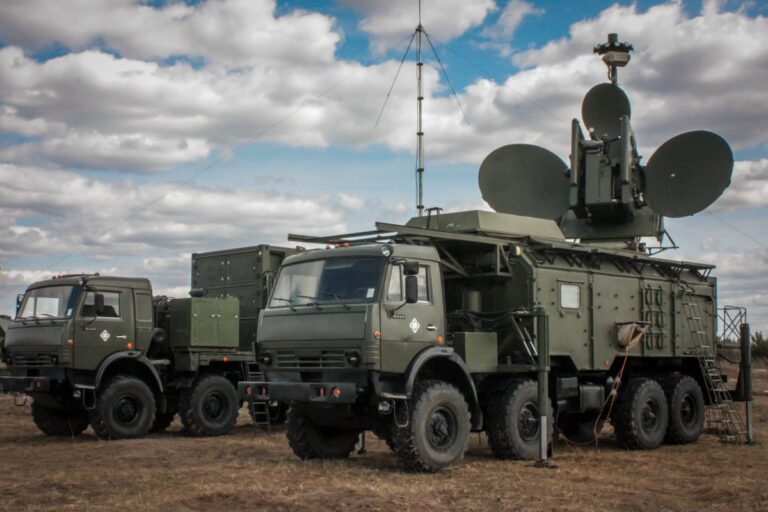
Russia’s Krasukha family is the Kremlin’s most famous truck-mounted electronic warfare (EW) jammer, designed to blind the eyes and deafen the ears of modern airpower across a wide slice of the radiofrequency spectrum.
Built by KRET on an 8×8 wheeled chassis, the best-known variant—1RL257E “Krasukha-4”—is a broadband, multifunctional electronic attack system intended to disrupt or degrade airborne radars, satellite downlinks, and high-power intelligence, surveillance, and reconnaissance (ISR) sensors like those on AWACS, JSTARS-type platforms, and high-altitude UAVs.
Open sources consistently describe an engagement envelope on the order of roughly 150–300 km depending on target set, terrain, and geometry, with effects focused on X/Ku/Ka-band radar and satellite communications where many modern ISR and datalink systems operate.
In practical terms, Krasukha attempts to raise the noise floor in targeted receivers, break track custody for long-range radars, and corrupt datalinks so that aircraft and drones lose situational awareness and guidance cues.
Krasukha is not a wonder-weapon that “turns off the sky,” but a powerful component inside a layered EW architecture that Russia has tested and refined in Syria and Ukraine.
In Ukraine, reporting has placed Krasukha well behind the front lines, using its power-aperture advantage to complicate airborne sensing at long ranges, while other Russian EW nodes closer to the line handle drone jamming and cellular-network interference.
There is no ceasefire.
There is just a halt in military actions.
Oh, here we go again! Not so long ago Syria had lots of high tech Russian stuff too and then the lights went out (as usual) after long negotiations with the bosses of this whirled.