
Matt Oliver – The Daily Telegraph July 19, 2025
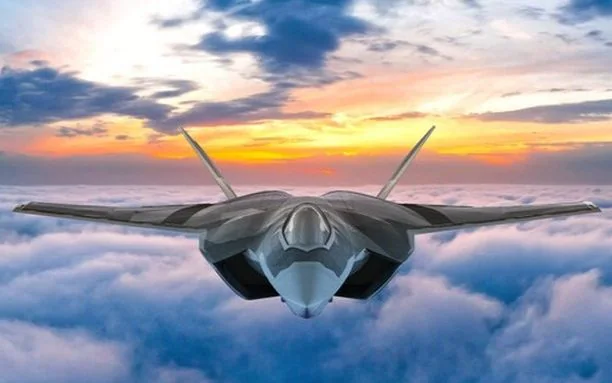
The first thing to know about Britain’s flagship new fighter jet is that it’s big.
This becomes immediately clear when you see the full-scale mock-up that dominates a warehouse at the Warton factory near Preston, Lancashire, which is run by British defence giant BAE Systems.
And here, size matters. Because it tells you a lot about what the UK, Italy and Japan are planning for the supersonic stealth jet they are building together.
The three countries are aiming to bring the aircraft – which has been christened “Tempest” in the UK – into service by 2035 under an agreement known as the Global Combat Air Programme (GCAP).
“This won’t be the final shape and size but, in terms of scale, it’s about the same,” says Jonny Moreton, of BAE, during a visit by The Telegraph. “Whatever GCAP as a core platform is going to be … she is going to be big.”
A bigger jet means bigger fuel tanks. That means more range and bigger payloads of explosive warheads.
But the size also means weapons can be stored internally – ensuring a smooth exterior that makes the aircraft harder to detect with radar.
At the same time, Tempest will be packed with technology allowing it to link up with other aircraft, drones, ground forces and satellites.
All this suggests Tempest is being designed for long-haul missions deep into enemy territory, where communicating with home base may be impossible.
If Nato ever ended up at war against Putin’s Russia, experts say this means the aircraft would take off from a British airfield, fly to Russia undetected, destroy hostile air defences and then fly all the way back again.
Not only that, but such a long range would allow Japanese pilots to strike deep into the Chinese mainland in any future Pacific conflict.
Moreton, who is also an ex-commodore of the Royal Air Force, remains tight-lipped about whether these propositions are correct.
But with modern warfare happening at ever-larger distances, he concedes that any deterrent to Russian and Chinese aggression must be able to operate “at ranges that previously we’ve been unable to do”.
“You need to be able to get there safely, undetected and return home,” he adds.
So critical is the need for range that project leaders have suggested the jet will be capable of crossing the Atlantic without mid-air refuelling – something no Royal Air Force fighter has ever been able to do.
A Typhoon jet, the backbone of the RAF’s existing fleet, has a combat radius of about 860 miles on a single tank of fuel.
Meanwhile, the American-made F-35A stealth jet, which air force chiefs recently said they were planning to acquire, has a combat radius of about 680 miles. That is less than half the distance between London and Moscow, which is roughly 1,550 miles.
It means Tempest will be in a league of its own when it comes to British fighters, says Francis Tusa, an independent defence analyst.
“As the requirements have changed over the years, so have the models,” he says. “You can make your aircraft as stealthy as you like but if it has to be refuelled by a tanker then ultimately your adversary just needs to track down and destroy the tanker.
“So you need enough internal fuel to go a very, very long way – and stay out there.”
Tempest expected to outstrip current combat ranges

Estimated ranges from RAF Coningsby, lower left to right: F-35B 580 miles, Typhoon 865 miles and (far right) Tempest 1,500 miles
Tempest in combat
I magine Nato and Russia did go to war in future – what does this mean for Tempest’s role in the fight? Tusa says in week one of the conflict, Tempest would probably have to go into Russia and attack surface-to-air missile defences and air bases.
Then in week two, when there is no threat from air defences, the jet can either be an air superiority fighter that loiters in the sky and takes out enemy fighters or continues in a ground support role.
To fulfil that role, it is expected to be able to unleash massive arsenals of explosive weapons on its targets – potentially twice as much as an F-35 can deploy.
Based on reports, Tusa says Tempest’s maximum takeoff weight could be “north of 30 tonnes” compared to Typhoon’s 23 tonnes. That is more than the Lancaster bombers used in the Second World War.
“It is going to be in a completely different league to anything we have ever built,” Tusa says.
The technology being built into Tempest will also ensure the jet can act as an airborne communications hub, even if contact with bases back in Britain has been disrupted.
This means it can act as a central contact point for nearby friendly drones and missiles, as well as forces on the ground and satellites in space.
“We need to be able to operate at range, where our communications might be disrupted,” explains BAE’s Moreton.
“Therefore we need to make sure we have a core platform that’s crewed, that’s in a position that it can be the heart of the network if we’re unable to communicate back to home base for operations.
“It needs to be able to operate in an isolated environment.”
Automation push
BAE is part of “Team Tempest”, a partnership between the Ministry of Defence and industry that also includes Rolls-Royce, missile maker MBDA and Italy’s Leonardo .
Since 2023, however, the effort has been amalgamated with GCAP, with the UK, Italy and Japan combining research and development into a single programme.
The British team, led by BAE, is working on a demonstrator jet that will road-test a key piece of equipment – a vent system that will feed air to Tempest’s engines using an S-bend that wends its way through the aircraft’s insides.
This is vital to reducing the jet’s radar signature.
A trial has been scheduled for some time in 2027 and remains on schedule, according to BAE.
At Warton, the company is trialling new production processes that will be used to fabricate the aircraft’s wings and tail fins in the coming months.
These include additive manufacturing, a form of 3D printing where material is added instead of removed, the production of large, carbon-based panels and more extensive use of robots.
For example, reconfigurable robot arms are being used instead of specialist “jigs” that were previously needed on the production lines of older aircraft such as the Typhoon.
Jigs are tools that hold components in place or guide cutting tools during manufacturing and are often tailor-made for a certain stage of the process.
Using robots instead will slash the cost of making the jigs – which often runs to tens of millions of pounds – and could shave up to three years off the run-up to full-rate production.
It also means the factory floor is more easily reconfigurable, saving money for BAE at its facilities and letting the company easily switch to the production of a different product when required.
All this will help to keep vital domestic skills alive as the company prepares to transition away from making Typhoon to producing Tempest in the next decade.
That is still some way away, BAE stresses, with workers likely to be kept busy for at least the next 10 years by orders anticipated from Saudi Arabia, Qatar and Turkey.
But the development of Tempest will help to preserve Britain’s sovereign capability to make its own aircraft, says Richard Hamilton, the managing director for Europe and International at BAE’s air business.
“We’re one of a small number of nations that have the whole aircraft capability,” he says.
“That means we can design an aircraft, we can make it and we can actually fly it from the site as well to our customers.
“Not many other countries still have that capability, so it’s a freedom of action that our Government has at the moment.”
This is one reason why other countries are also queuing up to join the GCAP consortium.
Saudi Arabia is understood to be one of the countries in discussions with the three existing national partners, although it is not clear yet what level of involvement the Gulf nation could have.
Riyadh is currently a buyer of the Typhoon jet but defence sources say the kingdom is looking for a potentially weightier role in GCAP that would give it more influence over capabilities and a greater role in manufacturing as well.
But Herman Claesen, the head of future combat air at BAE, says the window for new joiners is narrowing, particularly given the brisk pace the founding countries want to maintain.
“To be part of the core programme today in the same way as Japan, Italy and the UK, because of the pace we’ve achieved and where we are today, becomes quite challenging and will have an impact which the three governments will have to either reject or accept,” Claesen says.
“It’s never impossible … we can make anything happen. But I see the likelihood as diminishing all the time, considering the pace we have on the programme.”
Also makes a bigger target.
“A bigger jet means bigger fuel tanks. That means more range and bigger payloads of explosive warheads.” — So much for emissions and eh, “climate change” Ha Ha Ha 🙂
“But the size also means weapons can be stored internally – ensuring a smooth exterior that makes the aircraft harder to detect with radar.” — What guff. It won’t evade a few surface to air missiles. Just another F35 in drag I would think. But I guess the new Europeans AKA negros, asiatics and other turd world detritus will need “protection” After all the Notting Hill stab-fest must go on. Anything less would be waysisssssss. Ha Ha Ha 🙂
“Being jointly developed by Italy, Japan and Britain, the Tempest will be optimized for long-range missions deep into hostile territory – be it Iran, China or Russia”
Ziusudra of Sumer built the Ark but a committee designed the Titanic.
On one hand the distribution of the project demonstrates the eclipsing of the nation state due the deployment of transnational capital, but on the other hand it also seems a ceremonial meant for political display – “multilateral”, ceremonial “Swiss Guard” type of gesture. A project that can attract “tax dollars”, as they say, enriching the revolving door interests intertwined with the likes of BlackRock.
In other words populations are paying for the theatre of it all while being deceived. But of course, the prime example of this are the “nuclear weapons” programmes. The sucking of tax money also means TPTB have a means of sucking money out of the system and controlling inflation. I speculate therefore, the amount earmarked for “defence” can be arbitrarily adjusted by pushing up the costs of production of these essentially phantom projects.
And of course, the fallback of “creating jobs” (for the plebs) usually accompanies these announcements in the mainstream media.
“Putin should fear Britain’s next fighter jet” which will be “brought into service by 2035…”
Yes – you heard that right! – 2035!!! LMFAO!!! 🤣
LOL…
the Torygraph getting all moist over a ‘mock up’ at the British War Museum, commonly known as pirate rocks armed farces…storage yard..
someone never told this hack that the best way to view the Italian navy is through a glass bottomed boat…and no doubt will be the best place to view this maguffin…after its maiden flight..the French having surrendered..
and no Torygraph..it doen’t make me proud..lolo…
At least this futuristic projection of “a superior fighter” will keep the public distracted and comforted, thinking we have years left before tshtf ..
Just more military machinery to waste whites with.
More jingoistic bluster from an Establishment mouthpiece. If anything materialises at all, it will be another multi-billion pound fiasco like the two supercarriers.
Russia is a proxy threat to keep up the scare necessary to maintain the warfare establishment and for the pretext of dividing up and exploiting smaller nations such as the Ukraine and trade offs for places like Syria. No doubt by 2035 the big scare of the Tempest will be totally pissed out and obsolete and Russia and China will have much more advanced ones on the world warfare market for 1/4 of the price.
The warfare bastards running things are very good at scaremongering. We saw that in 2020 during Covid when the the US bioweapon was not knocking off even 1/2 of the aged and vulnerable people they expected to die, and the emergency wards were mostly empty. To “keep up the scare” (which is warfare battle tactic taught in military academies), the plandemic chain of command directing our governments and agencies and coming out of the military Cheyenne Mountain Complex in Colorado instructed them to fudge the mortality and morbidity numbers, and to do everything possible to ensure that the highly vulnerable with serious symptoms were denied the actual proven treatment protocols. Without those actual deaths there would have been no basis to exaggerate anything. Not only were all of our governments reading from the exact same script regarding the lockdowns but they were uniformly and with the exact same bogus reasons suppressing the known and proven HCQ and Ivermectin treatment protocols which, if used, would have meant that no one need have died from the bioweapon virus deliberately released on us. Had they not actually murdered those who actually died from the virus, they would not have had any basis to exaggerate anything, and their would have been no basis for their very shoddy and false-positive-producing PCR testing, indicating that even a melon when tested had Covid. Without the scare numbers inflated from their actual murders and the weird symptoms so many had from the virus, there would have been no basis for the lie that the mRNA vaccines were necessary.
Those on this site who have maintained there was no virus have been very good at cherry picking the evidence, thinking they can just apply some kind of Occam’s razor to the facts for their simplistic solution, ignoring unpleasant source and causation issues. Meanwhile, many of the actual whistleblowers have been murdered. Reiner Fuellmich, last I heard, continues to rot in a German jail.
Why would the west need any new jet if the F-35 is the dog’s b*ll*cks?
Tally ho Yookay ! Hopefully the Telegraph has convinced its readers with the candy floss waffle about jigs and robots as its their bank accounts that will be looted to pay for another white elephant . Russia has hypersonics today what will it be in 10 years time.
note big is not beautiful and GCAP have not idea the advances that will be made in detecting enemy aircraft form possibly 2000 miles away a combination of ground based and satellite radar and with the hypersonic missiles (mach 20+) it will only advance 125 miles before being destroyed. All for money and a waste thereof. the f35 is a basket case and costs north of $100m a piece. UK I believe bought 35 of these! What cost the tempest? Russian 5th gen mig 35 and sokhoi 50 costs 1/10th the price of the f35 and both have proved themselves and speed exceeds mach 2.4. Stick with the F4 phantom which outflies the f35, typhoon, mirage in speed, is 60 y/o and a lot cheaper.
@ bla bla bla
a dwarf lost its empire will get its ass kicked .
How terrifying…I’m sure that the new lumbering albatross will have Chabad Vlad Pukin pissing down both legs…with laughter while looking at the new recruiting posters of the “Royal” Air Farce featuring street-shitters, sodomites, and retarded dune coons….
“She is going to be big”! The only bit that will be big is the tidal wave that washes away broke Pirate rock for good!” Dream on Poms!
TTS Comments…what a bunch of jaded naysayers on all subjects..
I’m Out!
“She’s” gonna be called “Camilla”
turn the the Ruskies to stone if they look at her
Rarotflmfao this heap of shit isn’t going nowhere, the poms will be no more by 2035, F..king morons.
Meanwhile Russia will have the S500 anti-aircraft system well deployed, This specifically designed to take out “stealth” aircraft.
Right at the end is the real meaning, they don’t gave enough bsckers!,they need finance the whole telegraph article is an advert begging for money!
Question……just how many whistle blowers have the German government killed??……they have the behaviour/fanaticism to do this?…..
100 percent USDA AAA Horse Hockey.
When that trigger gets pulled the West will be sorry.